A scholar on the throne
Ulugh Beg, born in 1394, was a grandson of the conqueror Timur, also known as Tamerlane. In 1409, still a teenager, he became governor of Samarkand, the Timurid capital in today's Uzbekistan, and ruled the region for about forty years. He was more interested in mathematics and astronomy than in war. Around 1417–1420 he built a madrasa, a college, on Samarkand's Registan square, where astronomy and mathematics were taught alongside religious subjects. He gathered leading scholars, including the mathematician Jamshid al-Kashi, known for calculating pi to an extraordinary number of decimal places, and Qadi Zada al-Rumi. Ulugh Beg himself took part in observations and calculations.
The observatory
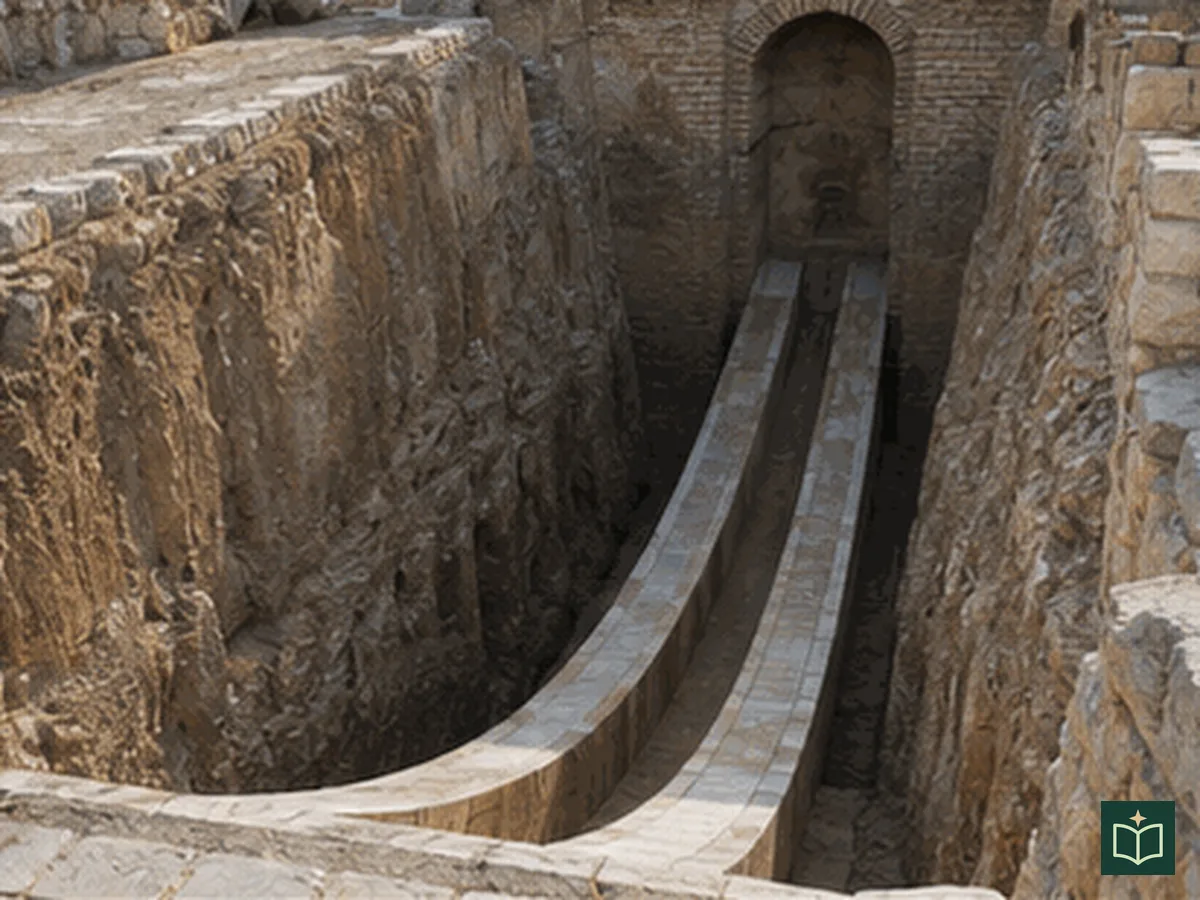
In the 1420s he built an observatory on a hill north-east of the city. Contemporary accounts describe a round, three-storey building about 46 metres across, decorated with tiles and with rooms for instruments and scholars. Its centrepiece was a giant meridian instrument, often called the Fakhri sextant, though it was actually a quadrant-like arc. A trench was cut into the hill along the north-south line, and two parallel curved walls lined with marble were built in it, marked with fine graduations. The arc's radius is generally estimated at around 40 metres, making it the largest astronomical instrument of its kind in the world at the time.
How the arc worked
Every star crosses the meridian, the north-south line overhead, once a day. At that moment it reaches its highest point in the sky. Astronomers in the observatory watched stars and the Sun cross above the arc through a small opening and read off their altitudes on the scale below. Because the arc was so large, each degree was spread over a long distance, roughly 70 centimetres, so it could be divided into very small parts. In principle, this allowed readings far more precise than small hand instruments could give. Combined with careful timing and repeated observations over years, it gave the team unusually reliable data for positions and motions.
The star catalogue
The main result was the Zij-i Sultani, a set of astronomical tables completed around 1437. It contained a catalogue of 1,018 stars, most freshly measured in Samarkand rather than copied from Ptolemy's ancient list, which had been repeated for centuries. It also contained tables for calendars, planetary positions and eclipses, and trigonometric tables of high accuracy. The astronomers measured the length of the year as 365 days, 6 hours, 10 minutes and 8 seconds, within about a minute of the modern value for that year type. The tilt of the Earth's axis was also measured closely. Copies circulated widely in the Islamic world, and the catalogue was published in Europe in the seventeenth century.
A violent end
After his father, Shah Rukh, died in 1447, Ulugh Beg became ruler of the Timurid empire, but he struggled to hold it together. His eldest son, Abd al-Latif, rebelled, and in 1449 Ulugh Beg was captured and killed on his son's orders. His observatory was abandoned and later dismantled, its stones taken for other buildings, and its location was forgotten. Some of his scholars moved to Istanbul, carrying knowledge to the Ottoman world. In 1908 the Russian archaeologist Vasily Vyatkin, guided by old documents, found the site and excavated the underground part of the great arc, which had survived because it was cut into the rock of the hill.
What you can see today
Today the excavated lower section of the arc is visible in Samarkand under a protective shelter, with a museum nearby. The upper parts of the building are gone, but foundations show its circular plan. The madrasa on the Registan still stands, and the city is a UNESCO World Heritage Site. Ulugh Beg's catalogue was one of the most accurate before Tycho Brahe in Denmark built his own large instruments in the late sixteenth century, shortly before telescopes changed astronomy. A lunar crater and an asteroid bear his name. The observatory shows a principle still used today: when you cannot sharpen your eyes, build a bigger instrument.
Sources & further reading
Figures are rounded and widely published; check the linked organisations for the latest editions. These organisations do not endorse this website.