A scholar between Basra and Cairo
Abu Ali al-Hasan ibn al-Haytham, known in Latin Europe as Alhazen, was born in Basra, in today’s Iraq, around 965 CE and died in Cairo around 1040. He wrote on mathematics, astronomy and optics, producing dozens of works. He spent much of his career in Cairo under the Fatimid dynasty. A well-known story says the caliph al-Hakim asked him to regulate the flooding of the Nile, and that when he realised the project was impossible he feigned madness to avoid punishment. The tale is widely repeated but comes from later biographers, so it is best treated with caution rather than as established fact.
The puzzle of seeing
Before Ibn al-Haytham, scholars disagreed about how vision worked. One influential tradition, associated with Euclid and Ptolemy, held that the eye sends out rays that touch objects, a theory called extramission. Another, associated with Aristotle and some physicians, argued that something from the object enters the eye. Neither side had a complete, testable explanation. Ibn al-Haytham argued that every point on a lit object reflects light in straight lines in all directions, and that the eye receives these rays. He then had to explain why we see a clear image rather than a blur, which led him to consider the anatomy of the eye in detail.
Experiments with dark rooms
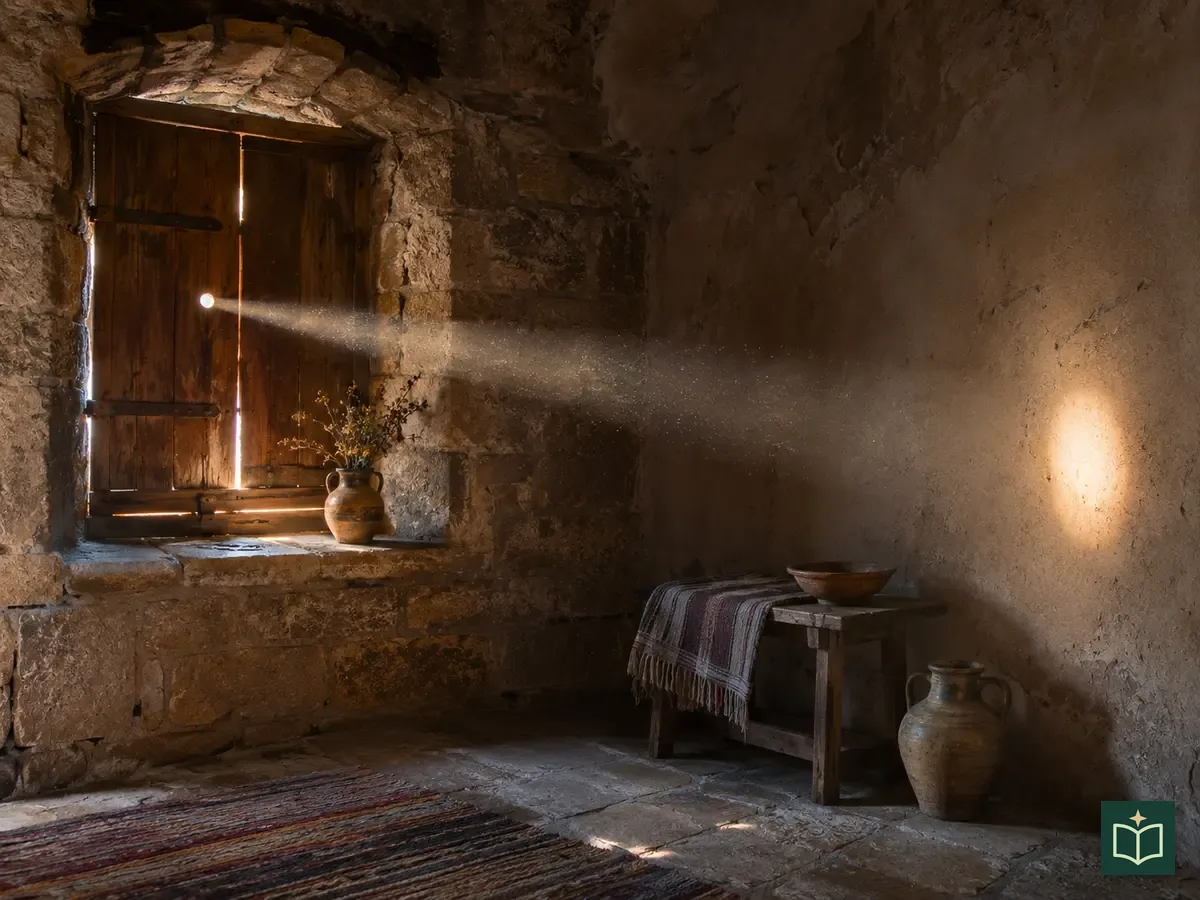
His method was as important as his conclusions. In the Book of Optics, Kitab al-Manazir, written in the early eleventh century, he described experiments using dark chambers with small openings, tubes and screens. When light from several lamps passed through a small hole into a darkened room, separate spots appeared on the opposite wall, each in line with its lamp. Blocking one lamp removed one spot. This showed that light travels in straight lines and that rays from different sources do not mix as they pass. The dark room with a small hole, later called a camera obscura, is the principle behind every camera.
Reflection, refraction and doubt
Ibn al-Haytham studied how light reflects from flat and curved mirrors and how it bends when passing between air, water and glass. He tackled a difficult geometry problem about finding the point on a curved mirror where light reflects to the eye, now known as Alhazen’s problem. He also wrote critically of Ptolemy, arguing that respected authorities could be wrong. In one passage he says that the seeker of truth should examine the writings of others critically and suspect even his own conclusions. That attitude, emphasising evidence and repeated testing, is why many historians count him among the important early figures in experimental science.
From Cairo to Kepler
Around 1200, the Book of Optics was translated into Latin as De aspectibus or Perspectiva. It became a standard reference in European universities and influenced scholars such as Roger Bacon, John Pecham and Witelo, who built their optical works on it. In the early seventeenth century, Johannes Kepler developed the modern theory of the retinal image, building on this tradition. Ibn al-Haytham did not get everything right: he did not fully understand how the lens and retina form an image. But he set the framework of rays, geometry and experiment within which later optical science was developed. His influence travelled further than he could have imagined.
Why he matters now
Modern optics, from spectacles and cameras to fibre-optic cables and telescopes, rests on the principles he helped establish: light travels in straight lines in a uniform medium, reflects and refracts according to geometric rules, and can be studied through controlled experiment. In 2015, UNESCO’s International Year of Light highlighted his work to mark roughly a thousand years since the Book of Optics. A common misconception is that the scientific method appeared suddenly in seventeenth-century Europe. Ibn al-Haytham’s writing shows that its key habits, measurement, testing and scepticism toward authority, were being practised in Cairo centuries earlier. His legacy is a way of thinking.
Sources & further reading
Figures are rounded and widely published; check the linked organisations for the latest editions. These organisations do not endorse this website.