A ridge in the desert
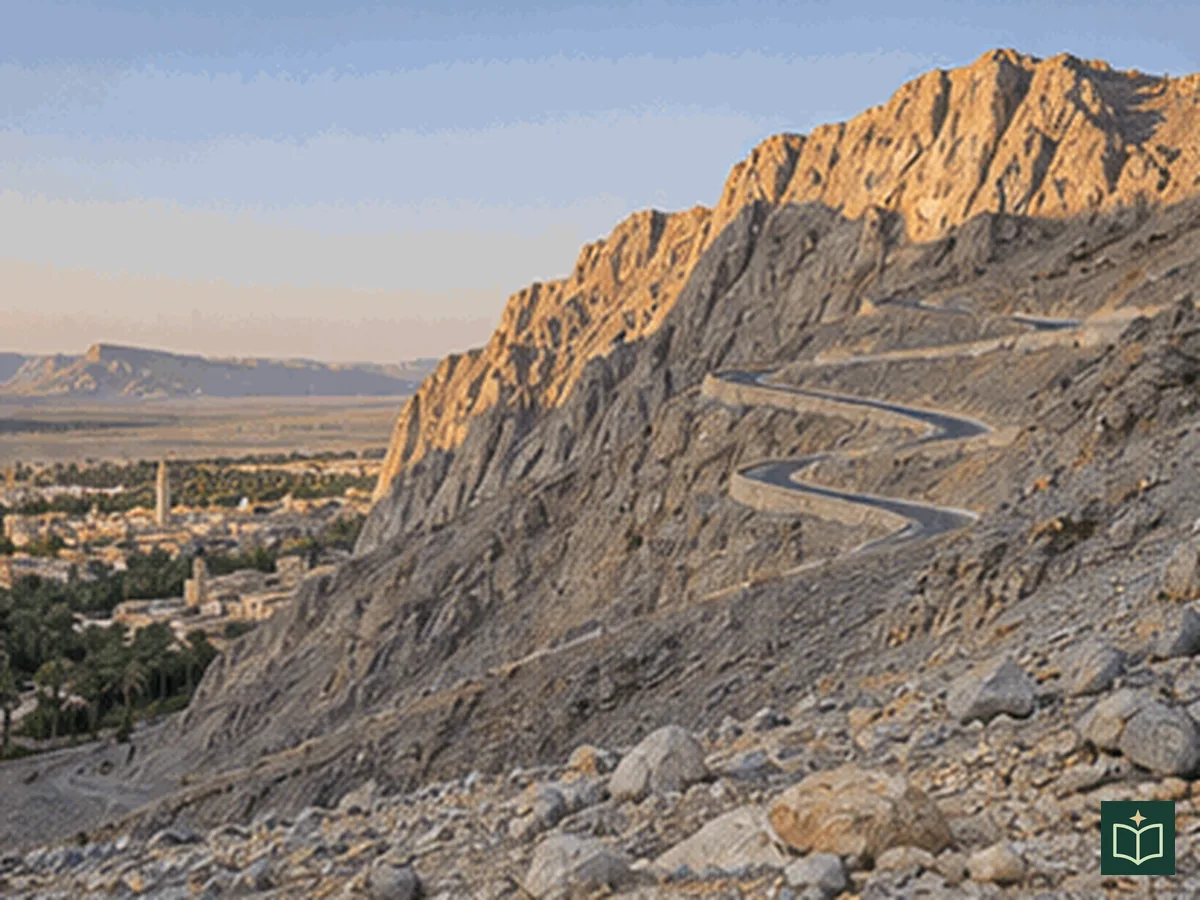
Jebel Hafeet rises abruptly from the gravel plains just south of Al Ain, a long, bare ridge running roughly north to south and straddling the border between the UAE and Oman. At about 1,240 metres, it is the second-highest peak in the UAE after Jebel Jais, and its isolation makes it a landmark for many kilometres around. A road climbs about 12 kilometres up its northern face in a series of hairpin bends to a summit with views across the oasis city. Yet the mountain’s most remarkable feature is less obvious from a car: its rock was once the floor of a warm, shallow sea.
Limestone from an ancient sea
Jebel Hafeet is built mainly of limestone and related rocks laid down roughly 50 to 20 million years ago, when the area lay beneath shallow tropical seas. Limestone forms largely from the skeletons and shells of marine organisms, which settle on the sea floor, pile up and harden into rock. Layer upon layer, these deposits accumulated to great thickness. Fossils are abundant. Visitors can find coin-shaped nummulites, a type of large single-celled organism, as well as corals, sea urchins, clams and snails preserved in the rock. Each layer records a moment in the life of a sea that has long since vanished from the region.
Folded by plate collision
The limestone did not stay flat. The Arabian plate has been moving north-eastward against the Eurasian plate, a collision that built the Zagros mountains of Iran and helped raise the Hajar range. The strain spread into the land at the foot of the Hajar, squeezing the young layers of limestone. Like a rug pushed against a wall, they buckled into folds. Jebel Hafeet is an anticline, an upward arch of rock, whose layers dip away on either side of its long central axis. This folding is geologically young, mostly within the last 20 million years, which is why the ridge still keeps a clear arched shape.
Reading the structure
From the air, Jebel Hafeet looks like an elongated dome, with ridges of harder limestone forming curving bands along its flanks. Erosion by rare heavy rains has cut steep gullies and exposed the tilted layers, making the fold visible to trained eyes. Caves and fractures riddle the rock. At the mountain’s foot, the Green Mubazzarah area has hot springs, where water that has circulated deep within the fractured rock emerges warm at the surface. The ridge also differs from the main Hajar mountains to the east, many of which are built from ancient ocean crust and mantle rock pushed onto Arabia, rather than from folded limestone.
Five thousand years of people
The mountain has a human story too. On its lower slopes and surrounding foothills stand hundreds of beehive-shaped stone tombs built roughly 5,000 years ago. They gave their name to the Hafit period, an early phase of Bronze Age settlement in south-eastern Arabia. These tombs are part of the Cultural Sites of Al Ain, inscribed on the UNESCO World Heritage List in 2011, together with the oases and archaeological sites of Hili and Bidaa Bint Saud. The mountain probably served as a landmark and a burial ground for communities that farmed, herded and traded in the surrounding plains and oases.
Why the mountain matters
Jebel Hafeet is a natural classroom for the geology of the UAE. In a single drive, visitors pass from desert plain to folded marine limestone, seeing evidence of ancient seas, plate collision and long-term erosion. Its fossils show that the region’s climate and geography have changed dramatically over tens of millions of years. The mountain also supports specialised wildlife, including reptiles and birds adapted to rocky slopes, and its springs and cool upper slopes contrast with the surrounding plains. Protecting its fossils and archaeological sites from damage and collecting is important, so that future generations can read the same record in the rock.
Sources & further reading
Figures are rounded and widely published; check the linked organisations for the latest editions. These organisations do not endorse this website.