The storage tank
The most common household water heater is a storage tank, often holding 50 to 100 litres in Gulf apartments and more in villas. Cold water enters near the bottom through a pipe called a dip tube, and hot water is drawn from the top, because warm water rises and settles in layers. An electric resistance element, typically rated at two to three kilowatts, heats the water until a thermostat switches it off. A sacrificial anode rod, usually magnesium, corrodes in place of the steel tank and needs replacing every few years. A pressure and temperature relief valve guards against dangerous build-up if the thermostat fails, an essential safety feature.
Heat that leaks away
A tank of hot water sits in a cooler room, so heat flows out continuously through its walls, fittings and pipes. This standby loss means the element switches on periodically even when no one uses any water. Older or poorly insulated tanks can lose a kilowatt-hour or more a day this way, and a loss of 1.5 kWh daily adds up to roughly 550 kWh a year. Thicker insulation, shorter pipe runs and lagging the first metre or two of hot pipe all reduce it. Setting the thermostat higher than needed increases the loss, while timers can switch the element off during long periods when the household is away.
How hot is hot enough
There is a trade-off between saving energy and safety. Health authorities, including the World Health Organization, advise storing hot water at 60°C or above, because Legionella bacteria, which can cause a serious form of pneumonia, multiply in lukewarm water between about 25°C and 45°C. Water at 60°C can scald, however, so many homes fit mixing valves at taps and showers to deliver it at a safer temperature. The energy needed is easy to calculate. Raising 150 litres of water by 30 degrees, from 30°C to 60°C, takes about 5.2 kWh before any losses. Lowering the setting much below 60°C saves little and carries a health risk.
Instant heaters
Instantaneous, or tankless, heaters heat water only as it flows. A powerful element or gas burner switches on when a tap opens, so there is no stored water and no standby loss. The catch is power. Heating a shower's flow by 25 or 30 degrees in real time can need well over 10 kilowatts of electricity, which may exceed what a household supply can deliver, and flow rates may be limited. Small point-of-use units under a basin need much less power but serve only one outlet. Gas tankless heaters are common in some countries. For homes with long gaps between uses, instant heating can save energy, but busy households often prefer a tank.
The sun as a heater
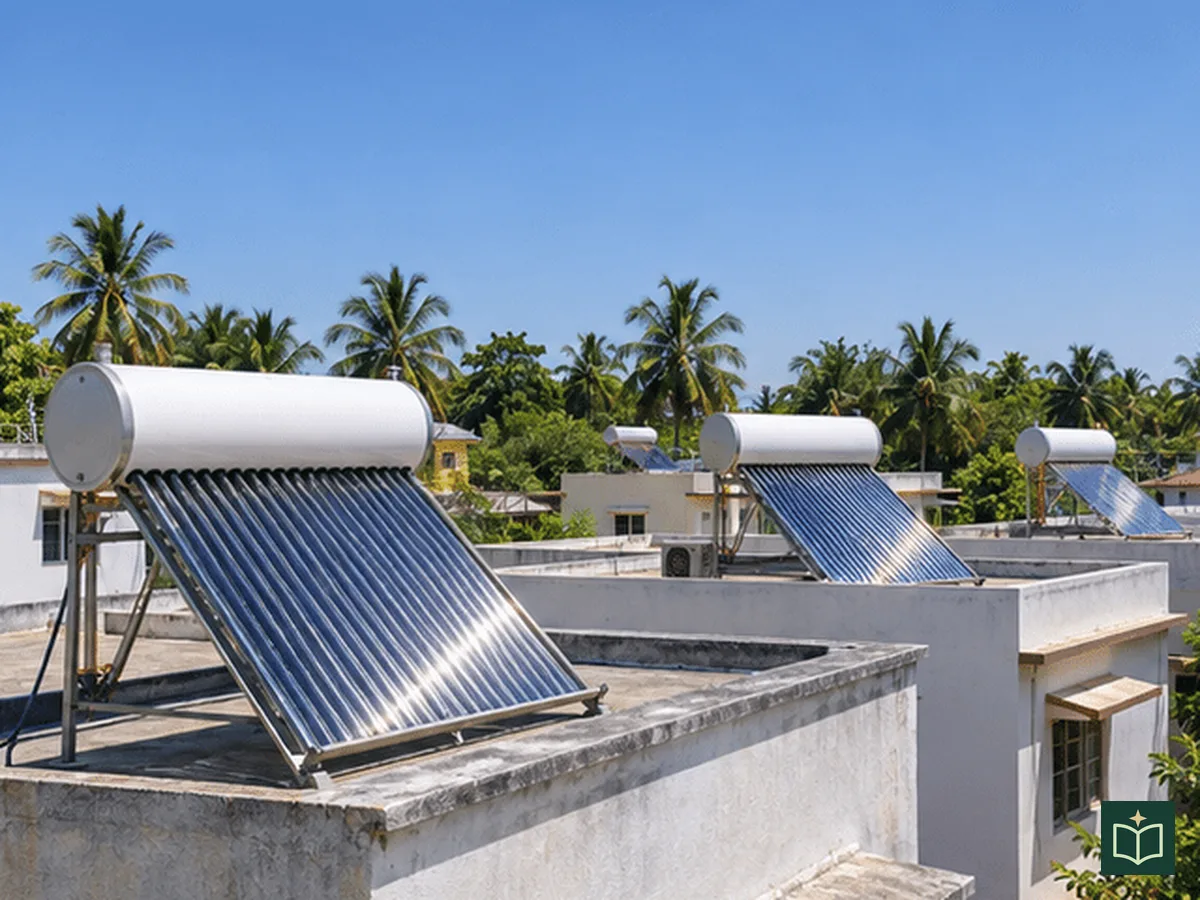
A solar water heater uses roof-mounted collectors, either flat dark plates under glass or rows of evacuated glass tubes, to absorb sunlight and warm water or a heat-transfer fluid. In the simplest thermosiphon design, the tank sits above the collector, so heated water rises into it naturally without a pump. A backup electric element covers cloudy spells. The Gulf's strong sunshine makes these systems effective for most of the year, and Dubai's green building regulations have required solar water heating in many new residential buildings since the 2010s. Heat pump water heaters, which move heat from the surrounding air, offer another efficient option, using roughly a third to a half of the electricity of a resistance element.
A Gulf summer quirk
In Gulf summers, the plumbing itself often becomes the heater. Rooftop storage tanks and pipes baked by the sun can deliver 'cold' water at 40°C or more, so many residents switch off their water heaters for months and some even fit coolers. Leaving a heater on in that season mainly feeds standby losses. In winter the picture reverses, and hot water becomes a noticeable item on the bill. Practical steps are simple: switch off or use a timer when demand is low, set the thermostat around 60°C, check that insulation is intact, fix dripping hot taps and choose a tank sized for the household rather than the largest available.
Sources & further reading
- US Department of Energy · Energy Saver, water heating ↗
- WHO · Legionellosis fact sheet ↗
- Dubai Electricity and Water Authority ↗
Figures are rounded and widely published; check the linked organisations for the latest editions. These organisations do not endorse this website.