Why lay power under the sea
Electricity often needs to cross water. Islands want connections to mainland grids instead of relying on costly local diesel or gas generators. Offshore wind farms must send their output to shore. Oil and gas platforms can replace on-board gas turbines with electricity from land. Neighbouring countries trade power across seas, sharing reserves and balancing different mixes of hydro, wind, solar and thermal plants. Overhead lines are impossible in these settings, so the answer is a cable laid on or beneath the seabed. Such links are expensive and technically demanding, but they can operate for forty years or more and reshape the energy options of the places they connect.
Inside the cable
A high-voltage subsea cable is built in concentric layers. At its centre is a conductor of copper or aluminium strands. Around it sits thick insulation, either paper impregnated with heavy oil, the traditional choice for direct current, or extruded cross-linked polyethylene, known as XLPE, now common for both AC and DC. A lead or other metal sheath keeps water out, since even slight moisture can degrade insulation. Layers of galvanised steel wire armour give strength for laying and protection against damage, and an outer covering of polypropylene yarn or plastic finishes it. The result can weigh tens of kilograms per metre and be manufactured in continuous lengths of many kilometres.
AC or DC
Short links, such as those connecting nearby offshore wind farms, often use alternating current. Over longer distances, AC becomes impractical underwater. A cable acts like a long capacitor, and with alternating current it must constantly charge and discharge, consuming much of its capacity before any useful power is delivered. Beyond very roughly 50 to 100 kilometres, high-voltage direct current, or HVDC, is usually the better choice. Converter stations at each end turn AC into DC and back again. Those stations are costly, but the cable itself carries more power with lower losses. Nearly all the world's long subsea interconnectors, including links across the North Sea and the Baltic, use HVDC.
Laying and burying
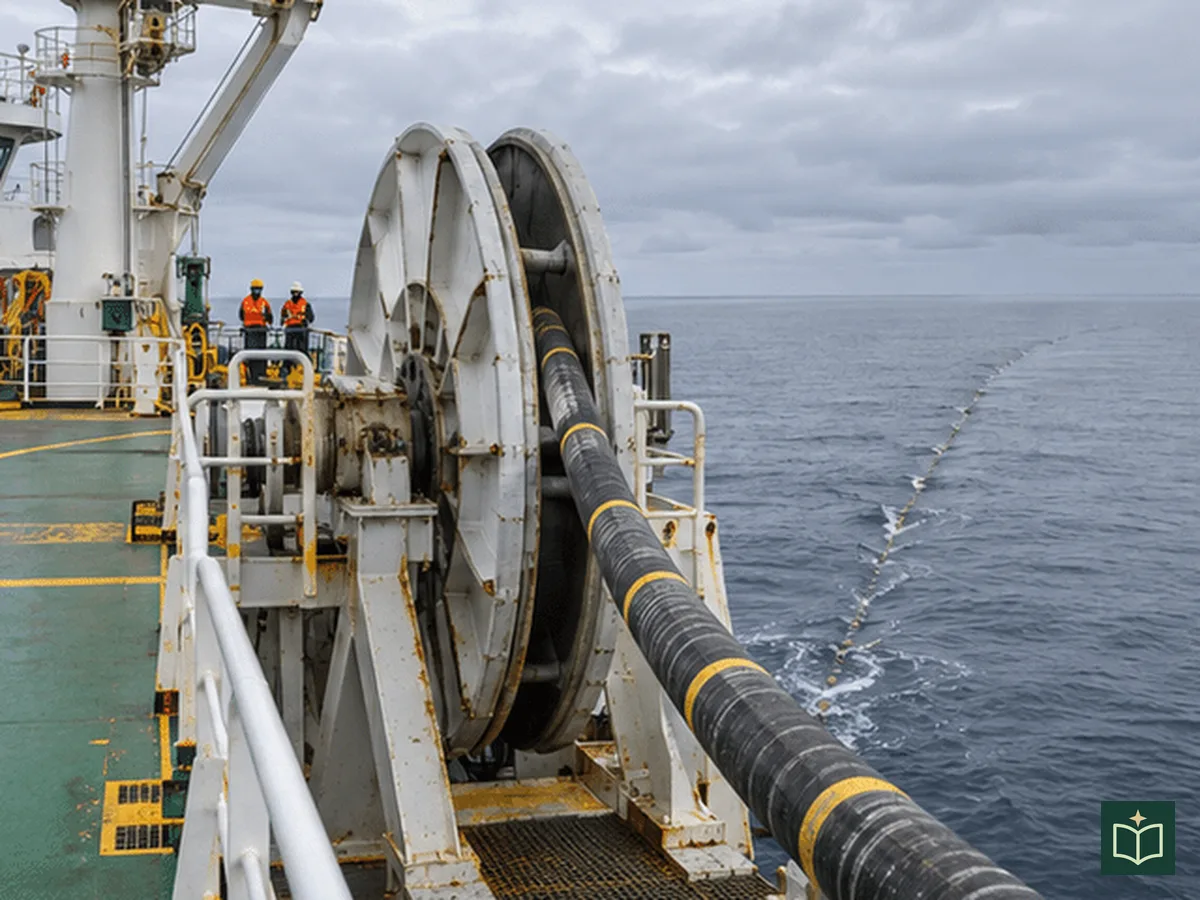
Cables are loaded onto specialised ships, coiled onto huge rotating turntables that can hold several thousand tonnes. The vessel moves slowly along a surveyed route, paying out cable over the stern while controlling tension so it does not kink or overstretch as it descends. Survey work beforehand maps the seabed for rocks, wrecks, steep slopes and existing pipelines and cables. In shallow waters, where ships' anchors and fishing trawls are the main threat, cables are usually buried one to three metres deep using ploughs, water jets or trenching machines. Where burial is impossible, rock is dumped over them. Near shore, they may be pulled through drilled tunnels to the landing point.
When cables fail
Most damage is caused by human activity, especially dragged anchors and fishing gear, rather than by the sea itself. A fault is first located by sending electrical pulses along the cable and timing their reflections. A repair ship then recovers both cut ends, which may lie far below the surface, and lifts them on board. Engineers splice in a new section using a factory-designed joint, a slow and exacting task done in a clean, controlled space on deck. The repaired cable is then lowered and protected again. The whole process can take weeks or months, depending on weather, ship availability and spare cable, so interconnectors are planned with backup capacity.
Links around the world
Notable examples include NorNed between Norway and the Netherlands, about 580 kilometres, which opened in 2008, and North Sea Link between Norway and Britain, about 720 kilometres, opened in 2021. Viking Link between Britain and Denmark, opened at the end of 2023, is longer still when its land sections are counted. The Gulf Cooperation Council's grid includes a subsea connection to Bahrain. Abu Dhabi has developed HVDC subsea links to supply offshore oil and gas operations with electricity from the onshore grid, cutting the gas burned at sea. Longer projects, such as proposed cables linking North Africa with Europe, show how ambitious such links are becoming.
Sources & further reading
- IEA · Electricity grids and secure energy transitions ↗
- National Grid · Interconnectors ↗
- International Cable Protection Committee ↗
Figures are rounded and widely published; check the linked organisations for the latest editions. These organisations do not endorse this website.