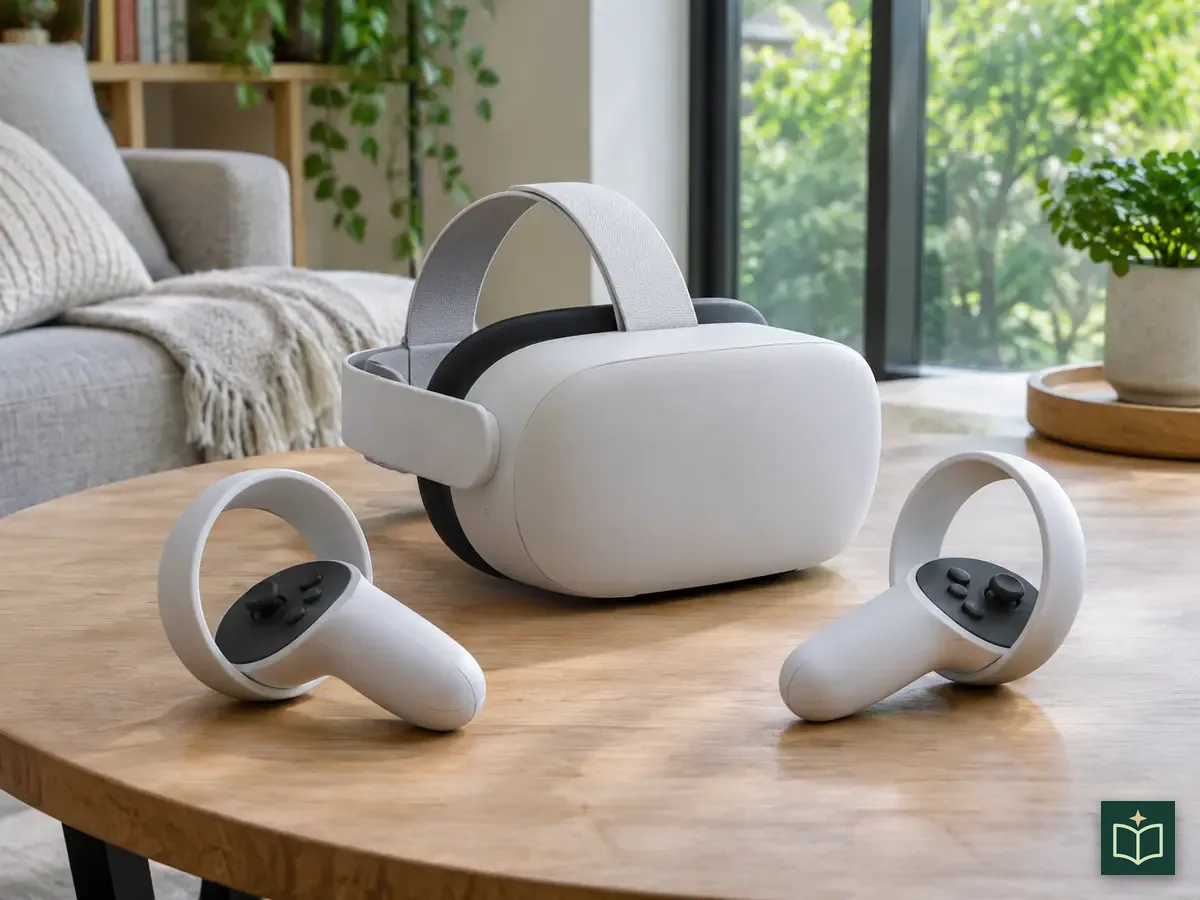
Borrowing how we see depth
Your eyes sit roughly six centimetres apart, so each sees the world from a slightly different angle. The brain fuses the two views and uses the differences to judge distance, an ability called stereoscopic vision. Victorian stereoscopes exploited this with pairs of photographs. A virtual-reality headset does the same with computer graphics: it renders the scene twice, once from the position of each eye, and shows each image only to the matching eye. Add motion, so that the view changes when you turn your head, and the illusion becomes far stronger than any flat screen. People instinctively duck from virtual objects, even knowing they are not real.
Screens and lenses
Inside a headset sit one or two small, high-resolution displays just a few centimetres from your eyes. At that distance the eye could not focus on them, so lenses bend the light, making the image appear farther away and spreading it across a wide field of view, typically around 100 degrees or more. Because the lenses distort the picture, software pre-warps each frame in the opposite direction so it looks correct through the glass. Screens are magnified greatly, so early headsets showed a visible grid between pixels, nicknamed the screen-door effect. Denser displays and thinner, folded lens designs have reduced this considerably and allowed smaller, lighter headsets.
Tracking every movement
For the world to feel solid, the headset must know exactly where your head is. Motion sensors measure rotation hundreds of times a second, while outward-facing cameras watch the room and calculate the headset's position from how features such as furniture edges shift, a technique called inside-out tracking. Together they give six degrees of freedom: turning, tilting and rolling the head, plus moving forwards, sideways and up or down. Hand controllers are tracked in a similar way, and many headsets can now follow bare hands with cameras. Some also track the eyes, which lets the system render sharp detail only where you are looking, saving computing power.
The race against delay
The crucial figure is latency: the time between moving your head and seeing the image update. If it is too long, the world appears to swim or lag behind your movements. Engineers generally aim to keep this delay to roughly 20 milliseconds or less, and displays refresh 90 or more times a second. To hit that target, headsets predict where your head will be when the frame appears, and can make last-moment adjustments to a nearly finished image to match your latest position. This combination of prediction and correction, running continuously, is what separates comfortable virtual reality from the nauseating experiments of earlier decades.
Comfort and its limits
Even good headsets can cause discomfort. Motion sickness occurs when the eyes report movement, such as gliding through a virtual corridor, that the balance organs of the inner ear do not feel. Many applications therefore let users jump between positions rather than glide. A subtler issue is the vergence–accommodation conflict: your eyes converge on virtual objects at different distances, but they always focus on a screen at a fixed optical distance, which can tire them. Headsets also add weight to the head and warmth to the face. Manufacturers commonly set minimum ages, often around the early teens, and suggest regular breaks; persistent symptoms deserve medical advice.
Virtual, augmented, mixed
Virtual reality replaces your surroundings entirely. Augmented reality overlays digital information on the real world, through transparent glasses or a phone screen. Many current headsets blur the boundary, using cameras to show the room in colour, called passthrough, with virtual objects placed convincingly within it, often described as mixed reality. Beyond games, these tools are used to train pilots, surgeons and maintenance crews in realistic but safe settings, to walk clients through buildings before they are built, as architects and developers in the Gulf have done for large projects, and to let museum visitors explore reconstructed historic sites. The key question for each use is whether presence adds real value.
Sources & further reading
Figures are rounded and widely published; check the linked organisations for the latest editions. These organisations do not endorse this website.