No joystick possible
Driving a rover on Mars by remote control, like a toy car, is impossible. Radio signals take between about 3 and 22 minutes to travel one way, depending on the planets' positions. By the time an image of a hazard reached Earth and a command to stop returned, the rover could have driven off a ledge. Contact is also limited, since signals often pass through orbiting spacecraft that are overhead only at certain times. Rovers therefore work in a cycle: engineers plan a day's activity, send it up, and the rover carries it out on its own, reporting back later. A Martian day, or sol, lasts about 24 hours and 40 minutes.
A generation of rovers
NASA's first rover, Sojourner, about the size of a microwave oven, explored a small area in 1997. The twin Spirit and Opportunity rovers landed in 2004; Opportunity, planned for 90 sols, kept working for nearly 15 years. Curiosity, the size of a small car and powered by a nuclear heat source, landed in Gale Crater in 2012. Perseverance followed in 2021 in Jezero Crater, an ancient lake bed, carrying instruments to search for signs of past life and collecting rock samples in sealed tubes for possible return to Earth. China's Zhurong rover also operated on Mars from 2021, reflecting growing international activity.
Seeing in three dimensions
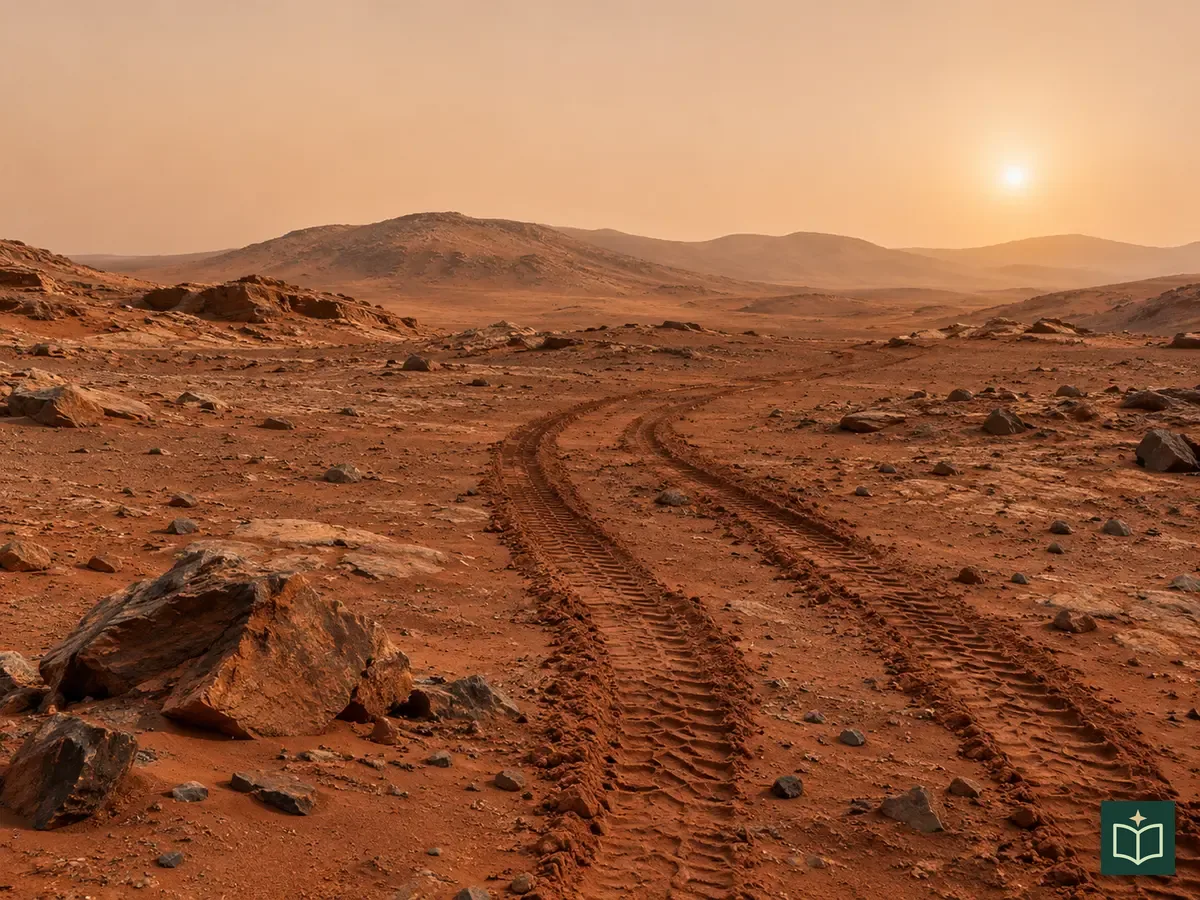
Rovers use pairs of cameras, set apart like human eyes, to judge distance. By comparing the slightly different views, software builds a three-dimensional map of the terrain ahead, identifying rocks, slopes and sand. Separate hazard-avoidance cameras watch close to the wheels. Engineers on Earth view the same images, sometimes with 3D glasses or virtual-reality tools, to plan routes and choose targets for scientific instruments. They mark safe zones and areas to avoid. Sand traps are a real danger: the Spirit rover became stuck in soft soil in 2009 and was never freed, eventually ending its mission as a stationary platform.
Self-driving, carefully
Within the plan from Earth, rovers can drive themselves. Their autonomous navigation software takes images, evaluates the terrain, picks a safe path towards a target point and moves a short distance before checking again. Perseverance can analyse terrain while moving, making it much faster than earlier rovers, which often stopped to think. Even so, rover speeds are tiny by Earth standards, often well under 200 metres an hour. Caution is deliberate. Computers that run in space must withstand radiation, so they are far less powerful than a modern phone, and there is no repair crew if a wheel breaks or the rover tips over.
Wear, weather and dust
Mars is harsh. Temperatures swing from below minus 70 degrees Celsius at night to near freezing by day at many sites, so electronics need heaters and careful insulation. Dust storms can block sunlight for weeks, which ended the solar-powered Opportunity's mission in 2018 when its panels could not recharge. Sharp rocks have punctured Curiosity's aluminium wheels, prompting engineers to adjust driving routes and software to reduce damage. Every movement is a trade-off between reaching scientific targets and preserving a machine that cannot be replaced. Teams sometimes spend days planning a single difficult manoeuvre around a slope or rock field. Caution keeps missions alive.
Why it matters
Rovers have transformed understanding of Mars, finding strong evidence that liquid water once flowed across its surface and that some places were potentially habitable long ago. Orbiters complement them by mapping the planet and studying its atmosphere; the UAE's Hope probe, in orbit since 2021, has produced detailed observations of Martian weather and climate. Techniques developed for rover autonomy inform robotics on Earth, from planetary-style mapping to vehicles that navigate mines and disaster zones. For the future, robots will scout sites for human missions. The lesson of Mars driving is patience: careful planning and modest speed win when mistakes are irreversible.
Sources & further reading
Figures are rounded and widely published; check the linked organisations for the latest editions. These organisations do not endorse this website.