What counts as debris
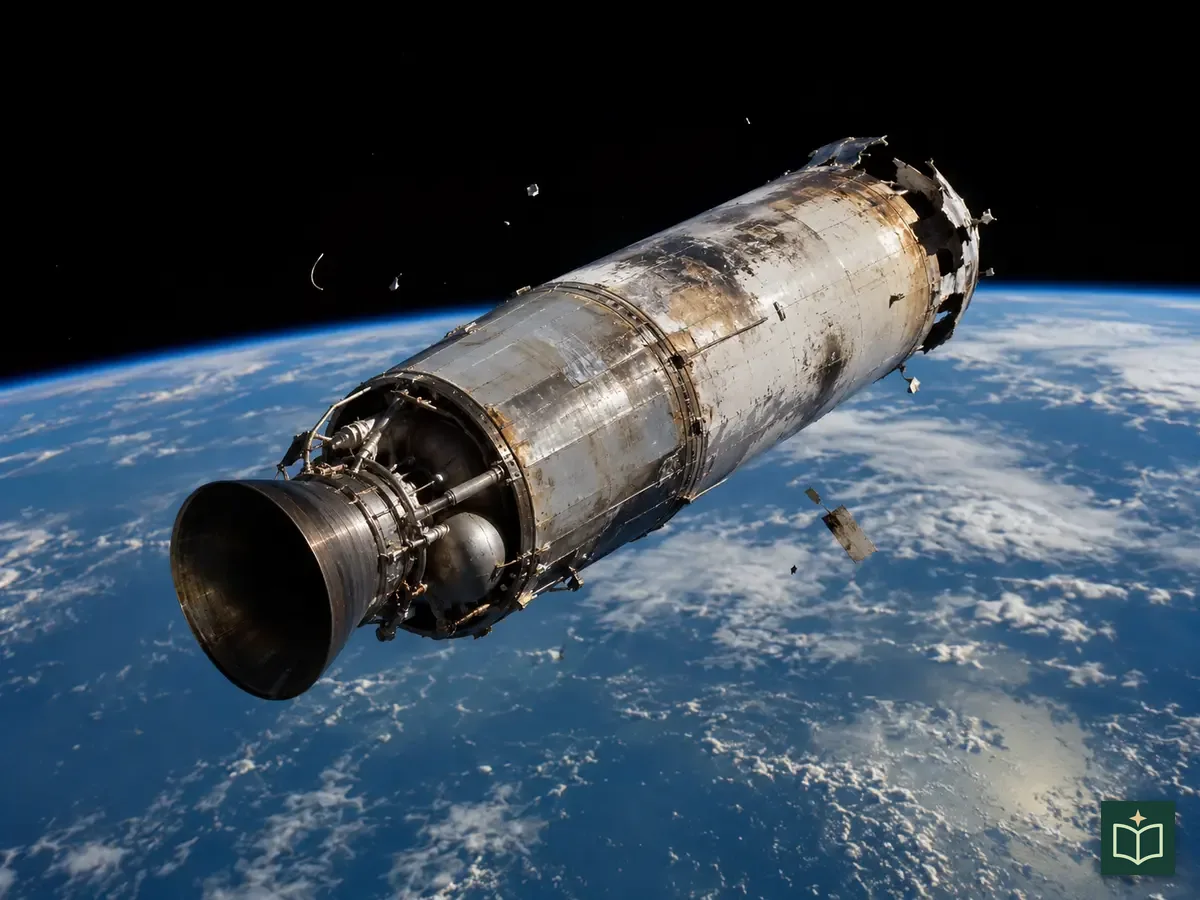
Since the first satellite reached orbit in 1957, thousands of launches have left material behind. Space debris includes dead satellites, spent upper stages of rockets, bolts and covers released during missions, flakes of paint and, most numerous of all, fragments from explosions and collisions. Only a minority of objects in orbit are working spacecraft. Space agencies track tens of thousands of objects larger than about ten centimetres, and statistical models suggest there are around a million pieces larger than one centimetre, and many millions smaller still, far too small to track individually. Most debris sits in low Earth orbit, the busiest and most useful region.
Why small things are dangerous
Objects in low orbit travel at around 7.5 kilometres per second, and two pieces in crossing orbits may meet at about 10 kilometres per second. At that speed, energy rises sharply with velocity: a fragment one centimetre across can strike with the energy of a small car crash, enough to disable a satellite. Even millimetre-sized particles can pit windows and puncture unshielded parts. The International Space Station carries layered shielding designed to break up small particles and regularly manoeuvres to avoid larger tracked objects. Its windows have been chipped by tiny debris, a reminder that astronauts share their orbit with a cloud of human-made fragments.
The cascade risk
In 1978 NASA scientist Donald Kessler warned that if debris became dense enough, collisions would create fragments that caused further collisions, a chain reaction that could make some orbits hazardous for generations. This is now called the Kessler syndrome. Real events showed the danger. In 2009 a defunct military satellite and a working communications satellite collided over Siberia, scattering thousands of pieces. Deliberate tests in which countries destroyed their own satellites with missiles, in 2007 and later, created large debris clouds that persisted for years. Experts debate how close any orbit is to runaway growth, but agree that adding debris carelessly makes the risk worse.
Tracking and dodging
Radars and telescopes on the ground track larger objects and predict their paths. When a close approach is forecast, operators receive warnings and can fire thrusters to move a satellite out of harm's way. Such manoeuvres have become routine for many operators, including the space station. The growth of large broadband constellations, with thousands of satellites each, means many more manoeuvres and a greater need for coordination and shared data between companies and countries. Commercial firms now offer tracking services alongside government networks. Accuracy matters: false alarms waste fuel, while missed warnings risk a collision that could create its own debris cloud.
Cleaning up and prevention
International guidelines encourage operators to remove satellites from busy low orbits within a set time after missions end, traditionally within 25 years, with some regulators now requiring much faster disposal. Satellites can be lowered to burn up in the atmosphere or, from higher orbits, pushed into little-used graveyard orbits. Rocket stages can be designed to re-enter quickly, and fuel tanks vented to prevent later explosions. Active removal, sending a spacecraft to capture debris, is being tested by several agencies and companies, but it is costly and technically difficult. Most experts see prevention, through good design and disposal, as more important than clean-up.
Why it matters
Orbit is a shared resource, and debris makes it more expensive and risky for everyone, including newer space nations such as the UAE whose satellites support mapping, communications and research. Satellites underpin navigation, weather forecasting and financial timing, so protecting them protects daily life on the ground. Falling debris rarely harms people, since most burns up and much of Earth is ocean or empty land, but large objects occasionally survive re-entry. Governance remains a work in progress, relying largely on guidelines rather than binding global rules. Watching how countries and companies coordinate traffic in orbit is a good indicator of whether space stays usable.
Sources & further reading
Figures are rounded and widely published; check the linked organisations for the latest editions. These organisations do not endorse this website.