The problem of distance
A radio signal spreads out as it travels, so its strength falls with the square of distance. Double the distance and the signal is four times weaker. For a probe near Mars, tens to hundreds of millions of kilometres away, or a spacecraft beyond the planets, the signal reaching Earth is unimaginably faint. The twin Voyager probes, launched in 1977 and now in interstellar space, transmit with roughly the power of a refrigerator light bulb, about 20 watts. By the time that signal reaches Earth, it is far weaker than a billionth of a billionth of a watt. Picking it out requires extraordinary engineering.
A network of giant dishes
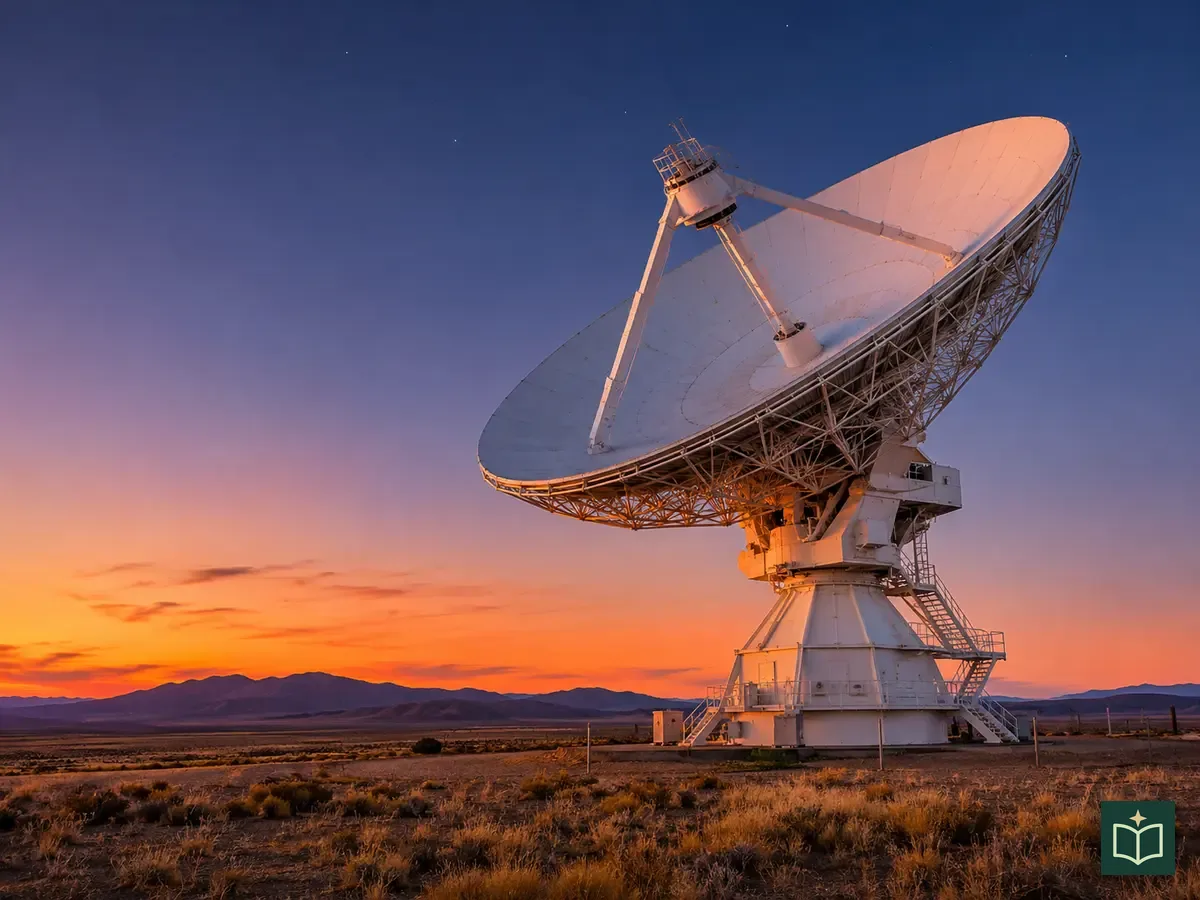
Earth rotates, so a single ground station would lose sight of a spacecraft for much of each day. NASA's Deep Space Network solves this with three complexes, in the Mojave Desert in California, near Madrid in Spain and near Canberra in Australia, spaced roughly a third of the way around the globe. As one station rotates away, another comes into view. Each complex has several dish antennas, the largest 70 metres across, wider than a football pitch. Other space agencies operate their own networks, and missions from many countries, including the UAE's Hope probe at Mars, have relied on such antennas for contact.
Listening to near-silence
A large dish collects more of the faint signal, much as a bigger bucket catches more rain. The radio waves are focused onto receivers cooled to a few degrees above absolute zero, which reduces the electronic noise their own warmth would otherwise create. Signals are sent on precisely known frequencies, so the receivers can filter out almost everything else. Several dishes can be combined, or arrayed, to act like one larger antenna. The ground stations also transmit commands, using powerful transmitters to send instructions outward, so a single dish both listens to distant whispers and shouts to probes billions of kilometres away.
Codes that fix errors
Even with huge antennas, noise corrupts some bits. Engineers therefore add carefully structured redundancy to the data before it is sent, using error-correcting codes. These let the receiver detect and fix mistakes without asking for retransmission, which would take hours from the outer solar system. The cost is that data rates from far away are low. A Mars orbiter may send back many megabits per second at favourable times, but distant probes manage only a few hundred bits per second or less. Rovers on Mars usually relay their data through orbiting spacecraft, which have larger antennas and more power. Patience is built into the design.
Time delay and tracking
Radio travels at the speed of light, but even that takes time across space. Signals between Earth and Mars take between about 3 and 22 minutes each way, depending on the planets' positions, while signals to the Voyagers take the best part of a day. Spacecraft must therefore act autonomously, carrying out command sequences sent in advance. The radio link does more than carry data. By measuring tiny shifts in the signal's frequency and the time for signals to make a round trip, navigators determine a spacecraft's speed and distance with remarkable precision, guiding it to its destination. Distance and timing are measured together.
What comes next
Demand on deep-space networks keeps rising as more missions travel to the Moon, Mars and beyond, and agencies are adding antennas and exploring new methods. Laser communication is the most promising: light can carry far more data than radio, and NASA has demonstrated laser links from deep space, though clouds can block them and pointing must be exceptionally precise. A common misconception is that space missions are in constant live contact with Earth; in reality, contact is scheduled, shared and often hours apart. Every image from another world has travelled an extraordinary path, caught by patient listening across the planet.
Sources & further reading
Figures are rounded and widely published; check the linked organisations for the latest editions. These organisations do not endorse this website.