More than rubber
A modern car tyre looks like a single piece of black rubber, but it contains a dozen or more components and as many as 200 raw materials. Natural rubber from plantations, mostly in Southeast Asia, is combined with synthetic rubbers made from oil. Carbon black, a fine soot, strengthens the rubber and gives it its colour, while silica improves grip in the wet and reduces rolling resistance. Oils, waxes, antioxidants and sulphur complete the recipe. Inside are textile cords of polyester, rayon or nylon, steel wire for the beads and steel cord for the belts. Each element has a specific job: holding air, carrying load, resisting heat or gripping the road.
Mixing and preparing parts
Production begins in large internal mixers, where rubber and additives are kneaded under heat into compounds with different properties. The tread compound must grip and wear slowly; the sidewall compound must flex millions of times without cracking; the inner liner, usually based on butyl rubber, must keep air in. These compounds are then pressed into sheets or extruded into profiles. Fabric cords are coated with rubber and cut at precise angles to form plies. Bundles of high-strength steel wire are wound into hoops called beads, which lock the tyre onto the wheel rim. Steel cord is coated and cut into belts that will sit under the tread.
Building the green tyre
On a tyre-building machine, the parts are assembled on a rotating drum in order: inner liner, body plies, beads, sidewalls, then the steel belts, a nylon cap ply and finally the tread. The drum shapes the plies around the beads and pushes the layers together. The result is called a green tyre: soft, sticky and only roughly tyre-shaped, without any tread pattern. It is then sprayed with a release agent and sent to a curing press. Precision matters at this stage, because a belt placed slightly off-centre or a ply with uneven tension can cause vibration, uneven wear or a weak spot once the tyre is in service.
Heat, pressure and a mould
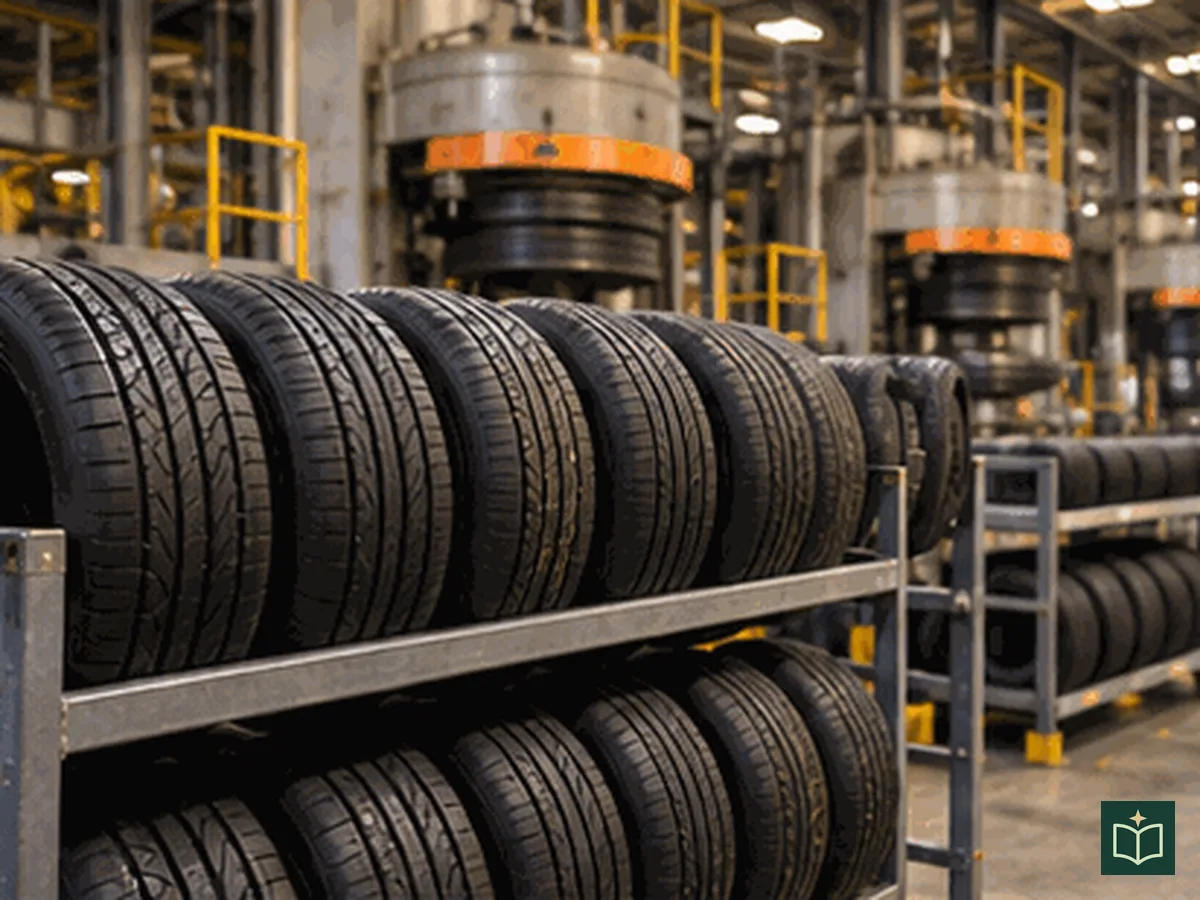
In the curing press, the green tyre is placed in a steel mould engraved with the tread pattern and sidewall lettering. A rubber bladder inside is filled with steam or hot water, pushing the tyre outward against the mould while heat flows in from both sides. For a passenger car tyre, curing usually takes around 10 to 15 minutes at temperatures roughly between 150 and 180 degrees Celsius. During this time, sulphur forms cross-links between the long rubber molecules. This vulcanisation turns a soft, sticky mass into an elastic material that springs back to shape, resists heat and binds all the layers into one structure.
Reading the sidewall
Every tyre carries a code that describes its build. Take 205/55 R16 91V. The tyre is 205 millimetres wide, and its sidewall is 55 per cent of that width, about 113 millimetres tall. R means radial construction, with plies running straight across from bead to bead. It fits a 16-inch rim, giving an overall diameter of roughly 632 millimetres. The load index 91 means each tyre can carry up to 615 kilograms, and V marks a maximum speed of 240 km/h. A four-digit date code, such as 2324, shows the week and year of manufacture: here, the 23rd week of 2024.
Testing and life on the road
Finished tyres are inspected visually, checked for uniformity on spinning machines and sampled for X-ray examination of their internal structure. Batches are tested for strength, high-speed endurance and resistance to bead failure. Once fitted, though, a tyre's life depends heavily on how it is used. Under-inflation makes the sidewalls flex too much and builds heat, a particular risk on long desert motorways in a Gulf summer. Rubber also ages through heat and sunlight even when tread remains, which is why many manufacturers advise inspection after around five years and replacement within ten. Pressure should be checked when tyres are cold, against the figure on the door pillar.
Sources & further reading
Figures are rounded and widely published; check the linked organisations for the latest editions. These organisations do not endorse this website.