Why solid things move
Almost every material expands when it warms and contracts when it cools, because its atoms vibrate more strongly and push slightly further apart. The change is tiny for a small object, but it adds up over long distances. Steel and concrete expand by roughly 10 to 12 millionths of their length for every degree Celsius of warming. That sounds negligible until it is applied to a bridge hundreds of metres long, or a road that bakes in the sun all afternoon and cools at night. If the structure is locked rigidly in place, the movement does not disappear: it turns into large forces that can crack, buckle or push parts out of line.
Doing the sums
Engineers estimate movement by multiplying the length, the temperature range and the material's coefficient of expansion. Take a 100-metre steel bridge deck in the Gulf. Steel exposed to the summer sun can become far hotter than the air, while winter nights are cool, so a range of 50 degrees is plausible over a year. Multiplying 100 metres by 50 degrees by 0.000012 gives 0.06 metres, or 60 millimetres. That is the gap the joint must open and close across, plus allowances for concrete shrinkage, creep and traffic loads. On long-span bridges the total movement can reach well over a metre.
Joints and bearings on bridges
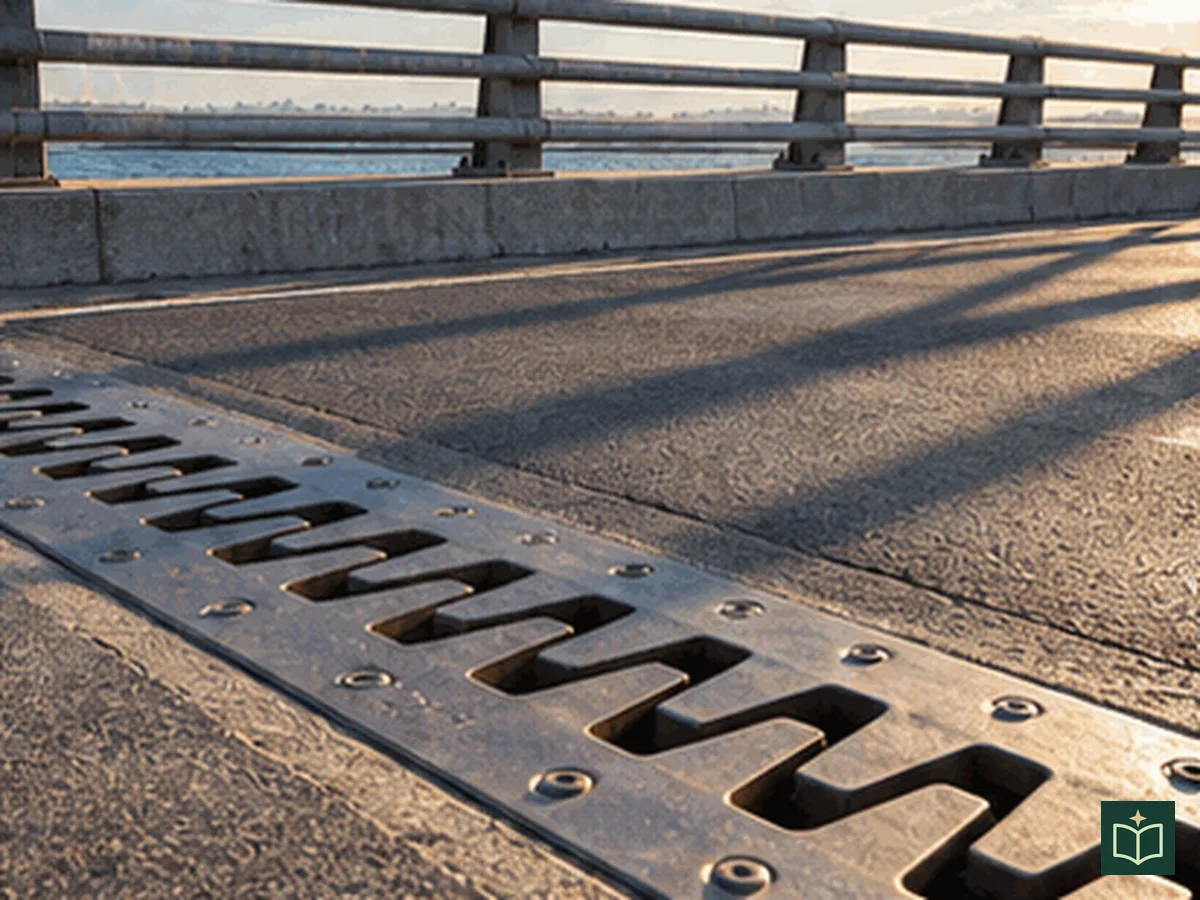
On a bridge, the deck usually rests on bearings that let it slide or rotate over the piers. Some are blocks of layered rubber and steel that shear slightly as the deck moves; others are sliding plates coated with low-friction materials. At the ends, the deck is separated from the road by an expansion joint. Small movements are handled by a rubber strip seal, while larger ones use interlocking steel fingers or modular joints with several moving beams. The clatter drivers hear crossing a bridge is often the tyres passing over these joints. Without them, a hot deck would shove against its abutments and damage both.
Roads, rails and buildings
Concrete roads and floors are cut into panels by sawn joints, so that shrinkage cracks form in straight lines where they are planned rather than randomly. Expansion joints filled with flexible material are placed where slabs meet bridges or buildings. Long buildings are divided by movement joints running through floors, walls and façades, sealed with flexible materials. Railways take a different approach. Instead of gaps every few metres, modern track uses continuously welded rail, which is installed at a carefully chosen temperature and held firmly by heavy sleepers and ballast, so that the steel carries the stress without moving. Joints are then needed only at a few points.
When the gap is missing
Leaving out or blocking a joint has visible consequences. Concrete pavements can lift and shatter in heatwaves when slabs press together with nowhere to go, a failure engineers call a blow-up. Rails that are poorly restrained can buckle sideways into a so-called sun kink, which can derail a train. Floor tiles laid without perimeter gaps sometimes tent upward into a ridge. Joints also fail when debris fills them, seals tear or bearings seize, so they are inspected and maintained regularly. A joint that cannot open and close is effectively no joint at all, and the forces it was meant to release end up elsewhere.
Designing for extremes
Climate determines how much room a structure needs. In the Gulf, metal surfaces in full sun can become much hotter than the shade temperature, and large daily swings add repeated cycles of expansion and contraction. Engineers account for both the hottest and coolest temperatures a structure may experience over its life, and some codes are being revised to allow for higher extremes as summers warm. Tall towers also move vertically as columns are loaded and cladding heats unevenly, so façade panels are mounted with sliding brackets. The gaps that drivers rattle over and the sealant lines on buildings are not flaws: they are deliberate, calculated room to move.
Sources & further reading
Figures are rounded and widely published; check the linked organisations for the latest editions. These organisations do not endorse this website.