Why compost at all
Food scraps and garden cuttings make up a large share of household rubbish in many countries. Sent to landfill, they break down without oxygen and release methane, a powerful greenhouse gas, along with liquid that must be collected and treated. Composting takes the same material and lets it break down with oxygen instead. The main products are carbon dioxide, water, heat and a dark, crumbly material that improves soil structure and helps it hold water and nutrients. In arid regions such as the Gulf, where natural soils are sandy and low in organic matter, compost is valued by landscapers and farms as a way to make each litre of irrigation go further.
Getting the recipe right
Microbes need a balanced diet. Nitrogen-rich materials, such as food waste and grass, help them grow, while carbon-rich materials, such as wood chips and dry leaves, give them energy and add structure so air can move through the pile. Operators usually aim for a carbon-to-nitrogen ratio of about 25 to 30 to one. As an illustration, suppose 100 kilograms of food scraps hold 30 kilograms of carbon and 2 kilograms of nitrogen, a ratio of 15 to one. Adding 50 kilograms of wood chips containing 25 kilograms of carbon and a quarter of a kilogram of nitrogen raises the mix to about 24 to one, close to the target.
Three ways to run a site
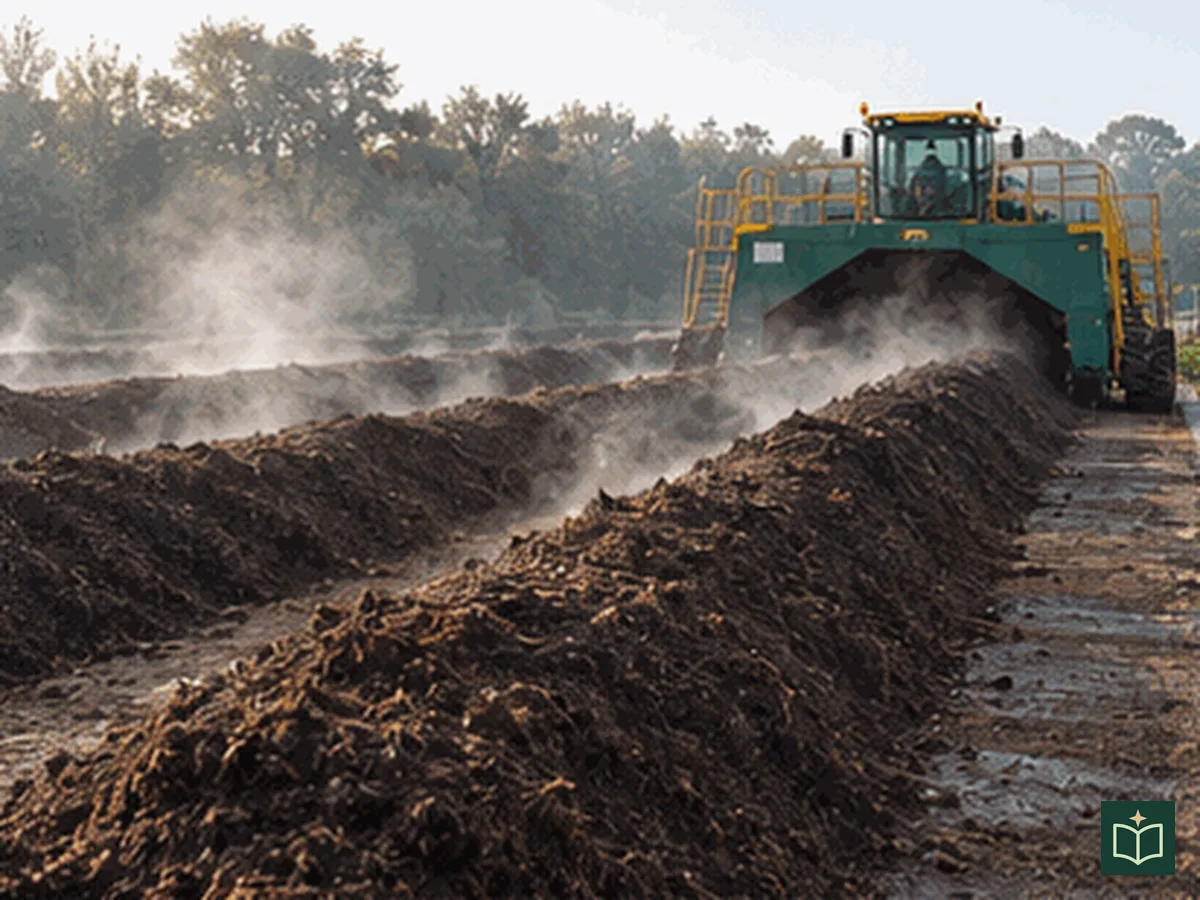
Large facilities use one of three main methods. In windrow composting, the material is laid in long rows a few metres high and turned regularly by special machines, which mix it and let air in. In aerated static piles, the heaps stay put while fans push or pull air through perforated pipes underneath. In-vessel systems enclose the material in drums, tunnels or containers where temperature, airflow and moisture are tightly controlled, which also helps contain odours. Whatever the method, moisture is typically kept around half the weight of the material: too dry and microbes slow down, too wet and air cannot reach them, producing smells.
The hot phase
Within days, microbial activity heats the pile, often to between 55 and 70 degrees Celsius. This thermophilic phase is when most of the breakdown happens, and the heat also destroys weed seeds and pathogens such as harmful bacteria. Regulations in many countries require the material to stay above a set temperature for a set time. One widely used standard asks windrows to remain at 55 degrees or more for 15 days, with at least five turnings so that every part spends time in the hot core. After several weeks, as the easy food runs out, temperatures fall and fungi and other organisms take over, gradually stabilising the material.
Contamination: the batch killer
The biggest problem for composters is not food but what comes with it. Plastic bags, cutlery, fruit stickers, glass and metal survive the process, end up shredded into small pieces and make the finished compost unsaleable or unsafe for farmland. Screening removes larger fragments but not every shard. Even products labelled compostable may need conditions or times that a particular site does not provide, so local rules vary on what is accepted. A batch heavily contaminated with plastic may have to be sent to landfill after all. This is why separate food-waste bins, clear labelling and household care matter as much as the technology at the plant.
From pile to product
After the active phase, compost is left to cure for several more weeks, sometimes months, so that remaining organic acids and compounds that could harm young plants break down. It is then screened into grades, tested for maturity, nutrients, heavy metals and pathogens, and sold to farms, landscapers, nurseries and home gardeners. Good compost is dark, earthy-smelling and crumbly, with no recognisable food. It is not a fertiliser in the strict sense, because its nutrient levels are modest, but it feeds soil life and improves structure. Every tonne used also represents waste that did not go to landfill, a figure that cities increasingly track when they set recycling targets.
Sources & further reading
Figures are rounded and widely published; check the linked organisations for the latest editions. These organisations do not endorse this website.