More than a giant drill
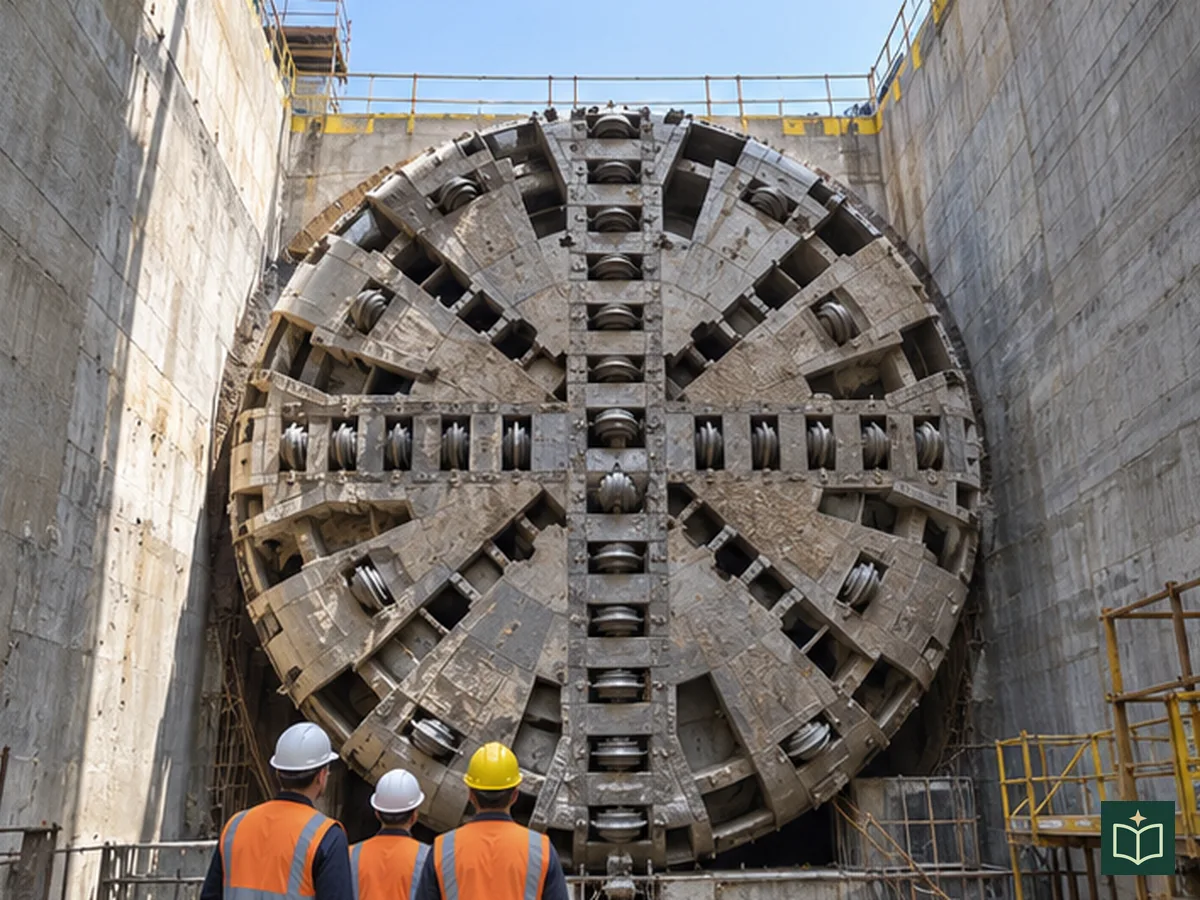
A tunnel boring machine, or TBM, is often described as a drill, but it is closer to a moving factory. The front is a circular cutterhead that can be more than ten metres across. Behind it trails a train of equipment up to a hundred metres or more long, carrying hydraulic power units, conveyors, ventilation, grout pumps and control cabins. The machine is built to the tunnel's exact diameter and usually lowered in pieces down a launch shaft. Once assembled, it advances in a repeating cycle of digging and lining, leaving behind a finished concrete tube that trains, cars, water or sewage can later pass through.
Cutting different ground
The cutterhead is matched to the ground. In hard rock, steel disc cutters roll against the face under enormous pressure and crack off chips of stone. In soft or wet ground the bigger danger is collapse and flooding, so the face must be supported. Earth pressure balance machines hold the excavated soil in a sealed chamber at the front and use its pressure to resist the surrounding ground, letting it out at a controlled rate by screw conveyor. Slurry machines pump bentonite clay mixed with water into the chamber instead, then carry the cuttings away as liquid. Choosing the wrong type for the geology can halt a project for months.
Building the lining
Every time the machine advances by the width of one ring, it pauses. Inside the protective steel shield, an erector arm picks up precast concrete segments, each a curved slab weighing several tonnes, and places them one by one to form a complete ring, bolted together and sealed with rubber gaskets against water. Hydraulic rams arranged around the shield then press against this new ring to push the machine forward again. As the shield slides away, grout is injected into the narrow gap between the ring and the ground, locking the lining in place. A conveyor or rail wagons carry the spoil back to the surface throughout.
Steering underground
Without a view of the surface, a TBM is steered by surveying. A laser station fixed in the completed tunnel shines onto a target on the machine, and software compares its position and angle with the designed route. The operator corrects course by applying more thrust on one side than the other, or by bending the articulated shield slightly. Small errors are corrected continuously, because a tunnel cannot be easily reversed. When two machines bore towards each other, as on the Channel Tunnel, they are expected to meet within a few centimetres. Engineers also monitor buildings above for settlement, a key concern when tunnelling beneath crowded cities.
A worked pace
Suppose a machine installs rings 1.5 metres wide and averages 15 metres a day in favourable ground. That is ten complete rings, each needing a full cycle of cutting, shoving, erecting and grouting. At that rate a 3-kilometre drive would take about 200 days of boring, before allowing for maintenance, cutter changes and slower stretches. Real progress varies widely: soft ground with no surprises may allow faster work, while faults, boulders or water inflows can slow it sharply. Large projects run several machines at once to save time. Qatar's Doha Metro, for example, used more than twenty TBMs simultaneously during construction.
From shields to supermachines
The idea of a protective shield dates to the early nineteenth century, when Marc Isambard Brunel used one to dig the first tunnel under the River Thames, completed in 1843. Workers mined by hand inside a moving iron frame. Mechanical cutterheads followed in the twentieth century, and modern TBMs combine excavation, support and lining in one system. They are expensive and slow to set up, so short tunnels are often still dug by drilling and blasting or by excavators. For long urban tunnels, though, boring machines cause far less disruption at street level, which is why metro, sewer and road projects around the world rely on them.
Sources & further reading
- Britannica · Tunnels and underground excavations ↗
- International Tunnelling and Underground Space Association ↗
Figures are rounded and widely published; check the linked organisations for the latest editions. These organisations do not endorse this website.