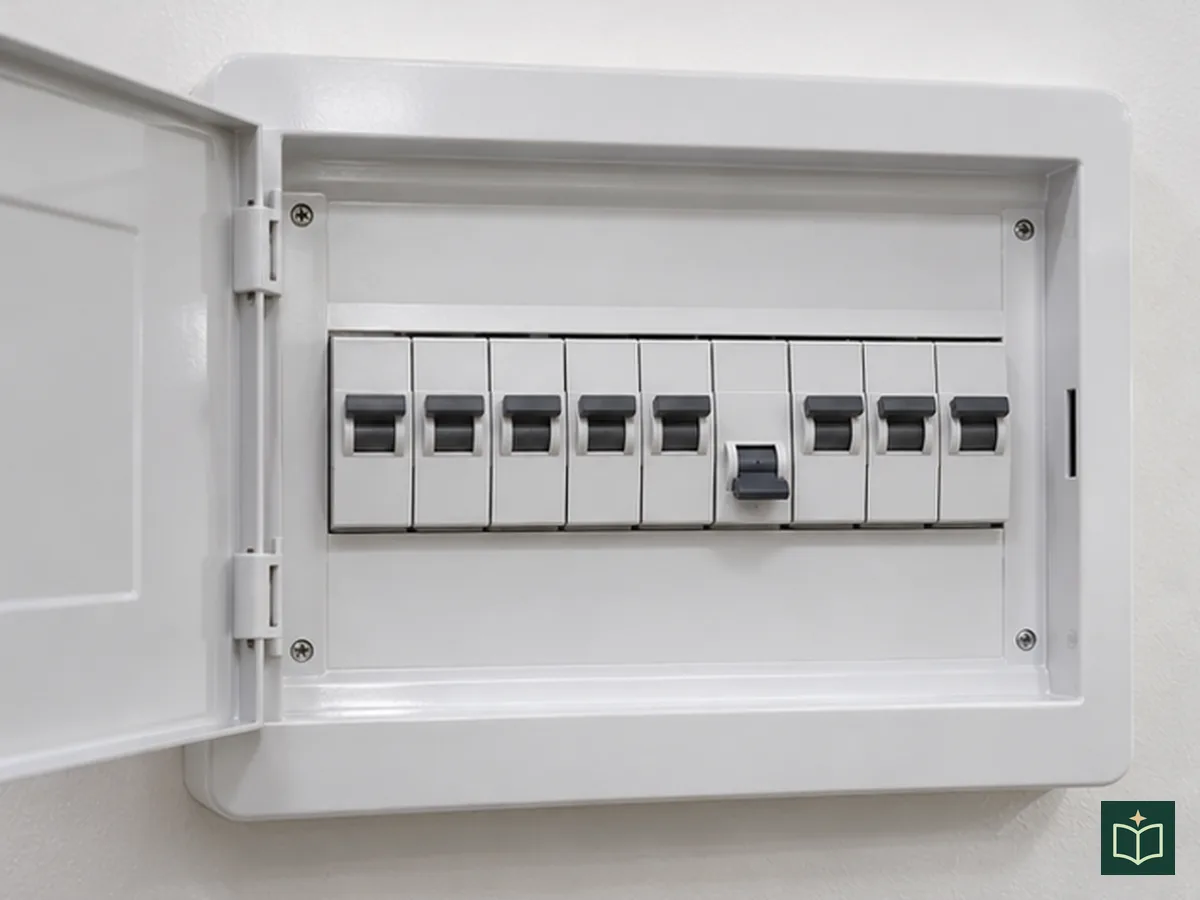
Why wiring needs protection
Every cable in a home is designed to carry a certain current safely. If more flows for long enough, the copper heats up, the insulation softens and a fire can start inside a wall long before anyone notices. The first protection was the fuse, a thin wire that melts when current is too high, breaking the circuit. Fuses work, but must be replaced each time. The modern distribution board, still often called the fuse box, uses miniature circuit breakers instead. Each one guards a single circuit, such as the kitchen sockets or the bedroom lights, and can simply be switched back on once the cause has been dealt with.
Heat for overloads
A breaker contains two sensing mechanisms. The first handles overloads, where a circuit carries somewhat too much current for minutes at a time. Current passes through a bimetallic strip made of two metals that expand at different rates. As it warms, the strip bends, and if it bends far enough it releases a latch and a spring snaps the contacts apart. The delay is deliberate. Many appliances draw a brief surge when they start, and a breaker that tripped on every surge would be useless. The greater the overload, the faster the strip heats, so a large excess trips in seconds while a slight one may take much longer.
Magnetism for short circuits
A short circuit is far more violent. When a live conductor touches neutral or earth directly, current can rise to hundreds or thousands of amps almost instantly. Waiting for a strip to warm would be dangerous, so the breaker also contains a coil. The sudden current creates a strong magnetic field that pulls a plunger and trips the mechanism within milliseconds. Opening a circuit under such load creates an arc, a spark that can keep current flowing through the air, so breakers include arc chutes, metal plates that split and cool the arc until it goes out. A breaker that has interrupted a serious short circuit may need checking afterwards.
Guarding people from shocks
Neither mechanism protects a person well, because a dangerous shock involves only a small current. A residual current device, often called an RCD or, in the Gulf, an earth leakage circuit breaker, solves this. It compares the current flowing out on the live wire with the current returning on neutral. Normally they are equal. If some current is escaping through a damaged appliance to earth, or through someone's body, the difference is detected by a small transformer. Devices for personal protection trip at around 30 milliamps, usually within a few hundredths of a second, fast enough to greatly reduce the risk of a fatal shock. A test button checks the mechanism.
An evening in the kitchen
Imagine a kitchen socket circuit protected by a 20-amp breaker on a 230-volt supply. A 3-kilowatt kettle draws about 13 amps. Add a 2-kilowatt heater on the same circuit and the total rises to about 21.7 amps, slightly over the limit. Nothing happens immediately, but if both stay on, the thermal strip warms and the breaker eventually trips. If, instead, a frayed flex lets the live wire touch the metal kettle casing, current flows to earth and the residual current device trips almost at once. If the flex's wires touch each other, the huge surge trips the breaker's magnetic coil. Three faults, three responses.
When a breaker keeps tripping
A breaker that trips once may simply have caught an overloaded circuit, and moving one appliance elsewhere solves it. One that trips repeatedly is signalling a real problem: a faulty appliance, damaged cable, moisture in an outdoor socket or a circuit too small for its load. Unplugging everything and reconnecting items one at a time often identifies the culprit. Taping a breaker on, or replacing it with a larger one, removes the protection and can lead to a fire. Breakers and residual current devices can also wear out. Persistent trips, burning smells or warm switches are a reason to call a licensed electrician rather than experiment.
Sources & further reading
Figures are rounded and widely published; check the linked organisations for the latest editions. These organisations do not endorse this website.