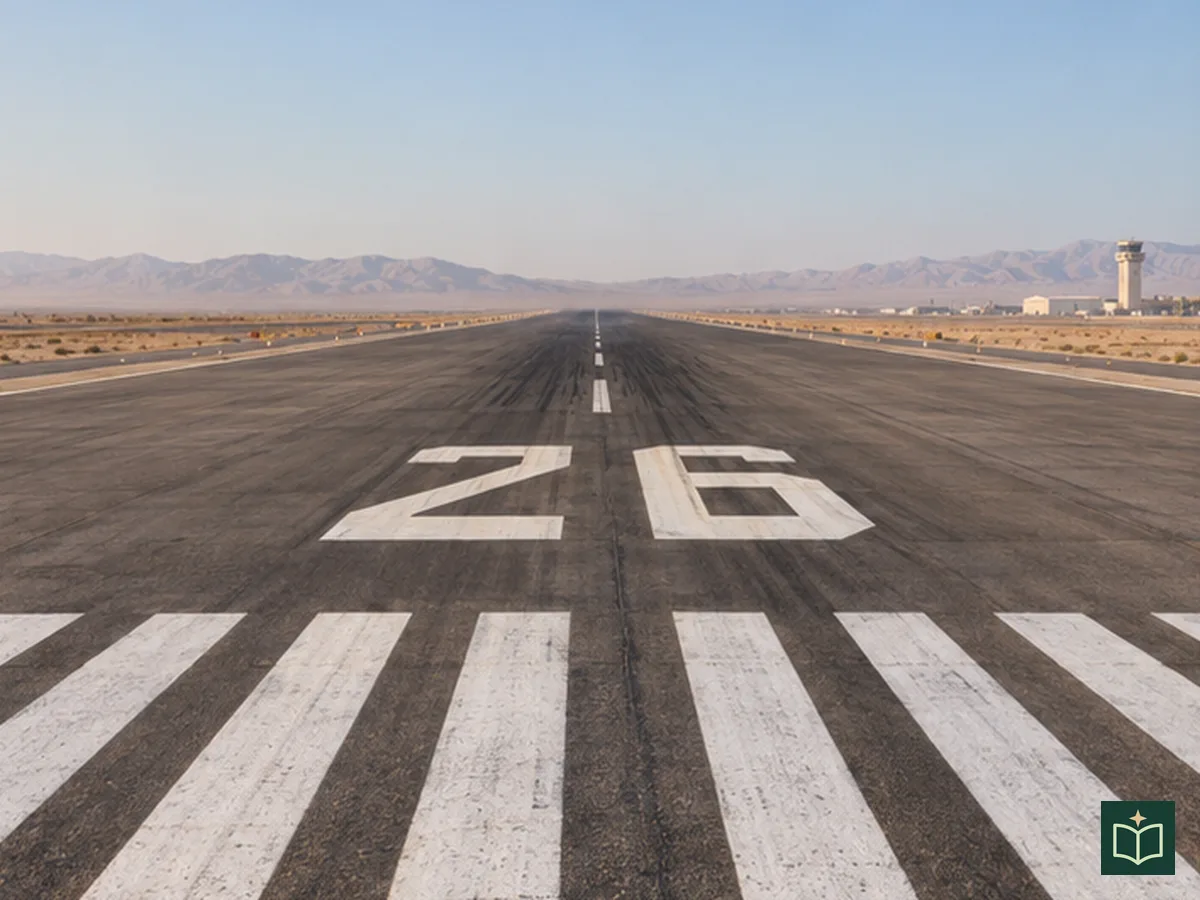
Big white numbers
At the threshold of every runway, painted in huge white figures, is a one- or two-digit number. It is not a sequence or a label chosen by the airport. It is a compass direction. The number tells pilots which way the runway points when an aircraft lines up at that end, measured as a magnetic bearing in degrees and divided by ten. Runway 09 points roughly east, towards 090 degrees; runway 18 points south; runway 36 points north. The system lets pilots and controllers identify a runway instantly and gives crews a quick check that they are lined up on the correct strip before take-off or landing.
How the rounding works
The bearing is rounded to the nearest ten degrees before the final digit is dropped. A runway aligned at 273 degrees magnetic becomes 27; one at 276 degrees becomes 28. North is written as 36 rather than 0, and single digits are usually painted with a leading zero, as in 09, although conventions vary by country. Because a runway is a straight strip, each end points the opposite way. The far end of runway 27 points at 093 degrees and is called runway 09. The two numbers always differ by 18, because 180 degrees divided by ten is 18. Together they form a pair, written as 09/27.
Left, centre and right
Large airports often have parallel runways pointing in the same direction, which would otherwise share a number. A letter distinguishes them: L for left, R for right and, where there are three, C for centre, judged from the pilot's view on approach. The letters swap at the opposite end, because left becomes right when facing the other way. Dubai International's two parallel runways are designated 12L/30R and 12R/30L, pointing south-east and north-west. Where an airport has four or more parallels, some may be numbered one off their true heading, so that each has a distinct designation without needing extra letters that pilots could confuse.
Why magnetic, not true north
Runways use magnetic bearings because aircraft compasses, and many older navigation aids, point to magnetic north rather than to the geographic North Pole. The angle between the two, called magnetic variation or declination, differs from place to place. Using magnetic headings means the runway number matches what the cockpit compass reads. The exception is close to the magnetic poles, where compasses become unreliable. In parts of northern Canada, for example, runways are numbered by true north instead. Modern aircraft navigate largely with satellite and inertial systems, but the magnetic convention remains embedded in procedures, charts and air traffic control phraseology around the world.
When runways are renamed
Earth's magnetic field is not fixed. The north magnetic pole has drifted hundreds of kilometres across the Arctic over the past century, moving from northern Canada towards Siberia. As it moves, the magnetic bearing of a runway slowly changes even though the concrete stays put. When the change is enough to alter the rounded number, the runway must be redesignated. That means repainting the markings, replacing signs and updating charts, instrument procedures and databases worldwide. Tampa International Airport in Florida, for instance, renamed its main runway from 18R/36L to 19R/1L in 2011. Such changes are scheduled carefully, because a mismatch between sign and chart could confuse crews.
Choosing a runway's direction
Runway direction itself is set by the wind. Aircraft take off and land into the wind where possible, because a headwind lowers ground speed and shortens the distance needed. Planners study years of wind records and align main runways with the prevailing direction, adding crosswind runways where winds vary widely. Terrain, airspace and noise over nearby towns also shape the choice. On a given day controllers pick which end is in use, so the same runway might be called 30 in the morning and 12 in the afternoon if the wind shifts. For passengers, the number glimpsed from a window is a small reading of the compass.
Sources & further reading
Figures are rounded and widely published; check the linked organisations for the latest editions. These organisations do not endorse this website.