Why bore instead of dig
In the past, tunnels were dug by hand or blasted with explosives, slow and dangerous work. In cities, another option is cut-and-cover: digging a trench, building the tunnel inside, then covering it over. That disrupts streets for years. Tunnel boring machines, often called TBMs, work deep underground instead. They can pass beneath buildings, rivers and roads with little disturbance at the surface, which is why they are used for metro lines, road tunnels, sewers and water pipes around the world.
The cutterhead
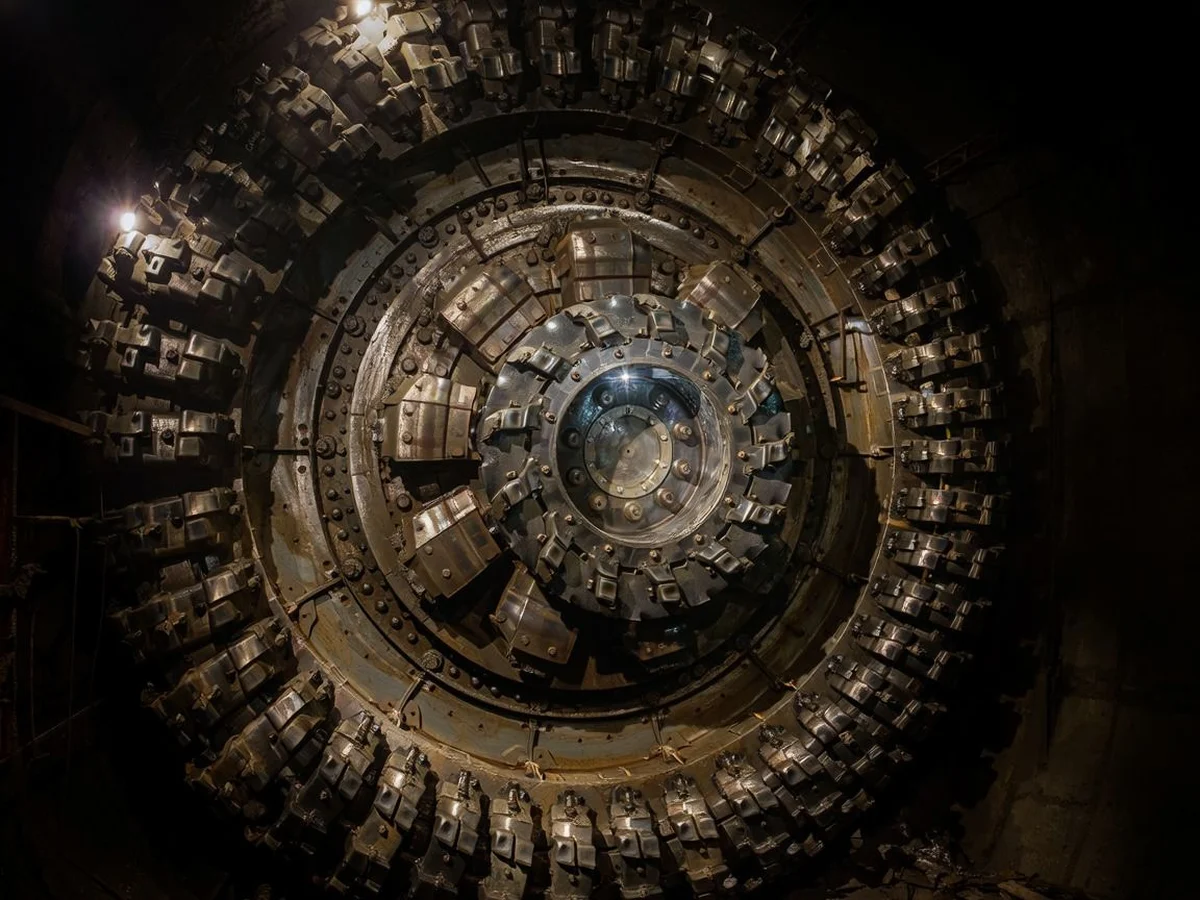
At the front of every TBM is the cutterhead, a huge rotating disc that can be more than 15 metres across on the largest machines. It is fitted with hardened steel disc cutters and scrapers. In hard rock, the discs roll against the face under enormous pressure, cracking the rock into chips. In soft ground, scrapers and teeth loosen the soil. The cutterhead turns slowly, often just a few times a minute, but with immense force supplied by powerful electric motors.
Holding back the ground
Digging through soft, wet ground is risky because the face can collapse or water can flood in. Earth pressure balance machines solve this by filling a chamber behind the cutterhead with the excavated soil and keeping it at a controlled pressure that matches the ground outside. Slurry machines instead pump a thick mixture of water and clay into the chamber to support the face. Engineers choose the type of TBM after studying the geology along the route in detail.
Moving the spoil
A large TBM can remove thousands of tonnes of material a day. In earth pressure balance machines, a long screw conveyor lifts the soil out of the pressurised chamber in a controlled way. Belt conveyors then carry it back through the tunnel to the shaft and up to the surface. Slurry machines pump the soil out mixed with liquid, and a separation plant on the surface removes the solids so the liquid can be reused. Much of the spoil is recycled for construction.
Building the tunnel lining
Behind the cutterhead, inside a protective steel shield, the machine builds the tunnel wall as it goes. Curved precast concrete pieces called segments are delivered by train, and a robotic arm called an erector lifts each one into place. Several segments fit together to form a complete ring, bolted and sealed with gaskets to keep water out. Grout is pumped into the gap between the ring and the surrounding ground to lock everything in place.
How it moves
A TBM does not drive on wheels. Instead, a ring of hydraulic rams at the back of the shield pushes against the last completed concrete ring. As the rams extend, the cutterhead is forced forward into the face. When the rams reach the end of their stroke, they are retracted, a new ring is built in the space, and the cycle repeats. Laser guidance systems and survey teams keep the machine on course, often to within a few centimetres.
A factory on rails
Behind the shield, a long train of trailers called the back-up carries everything the machine needs: electrical transformers, hydraulic pumps, ventilation, control cabins, workshops and sometimes rest areas for the crew. The whole system can be more than 100 metres long. Crews work in shifts around the clock. In good ground, a TBM may advance 10 to 20 metres a day, and much more in ideal conditions, but difficult geology can slow progress dramatically.
The end of the journey
When a TBM finishes its drive, it breaks through into a reception shaft or station box, often to cheers from the crew. Some machines are dismantled and lifted out in pieces; others are refurbished and reused on new projects, sometimes on another continent. In a few cases, it is cheaper to leave the shield buried underground, sealed in concrete, while the valuable parts are removed.
Famous machines and projects
Eleven TBMs were used to dig the Channel Tunnel between England and France, which opened in 1994. In Seattle, a machine nicknamed Bertha, about 17.5 metres in diameter, dug a highway tunnel beneath the city. In the UAE, TBMs have been used for metro lines in Dubai and for Abu Dhabi's Strategic Tunnel Enhancement Programme, a deep sewer tunnel about 40 kilometres long. By tradition, many TBMs are given names, often of women, before they start digging.
Sources & further reading
- Wikipedia · Tunnel boring machine ↗
- Herrenknecht · Tunnelling technology ↗
- Wikipedia · Channel Tunnel ↗
Figures are typical examples; machine sizes and speeds vary with geology and design. Photograph: original AI-generated illustration (Adobe Firefly). Reference organisations do not endorse this website.