What temperature really is
To understand absolute zero, it helps to know what temperature measures. Every substance is made of atoms and molecules that are constantly moving: vibrating in solids, sliding around in liquids and flying about in gases. Temperature is a measure of the average energy of that motion. When you heat something, its particles move faster; when you cool it, they slow down. Absolute zero is the theoretical point where this motion would be reduced to the lowest level that nature allows.
The kelvin scale
In 1848, the Belfast-born physicist William Thomson, later Lord Kelvin, proposed a temperature scale that starts at absolute zero. On the kelvin scale, absolute zero is 0 K, and each step of one kelvin is the same size as one degree Celsius. That means water freezes at 273.15 K and boils at about 373.15 K at sea level. Scientists prefer kelvin because it has no negative numbers, which makes many equations in physics and chemistry simpler.
Why it cannot be reached
The third law of thermodynamics says that it is impossible to cool any system all the way to absolute zero in a finite number of steps. Each time you remove some heat, the next bit becomes harder to remove. You can get closer and closer, but never arrive. Quantum physics adds another twist: even at absolute zero, particles would still have a tiny, unavoidable amount of motion, called zero-point energy. So absolute zero is a limit, not a state of perfect stillness.
How scientists get close
Reaching extremely low temperatures takes clever techniques. Liquid helium can cool materials to a few kelvin. Dilution refrigerators, which mix two forms of helium, reach thousandths of a kelvin and are used to cool quantum computers. For individual atoms, physicists use lasers: atoms absorb and emit light in a way that slows them down, a method called laser cooling. Further evaporative cooling removes the most energetic atoms, leaving an ultra-cold cloud behind, cooled to billionths of a kelvin.
Record-breaking cold
In 2021, a team of German researchers reported cooling a cloud of atoms to an effective temperature of about 38 trillionths of a kelvin, or 38 picokelvin, by dropping it down a 110-metre tower in Bremen and controlling it with magnetic fields. That is among the coldest temperatures ever measured. By comparison, the background radiation that fills deep space is about 2.7 kelvin, so laboratories on Earth can be far colder than the emptiest parts of the universe.
New states of matter
Strange things happen near absolute zero. In 1995, Eric Cornell and Carl Wieman in the United States created the first Bose-Einstein condensate, in which thousands of atoms behave as a single quantum object; Wolfgang Ketterle in Germany achieved it soon after, and all three shared the 2001 Nobel Prize in Physics. Some liquids, such as helium, become superfluids that flow without friction and can creep up the walls of a container. Some materials become superconductors, carrying electricity with no resistance at all.
Cold in everyday technology
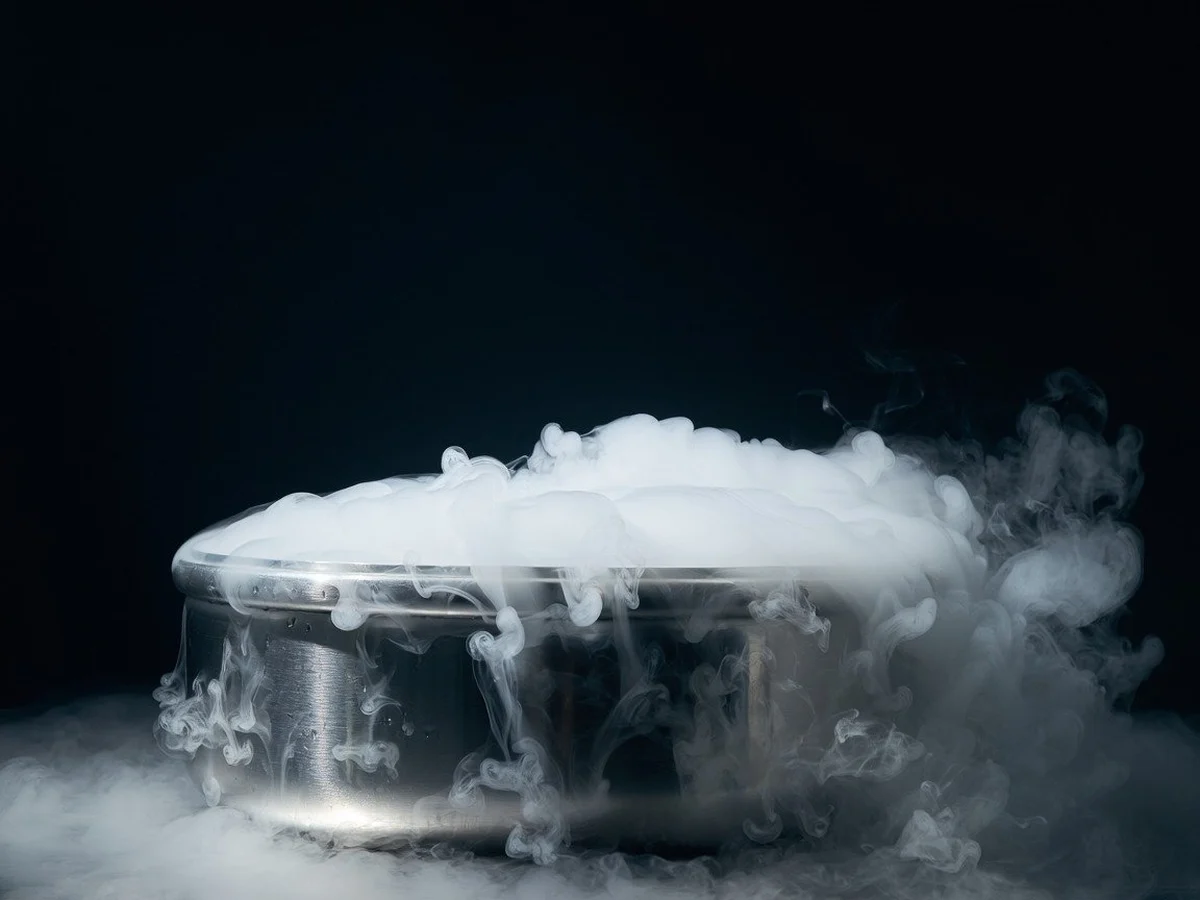
Very low temperatures are not just a laboratory curiosity. Hospital MRI scanners use superconducting magnets cooled by liquid helium to about 4 kelvin. Liquid nitrogen, at about 77 kelvin, is used to freeze biological samples and in some food processing. Quantum computers rely on dilution refrigerators to protect their fragile quantum bits from heat. Space telescopes such as the James Webb Space Telescope keep their instruments extremely cold so their own heat does not swamp faint signals from the distant universe.
Fahrenheit and Celsius
In everyday units, absolute zero is minus 273.15 °C or minus 459.67 °F. The American physicist William Rankine also proposed a scale starting at absolute zero, using Fahrenheit-sized steps, and it is still used by some engineers. But the kelvin is the official international unit of temperature, and since 2019 it has been defined using a fixed value of the Boltzmann constant rather than the properties of water.
The coldest natural place
The coldest known natural place in the universe is the Boomerang Nebula, a cloud of gas around a dying star about 5,000 light years away. Gas flowing out of it has expanded and cooled to about 1 kelvin, colder even than the background radiation of space. On Earth, the coldest naturally recorded air temperatures, in Antarctica, are around minus 89 °C, still far above absolute zero. Only careful human engineering gets truly close to the bottom of the scale.
Sources & further reading
Figures are approximate; record temperatures are reported by individual research teams. Photograph: original AI-generated illustration (Adobe Firefly). Reference organisations do not endorse this website.