The basic problem
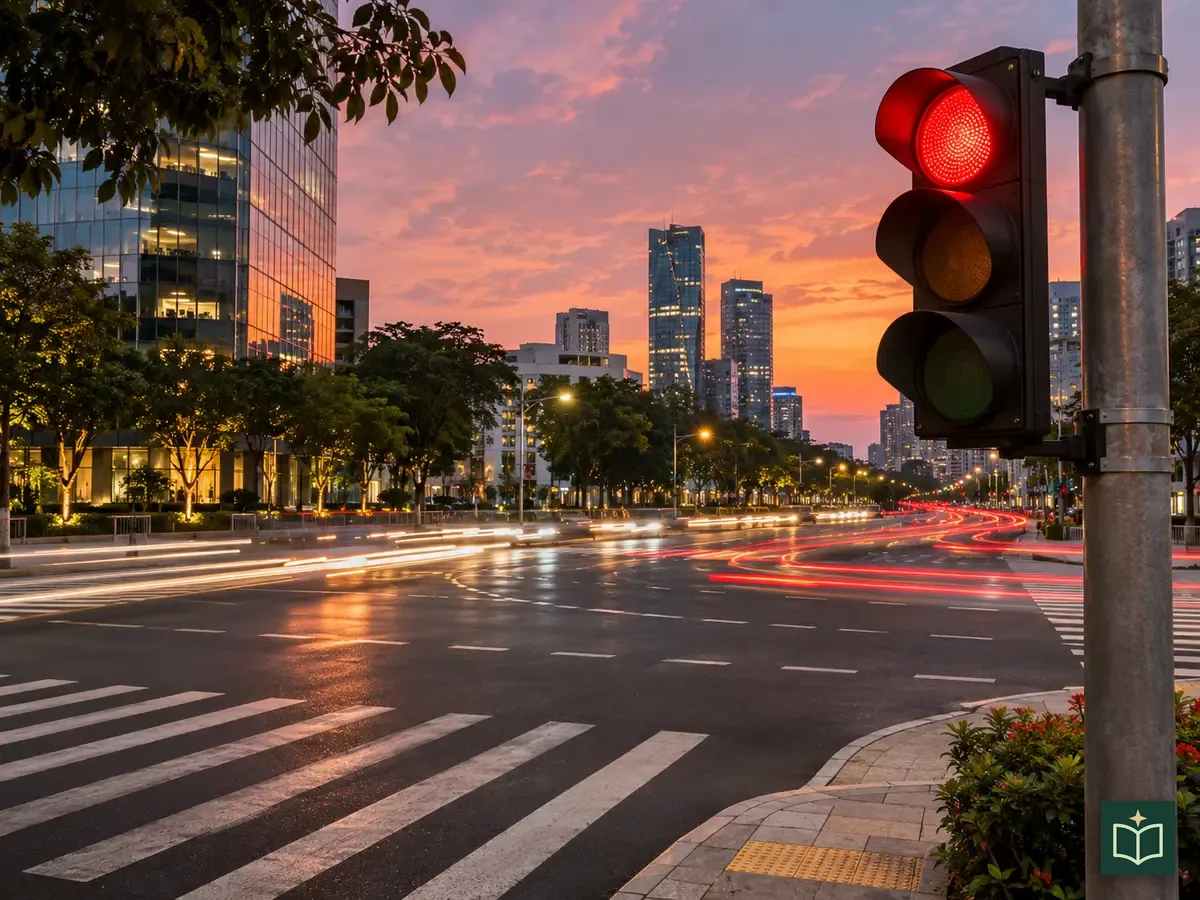
A junction is a shared space that conflicting movements cannot use at the same time. A traffic signal solves this by giving each group of movements, called a phase, its turn. The full rotation through every phase is a cycle, typically lasting between one and two minutes at busy junctions. Each phase receives a slice of green time, followed by amber and an all-red clearance interval, which lets the last vehicles leave the junction before crossing traffic starts. Engineers set minimum greens so that pedestrians can cross and drivers are not surprised, and maximum greens so that no direction waits indefinitely. Everything else is a negotiation over how to spend the remaining seconds.
How lights sense traffic
Many junctions are actuated, meaning they respond to traffic rather than running a fixed timetable. The classic detector is an inductive loop: a coil of wire cut into the road surface whose magnetic field changes when a metal vehicle passes over it. Cameras with video analytics, microwave radar and thermal sensors now do similar jobs without digging up the road. Pedestrian push buttons register people waiting to cross. When no car is waiting on a side road, the controller can keep the main road green; when demand appears, it schedules the side road’s turn. This is why some lights seem to change the moment you arrive, and others make you wait.
Green waves and adaptive control
Along a busy avenue, junctions are often coordinated so that a group of vehicles travelling near the speed limit meets a series of greens, known as a green wave. This requires all controllers to share a common cycle length and precise offsets in timing. Adaptive systems go further. Platforms such as SCOOT, developed in the United Kingdom, and SCATS, developed in Sydney, adjust cycle lengths, splits and offsets every few minutes using live detector data. A central traffic control centre watches the network on screens, can override timings during incidents or major events, and can give priority to buses, trams or emergency vehicles approaching a junction.
A short history
London installed the first traffic signal in 1868, a gas-lit, police-operated semaphore near Parliament that exploded the following winter, injuring its operator. Electric signals appeared in Cleveland, Ohio, in 1914, and the three-colour red, amber and green arrangement spread during the 1920s. Early signals were manually switched or ran on clockwork timers. Vehicle detection arrived in the following decades, and computer-controlled area systems in the 1960s and 1970s. Today, rapidly growing cities across the Gulf manage large signal networks from central control rooms, combining wide multi-lane junctions, pedestrian crossings and red-light cameras that help enforce the rules automatically, around the clock and in all weathers.
Limits and misconceptions
Signals cannot create road capacity. When more vehicles arrive than a junction can pass during its green time, queues grow whatever the timing. Clever control can delay that point and share the pain more fairly, but it cannot eliminate congestion caused by sheer demand. Pressing a pedestrian button repeatedly does not speed things up; one press registers the request. Longer cycles can increase capacity but also lengthen waits and tempt people to cross on red. Safety studies show that the all-red interval and well-timed amber are crucial: cutting them to squeeze in more vehicles tends to increase dangerous right-angle collisions.
What to watch
Connected vehicles and smartphones are beginning to share speed and position data that could help signals anticipate traffic rather than react to it. Some cities test systems that tell drivers the speed needed to meet the next green, reducing harsh braking and fuel use. Others prioritise buses, cyclists and pedestrians to encourage walking and public transport. Automated vehicles may eventually negotiate junctions with less need for lights at all, but that remains a distant prospect in mixed traffic. For now, the humble controller in a grey roadside cabinet remains one of the most effective, and least noticed, pieces of urban infrastructure.
Sources & further reading
Figures are rounded and widely published; check the linked organisations for the latest editions. These organisations do not endorse this website.