What counts as a tornado
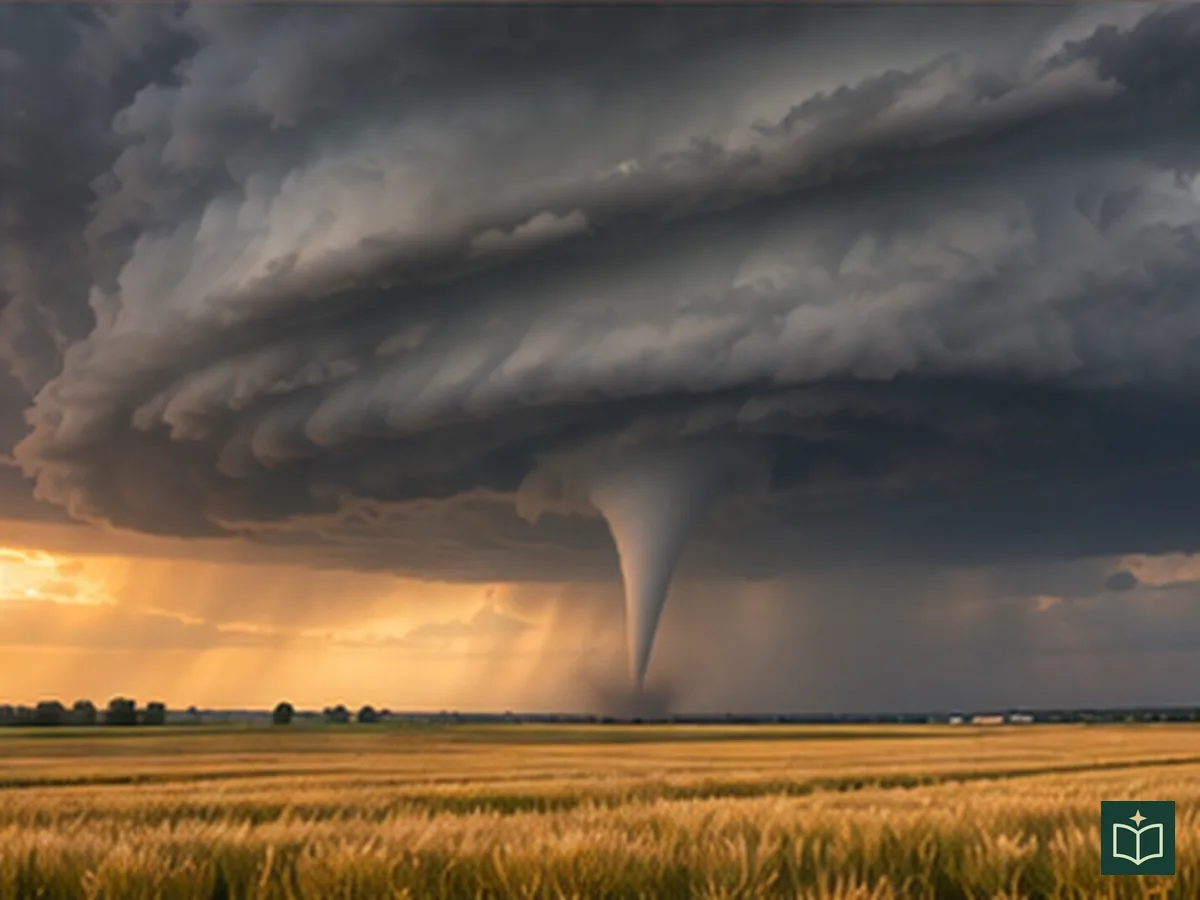
A tornado is a violently rotating column of air that is in contact with both the ground and the base of a thunderstorm cloud. The visible funnel is condensation and debris; the dangerous winds can extend beyond it. Most tornadoes last only minutes and are a few tens to a few hundred metres wide, but the strongest have winds above 300 kilometres an hour and tracks tens of kilometres long. A dust devil, the spinning column seen over hot desert ground on a calm day, is a different thing: it grows upwards from heated air near the surface and is not attached to a storm cloud.
The ingredients
Forecasters look for four ingredients together. Warm, moist air near the ground provides fuel. Cooler, drier air above makes the atmosphere unstable, so rising air keeps accelerating. Something must lift the air to start a storm, such as a cold front. The fourth, and the one that makes tornadoes possible, is wind shear: winds that change in speed and direction with height. Shear sets the lower atmosphere rolling like a pencil between two hands. When a strong updraft rises through that rolling air, it tilts the spin upright, and the storm begins to rotate as a whole. Without shear, storms tend to rain themselves out without rotating.
Inside a supercell
A thunderstorm with a long-lived rotating updraft is called a supercell, and it produces most strong tornadoes. Its rotation, known as a mesocyclone, can be several kilometres wide and sits in the middle of the cloud. Only a minority of supercells go on to produce tornadoes, and exactly why some do remains an active research question. A leading idea is that a downdraft at the back of the storm wraps around the mesocyclone, and air drawn into the updraft is stretched vertically. Like a skater pulling in their arms, the narrowing column spins faster until a tornado touches down beneath it.
Why Tornado Alley
The central United States brings the ingredients together better than anywhere else. In spring, moist air flows north from the Gulf of Mexico at low levels. Above it, hot, dry air arrives from the high deserts of the south-west and Mexico, while the jet stream crossing the Rocky Mountains adds strong winds aloft. With no east–west mountain range to keep these air masses apart, they meet over a broad, flat plain. Similar setups occur in Argentina, Bangladesh and parts of Europe, but less often. Canada usually ranks second for numbers, and Bangladesh has suffered some of the deadliest tornadoes on record.
Rating and warning
Tornado winds are rarely measured directly, so they are rated after the event by the damage they leave. The United States uses the Enhanced Fujita scale, from EF0 to EF5, introduced in 2007 to replace the original Fujita scale. Warnings rely on Doppler radar, which can detect rotation inside a storm and sometimes the debris a tornado lifts. Lead times are typically measured in minutes rather than hours, so forecasters first issue broader watches when conditions are favourable. Popular advice to open windows to equalise pressure is a myth; sheltering low in an interior room away from windows is what saves lives.
Limits and what to watch
Counts are harder to compare than they look. Better radar, more storm spotters and smartphone video have lifted the number of weak tornadoes reported since the mid-twentieth century, while the number of strong ones has not risen in the same way. Researchers have noted a shift in recent decades towards more tornado activity in the south-eastern United States, where forests, hills and night-time storms make tornadoes harder to see. In the Gulf, tornadoes are rare; waterspouts over the sea and dust devils inland are more familiar, and neither usually reaches the strength of a Great Plains tornado. Climate scientists are still studying how warming will change tornado frequency.
Sources & further reading
- NOAA Storm Prediction Center · Tornado FAQ ↗
- NOAA NSSL · Severe Weather 101: Tornadoes ↗
- Britannica · Tornado ↗
Figures are rounded and widely published; check the linked organisations for the latest editions. These organisations do not endorse this website.