Two ways to make a city
Every city's streets follow one of two broad logics. Organic patterns grow from the bottom up: paths between houses, wells and markets harden into lanes, and each new building adjusts to what is already there, to the slope of the land and to rights of way. Planned patterns are drawn from the top down by a ruler, colonial power or municipal government before most building begins. The grid is the most common planned form, and it is ancient. Mohenjo-daro in the Indus Valley had straight streets more than 4,000 years ago, and Greek and Roman planners laid out colonies and military camps on rectangular plans.
The medina of Fez
Fez el-Bali, the old city of Fez in Morocco, founded in the ninth century, is one of the largest car-free urban areas in the world and a UNESCO World Heritage site. Its lanes twist, narrow and end in dead-end alleys. The pattern made sense for the way people lived. Narrow, winding streets keep out the sun and wind, staying cool in summer. Dead ends give families privacy, while main routes link gates, mosques and markets. Trades cluster in their own quarters. Goods still move by handcart and donkey. To a visitor the medina feels like a maze; to residents it is a closely ordered neighbourhood.
Manhattan's grid
In 1811 New York's Commissioners' Plan laid a grid of numbered streets and long avenues across Manhattan, most of it then farmland and hills. The commissioners argued that straight-sided, right-angled houses were the cheapest to build and the most convenient to live in. The grid made land easy to survey, sell and develop, and it largely ignored the island's terrain, which was flattened over time. It also offered little public open space; Central Park was carved out decades later, from the 1850s. Today the grid makes the city easy to navigate, with addresses that hint at location, and it channels traffic predictably.
Barcelona's Eixample
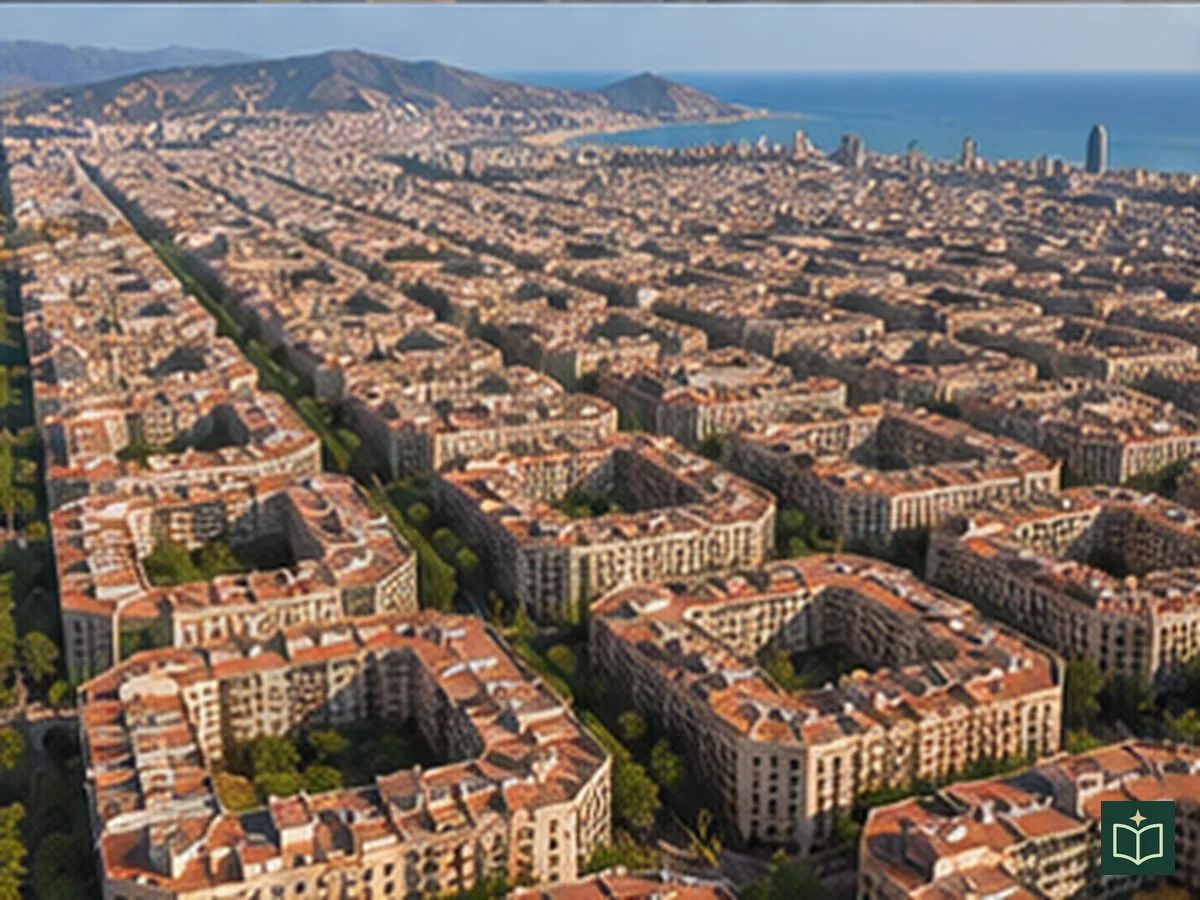
When Barcelona's medieval walls came down in the mid-nineteenth century, the engineer Ildefons Cerdà designed an expansion, the Eixample, approved in 1859. Its blocks are roughly 113 metres square with their corners cut off, creating small octagonal plazas at junctions that improve sight lines and give room for turning vehicles. Cerdà intended blocks built on only two or three sides, with gardens in the middle, for light and ventilation. Over time most were built up on all four sides. The city has since begun turning groups of blocks into pedestrian-priority superblocks, an attempt to recover some of the space and calm the original plan promised.
Trade-offs
Neither pattern is simply better. Grids are easy to navigate, extend and supply with pipes and transport, and they divide land fairly for sale. But on hilly sites they produce very steep streets, and long straight avenues can funnel wind and expose walkers to sun. Organic layouts suit pedestrians, shade and close-knit communities, but they are hard for cars, delivery lorries and fire engines, and difficult to modernise. Many Gulf cities show both. Old quarters such as Al Fahidi in Dubai preserve narrow lanes between courtyard houses, while Abu Dhabi's centre was laid out from the 1960s on a broad grid of large blocks.
Reading a city map
A city's plan reveals its history. A tangle at the centre surrounded by straighter streets usually means an old core with later planned expansions. Sudden changes in grid direction often mark old field boundaries, rivers or the edges of separate land grants. Ring roads frequently follow the line of demolished walls, as in Vienna and Barcelona. Planners today rarely choose a pure grid or pure organic pattern. Instead they borrow from both: connected, walkable streets that are easy to navigate, combined with shade, varied building lines and small public spaces that make the older cities pleasant to walk through. Each approach answers the same question differently: who the street is for.
Sources & further reading
Figures are rounded and widely published; check the linked organisations for the latest editions. These organisations do not endorse this website.