What al-Andalus was
Al-Andalus was the Arabic name for the parts of the Iberian Peninsula under Muslim rule, beginning with the arrival of Arab and Berber forces in 711. Its borders shifted constantly over nearly eight centuries, shrinking as Christian kingdoms in the north expanded. At its height it covered most of modern Spain and Portugal. Córdoba, on the Guadalquivir river, became its capital. The city had been a Roman provincial centre, and the new rulers built on that inheritance: a fertile river valley, an old bridge and roads, and a location that commanded the agricultural wealth of the south. Arabic became the language of government and learning, while Christians and Jews lived alongside Muslims as protected communities paying a special tax.
From exile to caliphate
The city's rise began with a dramatic escape. In 750 the Umayyad dynasty of Damascus was overthrown by the Abbasids, and most of the family was killed. One young prince, Abd al-Rahman, fled across North Africa and in 756 established himself as emir in Córdoba. His dynasty ruled for more than 250 years. In 929 Abd al-Rahman III went further and declared himself caliph, a title claiming leadership of the Muslim community. It was partly a statement against the Fatimids, a rival caliphate across the Mediterranean. The claim came with real power: he subdued rebellious provinces, rebuilt the navy and ran a centralised administration. Córdoba became a diplomatic capital, receiving embassies from Byzantium and the German emperor.
A city with services
Chroniclers describe Córdoba as a city of paved streets, public baths, markets and suburbs spreading along the river. Some writers mention lamps lighting the main streets at night, something most European towns lacked for centuries. Water was brought from the Sierra Morena hills through channels and pipes to fountains, gardens and the palace. Population figures from the period are unreliable, and modern estimates range widely, but historians agree it was among the largest cities in Europe. Three miles west, Abd al-Rahman III began building Madinat al-Zahra from 936, a palace-city of terraces, halls and administrative offices. It was looted and largely destroyed during the civil wars of the early eleventh century.
Libraries and learning
Córdoba's reputation rested above all on books. Al-Hakam II, who ruled from 961 to 976, assembled a royal library that later sources say held around 400,000 volumes; the figure is probably exaggerated, but it reflects a real passion for collecting. Agents bought manuscripts in Baghdad, Cairo and Damascus, and copyists, many of them women, produced books in large numbers. Scholars worked on medicine, astronomy, mathematics, botany and law. The physician al-Zahrawi practised nearby and wrote a celebrated medical encyclopaedia. Paper made locally from the tenth century helped. Later, Córdoba produced the philosopher Ibn Rushd, known in Europe as Averroes, and the Jewish thinker Maimonides, both born in the twelfth century.
The Great Mosque
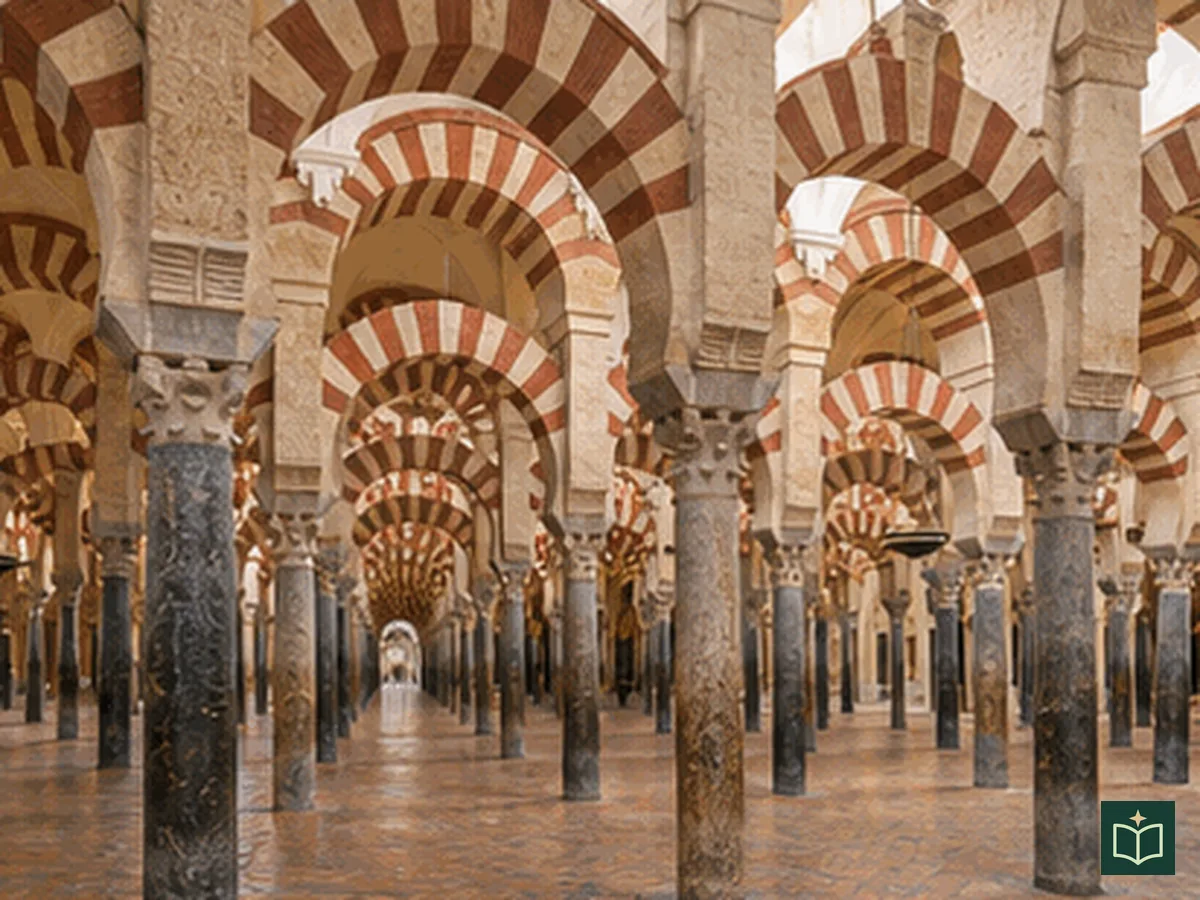
The building most closely tied to the city's golden age still stands. The Great Mosque was begun in 785 on the site of a church and enlarged several times over the next two centuries. Its prayer hall is a forest of more than 800 columns, many reused from Roman and Visigothic buildings, supporting double arches striped in red brick and pale stone. Al-Hakam II added a richly decorated mihrab covered in gold and glass mosaic made with help from Byzantine craftsmen. After Castile captured Córdoba in 1236 the mosque became a cathedral, and in the sixteenth century a Renaissance nave was inserted into its centre. The historic centre is a UNESCO World Heritage Site.
Myths and the fall
Córdoba is often described as a perfect model of religious harmony. The reality was more complex: non-Muslims had protected but unequal status, and there were periods of tension as well as cooperation. The caliphate itself proved fragile. After the death of the powerful chamberlain al-Mansur's son in 1008, rival factions fought a civil war known as the fitna, and the caliphate was formally abolished in 1031. Al-Andalus splintered into dozens of small kingdoms, the taifas. Several of them were rich and cultured, but they were militarily weak. Córdoba never regained its political role, and Christian forces took it in 1236, leaving Granada as the last Muslim kingdom on the peninsula.
Sources & further reading
Figures are rounded and widely published; check the linked organisations for the latest editions. These organisations do not endorse this website.