A grief made permanent
In 1631 Mumtaz Mahal, the favoured wife of the Mughal emperor Shah Jahan, died in Burhanpur after giving birth to their fourteenth child. The emperor resolved to build her a tomb in his capital, Agra, on a site beside the Yamuna River. Work began around 1632. Contemporary chronicles describe the project as an expression of devotion, but it was also a statement of imperial power at the height of Mughal wealth. Shah Jahan was a dedicated builder, later responsible for the Red Fort and the Jama Masjid in Delhi. The name Taj Mahal is usually understood as “crown of the palace”, possibly echoing Mumtaz Mahal’s own title.
Who built it
Records name many contributors. The chief architect is generally believed to have been Ustad Ahmad Lahauri, working within a court tradition of design. Labour came from across the empire and beyond, with tradition putting the workforce at about 20,000 people, including masons, stonecutters, inlayers, carvers, painters and calligraphers. The leading calligrapher, Amanat Khan, signed his work, an unusual honour. Builders used brick for the core structure and faced it with white marble quarried at Makrana in Rajasthan, more than 300 kilometres away, and red sandstone from quarries nearer Agra. Long ramps, scaffolding and animals, including elephants and oxen, moved the heavy blocks into place.
Designed around a garden
The Taj Mahal is a complete planned complex, not just a tomb. A grand gateway opens into a large walled garden in the Persian charbagh style, divided into four parts by raised water channels and walkways, with a central pool that reflects the building. Unusually, the tomb stands not in the centre of the garden but at its far end, on a raised platform overlooking the river. On either side are two red sandstone buildings: a mosque to the west and an identical building to the east, added largely for symmetry. Across the river lies another garden, Mehtab Bagh, aligned with the tomb, from which it can be viewed by moonlight.
Marble, stone and script
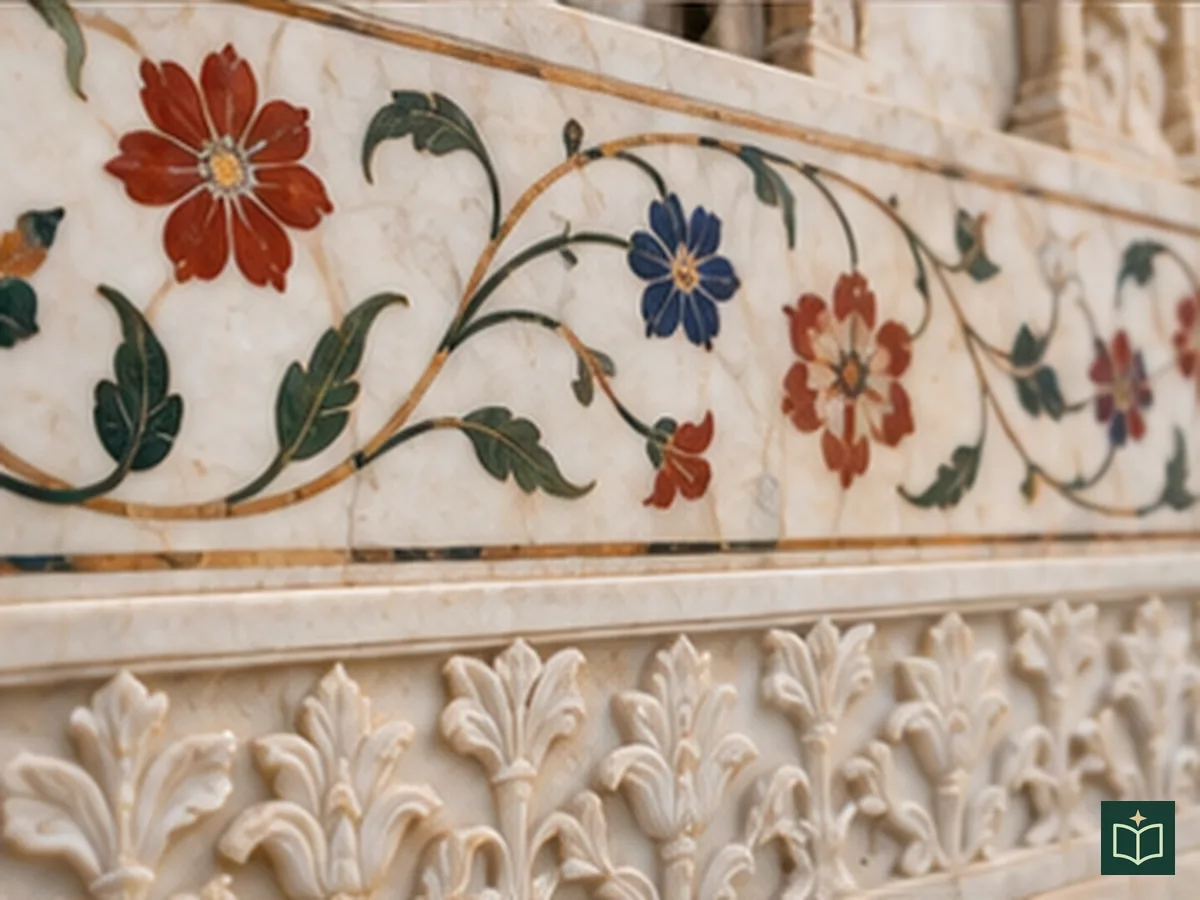
Up close, the surface is richly decorated. Craftsmen used a technique known in India as parchin kari, related to Italian pietra dura, cutting thin pieces of coloured stone such as jasper, jade, carnelian and lapis lazuli and fitting them precisely into carved recesses in the marble to form flowers and vines. Carved low-relief plants line the lower walls. Around the arches, black stone inlay spells out verses from the Quran. The letters grow larger towards the top so that, seen from below, they appear evenly sized, a careful optical adjustment. Inside, cenotaphs of Mumtaz Mahal and Shah Jahan lie within a carved marble screen, while their actual graves are in a crypt below.
Proportion and illusion
Much of the Taj Mahal’s effect comes from proportion and symmetry. The main tomb is the same on all four sides, with a large central arch and smaller arches, crowned by a bulbous double dome rising to about 73 metres. Four minarets stand at the corners of the platform, each built leaning very slightly outwards, a precaution often explained as protecting the tomb if one were to fall. The white marble changes colour through the day, warm at dawn and sunset and cool at noon. The only break in symmetry is Shah Jahan’s cenotaph, placed beside his wife’s after his death in 1666, as the original plan centred on hers alone.
Protecting the monument
UNESCO listed the Taj Mahal as a World Heritage Site in 1983, calling it the jewel of Muslim art in India. Its fame now brings millions of visitors each year, along with challenges. Air pollution has tinged the marble yellow and brown, and conservators periodically apply a clay pack that absorbs dirt. India’s Supreme Court created a protected zone around the monument, restricting polluting industries and vehicles nearby. Engineers also monitor the riverbank, as changes in the Yamuna’s flow and groundwater could affect the foundations, which rest on wells filled with masonry and timber. Preserving it requires constant care, much as building it once required the skills of an entire empire.
Sources & further reading
Figures are rounded and widely published; check the linked organisations for the latest editions. These organisations do not endorse this website.