A continent between continents
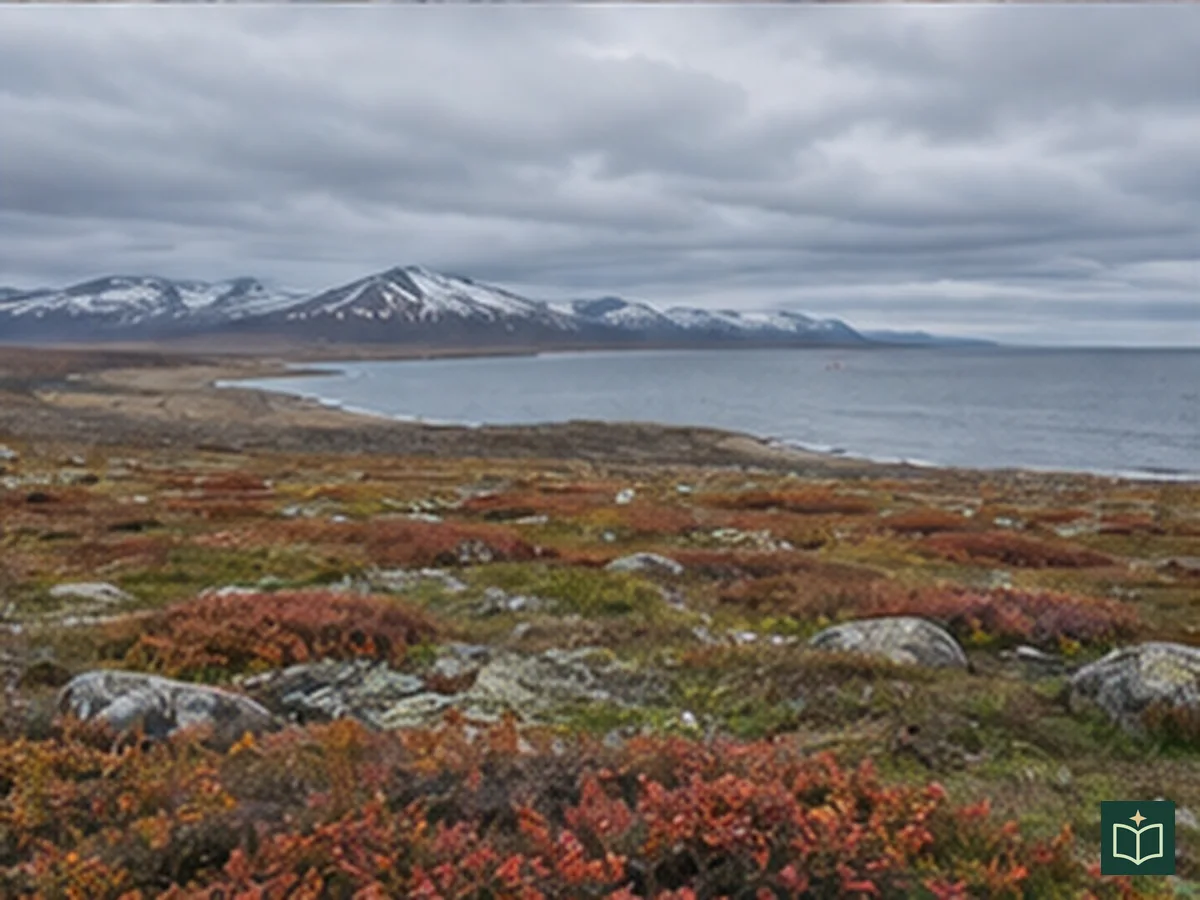
Today Siberia and Alaska are separated by the Bering Strait, about 82 kilometres wide and in places only around 50 metres deep. During the last Ice Age, so much water was stored in ice sheets that sea level fell by roughly 120 metres. The shallow sea floor between Asia and North America became a broad plain known as Beringia, which at its widest stretched about 1,000 kilometres from north to south. It was not a narrow bridge but a vast, cold, dry steppe of grasses and shrubs, home to mammoths, horses, bison and caribou. Much of it escaped the ice sheets because the climate was too dry for glaciers to form.
People reach the far north
Humans were in the Arctic surprisingly early. At the Yana site in north-east Siberia, people were hunting mammoths about 32,000 years ago, well above the Arctic Circle. Genetic studies show that Native Americans descend mainly from a population formed by a mixture of East Asian ancestors and a group known as Ancient North Eurasians, represented by a boy buried at Mal’ta, near Lake Baikal, about 24,000 years ago. Some time after this mixture, the ancestors of Native Americans became genetically separate from other Asian populations. Many researchers think this happened in or near Beringia, where they could survive the coldest phase of the Ice Age.
The Beringian standstill
The genetic evidence suggests that the founding population stayed isolated for several thousand years before moving south, an idea known as the Beringian standstill. During that time they developed distinctive genetic variants shared by Native American peoples today. Southward movement was blocked by two great ice sheets covering Canada: the Cordilleran in the west and the Laurentide in the centre and east. Exactly where the population waited, and for how long, is debated, since much of the evidence lies on drowned land now under the Bering and Chukchi seas. Bluefish Caves in the Yukon, where cut-marked animal bones are around 24,000 years old, may record an early presence.
Coasts and corridors
Two main routes south have been proposed. One followed an ice-free corridor that opened between the two ice sheets east of the Rocky Mountains, but studies suggest it became habitable, with plants and animals, only around 13,000 years ago. The other followed the Pacific coast, where retreating glaciers exposed land and islands earlier, perhaps by about 16,000 years ago. Coastal migrants could have used boats and lived on fish, seabirds, shellfish and kelp-forest resources, an idea sometimes called the kelp highway. Because sea levels have since risen, many early coastal camps are now underwater, which makes this route hard to prove, but many researchers now favour it for the earliest arrivals.
Older than once thought
For much of the twentieth century, the Clovis culture, known for its fluted stone spear points and dated to about 13,000 years ago, was considered the first in the Americas. That view has been overturned. At Monte Verde, in southern Chile, people lived about 14,500 years ago, far to the south. Sites at Paisley Caves in Oregon and Cooper’s Ferry in Idaho push dates back to roughly 14,000 to 16,000 years ago. Most strikingly, footprints at White Sands in New Mexico have been dated to around 21,000 to 23,000 years ago. That date is debated, but if it holds, people crossed into the Americas before the ice sheets reached their maximum.
When the bridge disappeared
As the Ice Age ended, melting ice raised sea levels again, and Beringia flooded. The land connection was cut roughly 11,000 years ago, separating the peoples of the Americas from Asia, apart from later movements by Arctic groups such as the ancestors of the Inuit, who arrived by boat and over ice in the last few thousand years. The peopling of the Americas remains one of archaeology’s liveliest debates, with new dates and genetic results regularly revising the picture. Part of Beringia is now protected as the Bering Land Bridge National Preserve in Alaska, a reminder that this lost landscape once linked two continents and their histories.
Sources & further reading
Figures are rounded and widely published; check the linked organisations for the latest editions. These organisations do not endorse this website.