A mountain of stone
Borobudur rises from the Kedu Plain in Central Java, Indonesia, ringed by volcanoes. It was built around the late eighth and early ninth centuries, probably between about 780 and 830, under the Sailendra dynasty, which supported Mahayana Buddhism. Rather than a building with rooms, it is a stepped monument wrapped around a natural hill. Nine stacked platforms rise in turn: six square terraces topped by three circular ones, crowned by a large central stupa, a dome-shaped Buddhist monument. Construction used grey volcanic andesite, cut and fitted without mortar, with an internal drainage system to cope with tropical rain. Seen from above, the whole plan forms a mandala, a sacred diagram of the universe.
Three worlds, one ascent
The levels follow Buddhist cosmology. The base represents Kamadhatu, the world of desire. Its 160 panels show cause and effect, with scenes of good and bad deeds and their consequences. Most of these were covered by an extra stone platform during construction, probably to stabilise the structure, and a few panels at one corner are now exposed for viewing. The square galleries above represent Rupadhatu, the world of form, where people have overcome desire but remain bound by form. The circular terraces at the top represent Arupadhatu, formlessness. Here the walls disappear and pilgrims emerge into open air with wide views, a physical sense of release.
Reading the reliefs
On the square terraces, pilgrims walk clockwise along narrow galleries lined with carved panels on both sides. Read in sequence, they tell several texts. One, the Lalitavistara, follows the life of the historical Buddha from his birth to his first sermon. Others illustrate Jataka tales of his earlier lives and stories of virtuous deeds. The longest narrative follows Sudhana, a young pilgrim who visits many teachers in his search for wisdom, mirroring the visitor’s own journey. The panels also preserve details of daily life in ancient Java: houses, ships with outriggers, musical instruments, clothing and markets. Completing every gallery means walking several kilometres around the monument.
Buddhas behind lattice
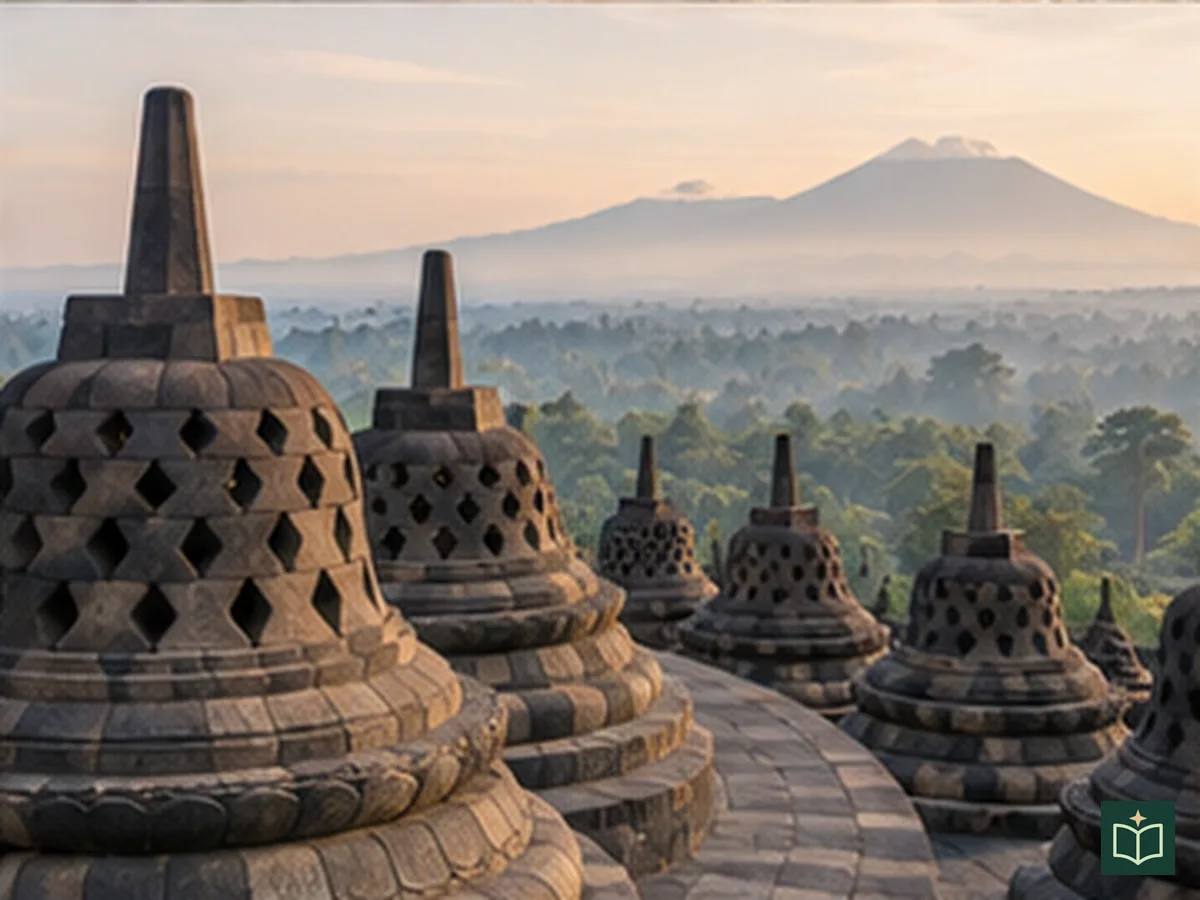
Borobudur holds 504 Buddha statues. Many sit in niches along the square terraces, facing outwards, with different hand gestures on each side according to direction. On the three circular terraces stand 72 bell-shaped stupas made of stone lattice, each containing a seated Buddha partly visible through diamond-shaped or square openings. The large central stupa at the summit is closed. The partly hidden figures create a sense of moving from the visible world towards something beyond sight. Together the panels and statues number in the thousands: 2,672 carved panels, of which 1,460 are narrative and 1,212 decorative, making Borobudur one of the largest collections of Buddhist relief sculpture anywhere.
Lost and restored
After about the tenth century, as the centre of power on Java shifted eastwards and Islam later spread, Borobudur fell out of use. Volcanic ash and vegetation covered much of it. In 1814, during the British administration of Java, Thomas Stamford Raffles heard reports of the site and sent an engineer to investigate, beginning its rediscovery. A first restoration took place between 1907 and 1911 under the Dutch engineer Theodoor van Erp. Water damage continued, and a major restoration supported by UNESCO between 1975 and 1982 dismantled the lower terraces stone by stone, installed new drainage and waterproofing, and rebuilt them. UNESCO inscribed the temple compounds as a World Heritage Site in 1991.
A living site
Borobudur is Indonesia’s most visited historic monument and remains a place of worship. Each year Buddhists from Indonesia and abroad gather for the Vesak festival, walking in procession between the smaller temples of Mendut and Pawon and Borobudur itself, which together form the protected complex. The monument faces modern pressures: crowds wear the stone steps, and the eruption of nearby Mount Merapi in 2010 coated it in ash that had to be cleaned from every surface. Authorities now limit the number of people allowed onto the upper terraces. The challenge is to keep the monument accessible as a journey to be walked while protecting the carvings that make that journey meaningful.
Sources & further reading
Figures are rounded and widely published; check the linked organisations for the latest editions. These organisations do not endorse this website.