An unusual moon
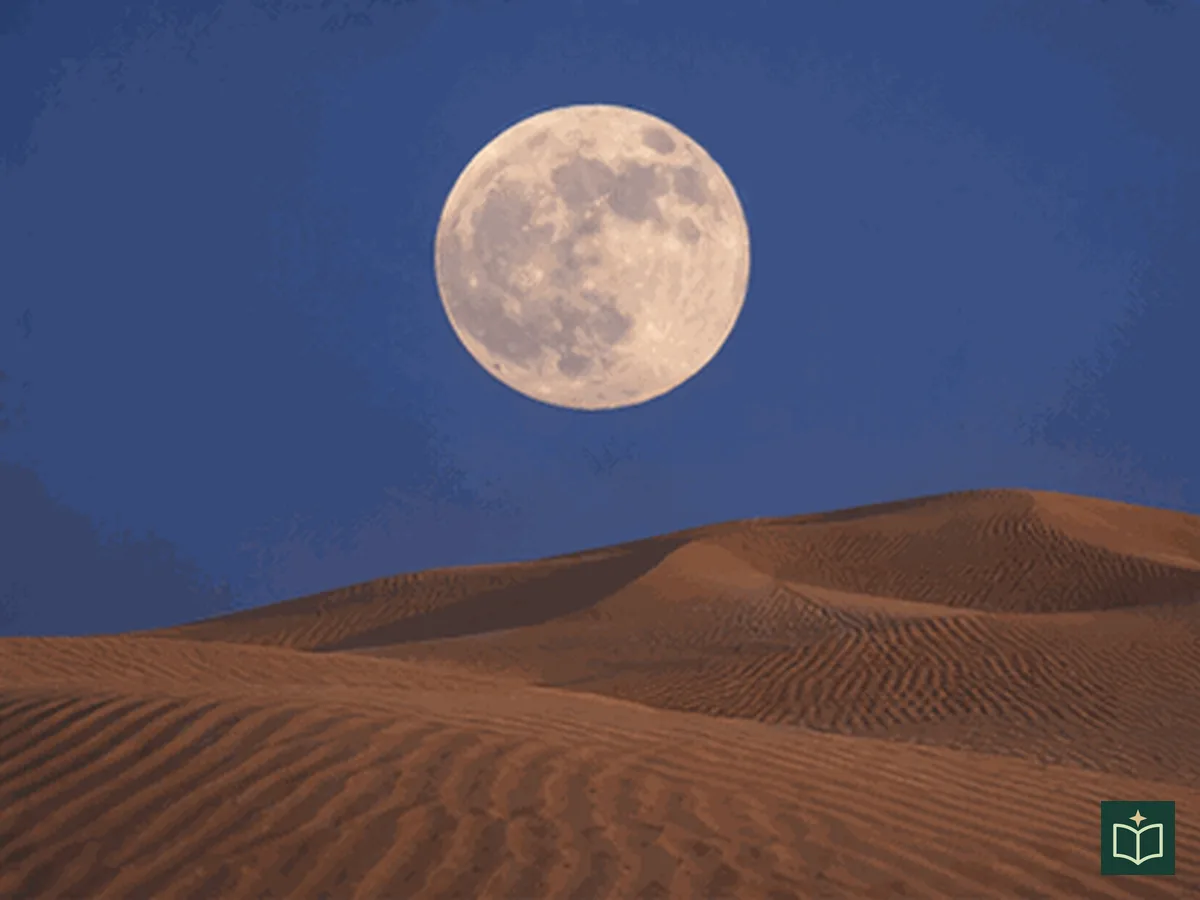
Our Moon is strange by solar-system standards. It is more than a quarter of Earth's width, very large compared with its planet, and it is much less dense than Earth, about 3.3 grams per cubic centimetre against Earth's 5.5. That points to a small iron core and a body made mostly of rocky material. Any theory of its origin has to explain those facts. Before the Apollo missions, scientists debated three main ideas: that the Moon split off a fast-spinning Earth, that it formed alongside Earth from the same cloud, or that Earth captured a passing body. Each struggled with the numbers, especially the Moon's chemistry and the amount of spin in the Earth-Moon system.
The giant-impact idea
In the mid-1970s two research teams independently proposed a different answer. Early in the solar system's history, perhaps 4.5 billion years ago, a body about the size of Mars, now often called Theia, collided with the young Earth at a glancing angle. The impact melted much of both bodies. Their iron cores largely merged into Earth, while a vast amount of rocky material from the outer layers was blasted into orbit as a ring of vapour and molten rock. Computer simulations suggest this debris could have gathered into a moon very quickly, possibly in years to centuries. A collision of that kind naturally explains why the Moon is rocky and short of iron.
What the Apollo rocks revealed
Between 1969 and 1972, six Apollo crews brought back about 382 kilograms of lunar rock and soil. Those samples transformed the debate. The light-coloured rocks of the lunar highlands turned out to be rich in anorthosite, a mineral that floats to the top of a cooling ocean of molten rock. That suggested the young Moon had been covered by a deep magma ocean, which fits the heat of a giant impact. The samples were also strikingly dry and depleted in elements that evaporate easily, as expected for material that had been vaporised. Crucially, their oxygen isotopes, a chemical fingerprint that differs between bodies in the solar system, are almost identical to Earth's.
A puzzle within the answer
That isotopic match is both evidence and a problem. Simple simulations predicted that most of the Moon should be made of Theia, not Earth, so it should carry Theia's chemical fingerprint. Instead, the Moon looks like Earth's twin in several isotope systems. Scientists have proposed several fixes. Perhaps Theia formed close to Earth and had a similar make-up. Perhaps the impact was more energetic than first assumed, thoroughly mixing the two bodies. One idea describes a spinning, doughnut-shaped cloud of vaporised rock, called a synestia, from which the Moon condensed. The giant impact remains the leading explanation, but the precise details of that collision are still actively researched.
Why the Moon is drifting away
The Moon raises tides in Earth's oceans. Because Earth spins faster than the Moon orbits, the tidal bulges are carried slightly ahead of the Moon. Their gravity tugs the Moon forward, adding energy to its orbit and lifting it gradually outward. At the same time, the friction of the tides slows Earth's rotation, lengthening the day by roughly two thousandths of a second per century. The drift is measured precisely. Apollo astronauts left mirror-like reflectors on the surface, and observatories fire lasers at them and time the returning light. The results show the Moon receding by about 3.8 centimetres a year, roughly the rate a fingernail grows.
What it means for Earth
The Moon now sits about 384,400 kilometres away on average, and it was far closer when it formed. Fossil growth bands in ancient corals and tidal sediments suggest that hundreds of millions of years ago a day lasted only around 22 hours. The Moon's presence matters beyond tides. Its gravity helps steady the tilt of Earth's axis, which in turn keeps seasons relatively stable over long periods. Total solar eclipses are a temporary coincidence: the Moon currently appears almost exactly the same size as the Sun in our sky. As it continues to drift away, in the far future it will appear too small to cover the Sun completely.
Sources & further reading
Figures are rounded and widely published; check the linked organisations for the latest editions. These organisations do not endorse this website.