Smooth is an illusion
Push a book across a table and it slows and stops. The force responsible is friction, which always acts against sliding. Its origin lies in a fact invisible to the eye: no surface is truly flat. Under a microscope, even polished metal looks like a mountain range. When two surfaces meet, they touch only at the tips of these tiny peaks, called asperities. The real area of contact is usually a small fraction of the apparent area. At those points, atoms come close enough to attract one another and even form brief bonds, while the bumps snag and deform. Sliding requires breaking those contacts, again and again.
The old rules still work
Leonardo da Vinci sketched friction experiments around 1500, and the French scientist Guillaume Amontons published two simple laws in 1699. First, friction is proportional to how hard the surfaces are pressed together. Second, it does not depend on the apparent area of contact. The second law seems odd until you remember the asperities: a heavier load flattens more peaks, increasing real contact, whatever the size of the block. Physicists summarise this with a coefficient of friction, the ratio of friction force to the pressing force. Rubber on dry asphalt has a coefficient around 0.7, steel on ice far lower. These rules are approximate, but remain useful for engineering.
Static and sliding
Starting something moving is harder than keeping it moving. Static friction, which holds a resting object in place, is usually greater than kinetic friction, which acts during sliding. Contacts at rest have time to settle and bond more strongly; once sliding begins, they have less time to form. You feel this when a heavy wardrobe suddenly lurches after a hard push. The difference also explains anti-lock brakes. A tyre that keeps rolling grips the road with static friction at its contact patch, while a locked, skidding wheel switches to weaker kinetic friction and loses steering. Anti-lock systems pulse the brakes to keep wheels just short of skidding.
A worked example: braking
The maximum braking deceleration a car can achieve is roughly the friction coefficient multiplied by the acceleration of gravity, 9.81 metres per second squared. With good tyres on dry asphalt, a coefficient of 0.7 gives about 6.9 metres per second squared. A car travelling at 100 km/h, almost 28 metres per second, therefore needs around 56 metres to stop once the brakes are fully applied. On a wet road, where the coefficient may fall to about 0.4, the distance grows to roughly 98 metres. Driver reaction time adds more. That is why speed limits drop and following distances should grow when rain makes roads slippery, including after rare Gulf downpours.
Friction makes motion possible
Friction is often treated as a nuisance, because it wastes energy as heat and wears out machines. Lubricants help by separating surfaces with a thin film. Yet almost every movement depends on friction. Walking works because your shoe pushes backwards on the ground and static friction pushes you forwards. Car tyres accelerate, brake and corner only through grip at a contact patch about the size of a hand. Nails, screws and knots hold because of friction, and violin bows and matches use it deliberately. On ice, where a thin slippery layer cuts friction, everyday actions suddenly become difficult. Engineers spend as much effort adding grip as removing it.
Tyres on sand
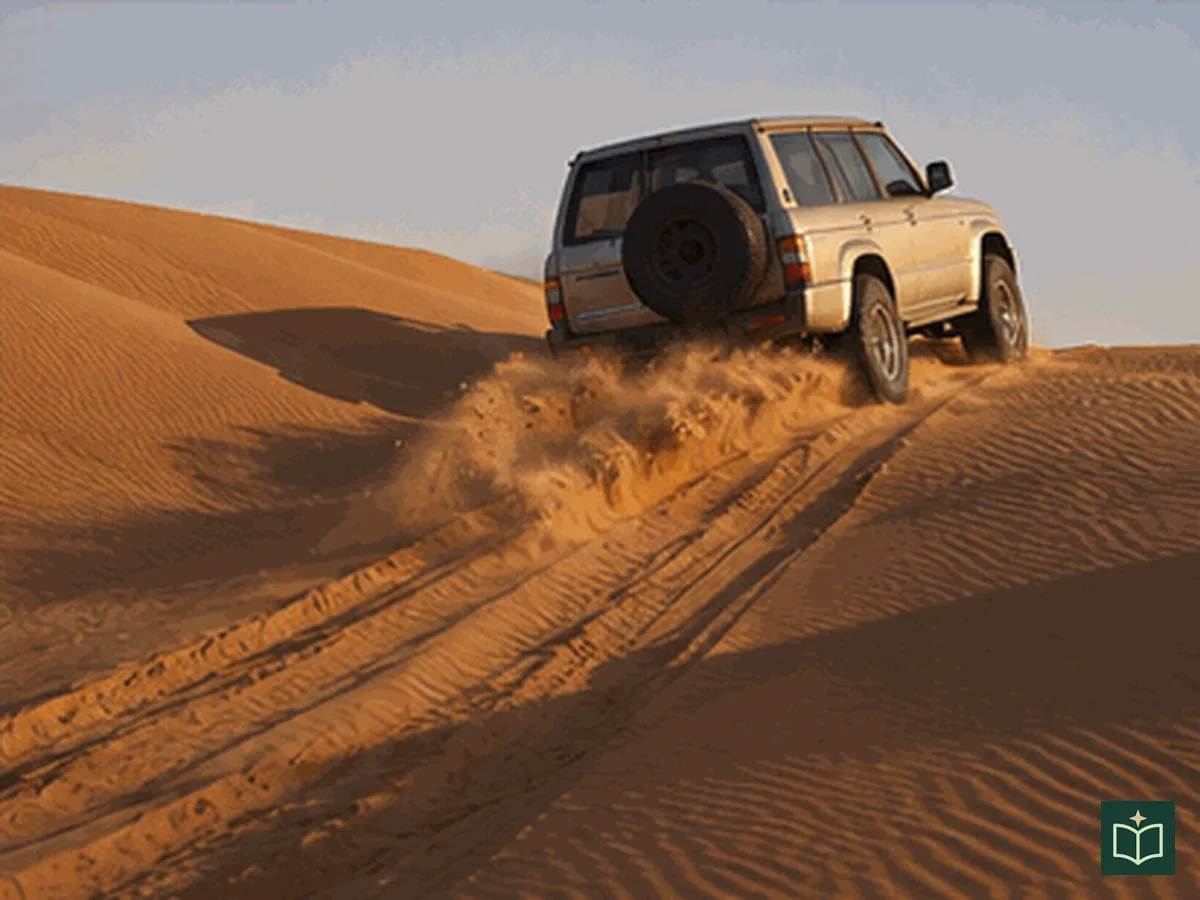
Desert driving shows friction and pressure working together. Sand grains hold a slope only up to an angle of about 30 to 35 degrees, set by friction between grains; steeper dune faces collapse in small avalanches. A car tyre at normal road pressure presses hard on a small patch, digging into loose sand rather than riding over it. Experienced off-road drivers lower tyre pressure so that the tyre flattens and spreads the car's weight over a longer footprint. The sand underneath is compacted less, giving more grip and reducing the tendency to sink. The pressure must be restored before returning to tarmac, where soft tyres overheat and handle poorly.
Sources & further reading
Figures are rounded and widely published; check the linked organisations for the latest editions. These organisations do not endorse this website.