Why wind matters most
For a low building, the main challenge is carrying its own weight to the ground. For a very tall one, wind becomes the dominant force. Wind speed increases with height, and a tower acts like a giant cantilever fixed at the base, so even modest pressure on hundreds of metres of facade creates enormous bending forces at the bottom. Engineers check two separate things. Strength means the structure must survive the strongest winds expected over its lifetime without damage. Serviceability means that in ordinary storms the building must not sway so much that occupants feel uneasy, lifts misbehave or facade panels and partitions crack.
Vortices and resonance
The most troublesome wind effect is often not the direct push but the swirl behind the building. As air flows around a tall block, it peels off alternately from each side, forming vortices that tug the building from side to side across the wind direction. The frequency of this shedding is roughly 0.2 times the wind speed divided by the building's width. For a tower 40 metres wide in a 30-metre-a-second wind, that is about 0.15 cycles a second, or one sway every 6.7 seconds. Supertall towers often have natural sway periods in that range. If the two match, small pushes add up, like a child pumped higher on a swing.
Confusing the wind
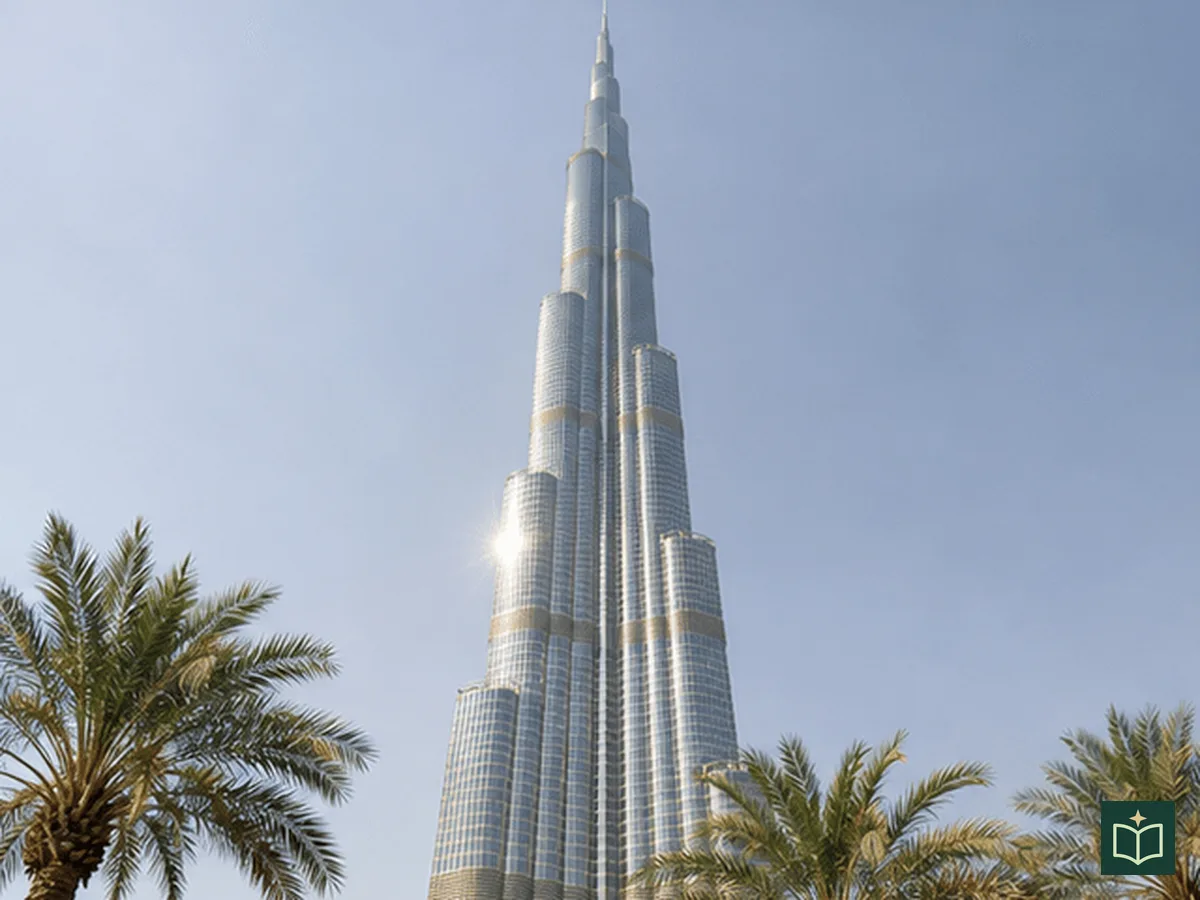
Designers therefore shape towers so vortices cannot form in a steady rhythm. Burj Khalifa is the best-known example. Its Y-shaped plan wraps three wings around a central hexagonal core, and the wings step back at different heights in a spiral pattern as the tower rises. Because the cross-section keeps changing, vortices form at different frequencies along the height and cannot organise into a single strong pulse. The design was refined through extensive wind-tunnel testing of scale models. Other towers use tapering profiles, softened or notched corners, or openings near the top that let wind pass through, all to disrupt the regular shedding that drives sway.
Cores, frames and dampers
The structure itself must be stiff. Most supertall towers rely on a massive reinforced-concrete core around lifts and stairs, connected to perimeter columns by deep outrigger walls or trusses at intervals, so the whole building bends as one unit. Codes often limit sway at the top to around the height divided by 400 to 500. For an 828-metre tower, height divided by 500 is about 1.7 metres. Some buildings add tuned mass dampers, heavy weights on springs or cables tuned to the building's period. Taipei 101's 660-tonne steel ball is the famous example. Others use tanks of water that slosh against the motion, damping it in the same way.
Feeling the sway
Comfort depends more on acceleration than on distance. People begin to notice motion at accelerations of a few thousandths of the force of gravity, and they may feel queasy at higher levels, especially in homes and hotel rooms where they are still and quiet. Design guides therefore set acceleration targets for different uses, stricter for apartments than offices. Burj Khalifa's tip is often reported to move around a metre and a half in extreme winds, yet the long period and low acceleration make it hard to notice. Occupants are more likely to hear creaks, see water ripple in a glass or notice a lift slowing in high winds than feel the building move.
Common misconceptions
A swaying skyscraper is sometimes seen as a sign of danger. In fact, all tall structures flex, and a building that could not move at all would need to be impractically massive and might crack instead. The aim is controlled, limited movement. Another myth is that earthquakes are always the bigger threat. In regions with low seismic risk, such as much of the Gulf, wind usually governs tall-building design, while in places like Japan and Taiwan both must be considered. Finally, aerodynamic shaping is not just decoration. Reducing wind loads can save large quantities of concrete and steel, making very tall buildings both feasible and more economical.
Sources & further reading
- Council on Tall Buildings and Urban Habitat ↗
- Britannica · Skyscraper ↗
- Burj Khalifa · Official site ↗
Figures are rounded and widely published; check the linked organisations for the latest editions. These organisations do not endorse this website.