Two ways to count
Car park guidance systems answer a simple question: where are the empty spaces? There are two broad approaches. Zone counting places detectors at entrances, exits and the ramps between levels and keeps a running tally: cars in minus cars out. It is cheap and works well for showing how many spaces are free on each floor. Bay-level guidance goes further, placing a sensor at every single space. That allows lights above each bay and signs at the end of each aisle showing exactly how many spaces lie ahead. Large shopping malls, airports and hospitals in the Gulf often use bay-level systems, because their car parks hold thousands of vehicles across several levels.
Ultrasonic sensors
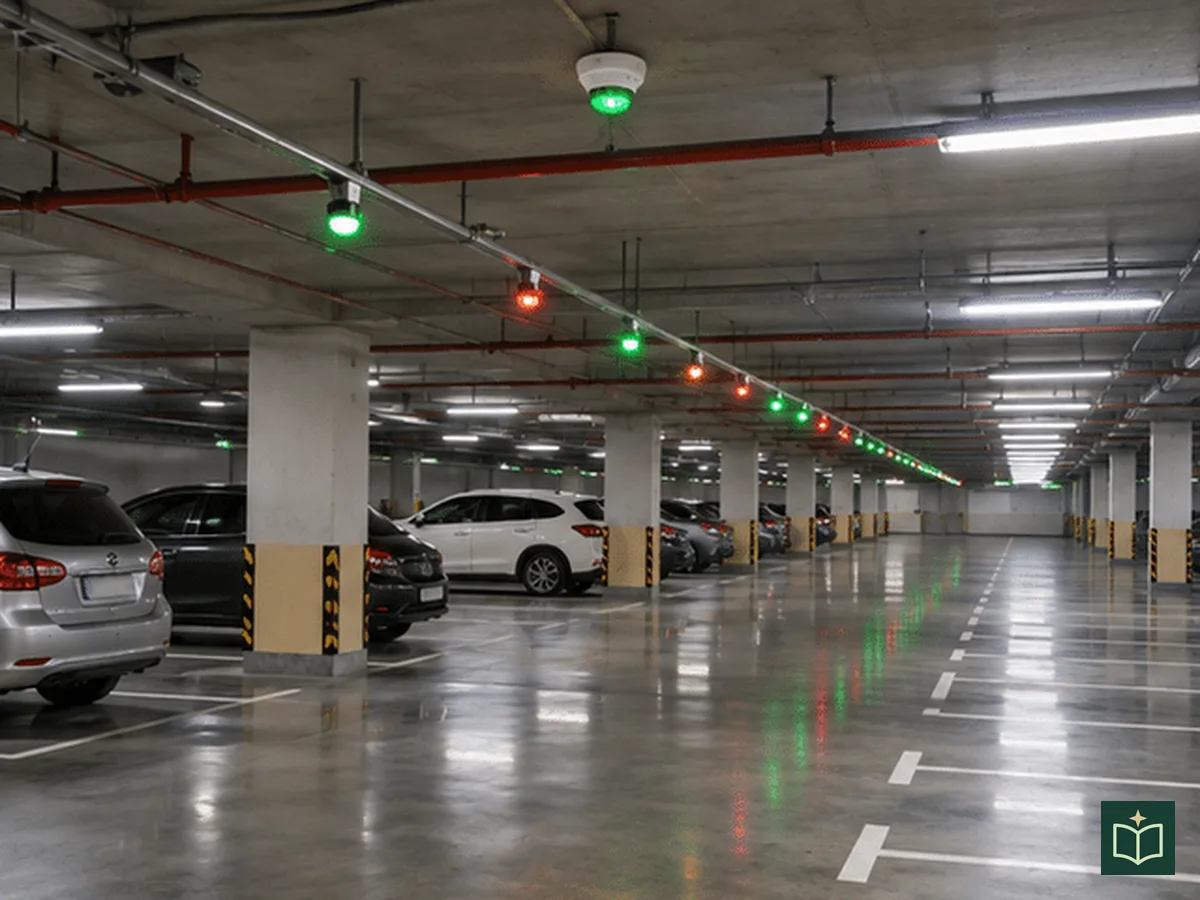
The most common bay sensor is an ultrasonic unit mounted on the ceiling above each space. It sends a short pulse of sound, too high-pitched to hear, and times the echo. If it is fitted 2.8 metres above the floor, the pulse travels down and back 5.6 metres, which at about 343 metres a second takes about 16 milliseconds. A car roof 1.5 metres high is only 1.3 metres from the sensor, so the echo returns after about 7.6 milliseconds. The sensor compares the timing with a set threshold and reports the bay as occupied or free. Many units include a coloured indicator light, or connect to one hanging nearby.
Cameras and ground sensors
Other systems use cameras. A single camera mounted in an aisle can watch several bays, using image recognition to decide which are occupied. Cameras can also read number plates, which lets some car parks offer a find-my-car service at payment kiosks and run ticketless entry and exit. Outdoor car parks, where ceilings are not available, may use small sensors fixed into the ground that detect the metal mass of a car by its effect on the Earth's magnetic field, sending data by radio. At ramps and entrances, inductive loops cut into the road surface sense vehicles passing over them, the same technology used at many traffic signals.
Keeping the numbers right
All the sensors feed controllers that add up free spaces by aisle, level and zone, and pass totals to the signs. Imagine a level with 400 bays. When the mall opens, 300 are occupied by staff and overnight cars. During the morning, ramp counters record 1,250 cars arriving and 1,180 leaving. The running tally shows 370 occupied, leaving 30 free. Counting systems can drift when a detector misses a car or counts a trailer twice, so operators recalibrate them, often overnight, against actual bay occupancy. Bay-level sensors avoid most of this drift, which is one reason they are preferred where accuracy matters.
Why it is worth installing
Searching for a space wastes time and fuel and adds to congestion inside car parks and on nearby roads. Guidance systems shorten that search by sending drivers to levels and aisles with free bays. Operators also gain data on how full the car park is by hour and day, which informs pricing, staffing and expansion plans. Red lights mark occupied bays, green free ones and blue often reserved spaces for disabled drivers, helping enforcement. Some systems publish availability to apps and road signs before drivers arrive. In large Gulf malls, where weekends and holidays bring heavy peaks, this can noticeably ease queues at entrances and exits.
Limits and misconceptions
Guidance systems are not perfect. A motorbike or a small car parked unusually can confuse an ultrasonic sensor, and a car straddling two bays may make both show as taken. Cameras can struggle with poor lighting or dirty lenses. Signs show the count at the moment they update, so by the time a driver reaches an aisle the last space may be gone. Another misconception is that the systems track individual drivers. Basic bay sensors only report whether something is in the space. Number-plate cameras do collect more data, which is why operators are subject to local data protection rules. Overall, the systems turn a frustrating search into a guided one.
Sources & further reading
- US Federal Highway Administration · Parking management ↗
- Britannica · Ultrasonics ↗
- Roads and Transport Authority Dubai ↗
Figures are rounded and widely published; check the linked organisations for the latest editions. These organisations do not endorse this website.