More than the medicine
A tablet contains its active pharmaceutical ingredient, the substance that has the medical effect, and a set of excipients that make it work as a product. Fillers add bulk, so a tiny dose can be pressed into a tablet large enough to handle. Binders hold the particles together. Disintegrants help the tablet break apart in the stomach, and lubricants stop powder sticking to the machinery. Some tablets contain only a few milligrams of active ingredient in a tablet weighing hundreds of milligrams. The formula is fixed during development and approved by regulators, and the factory must follow it exactly, under rules known as good manufacturing practice.
Weighing and blending
Production begins in a dispensing area where each ingredient is weighed against the batch record, often with barcode checks to prevent mix-ups. The powders are then loaded into blenders, which tumble or stir them until the active ingredient is evenly distributed. This step is critical. If the medicine clumps in one part of the blend, some tablets would contain too much and others too little. Samples from different points in the blender are tested for uniformity. Many blends are then granulated, either by adding liquid and drying the mixture or by compacting it dry, to form free-flowing granules that fill the tablet press consistently.
The tablet press
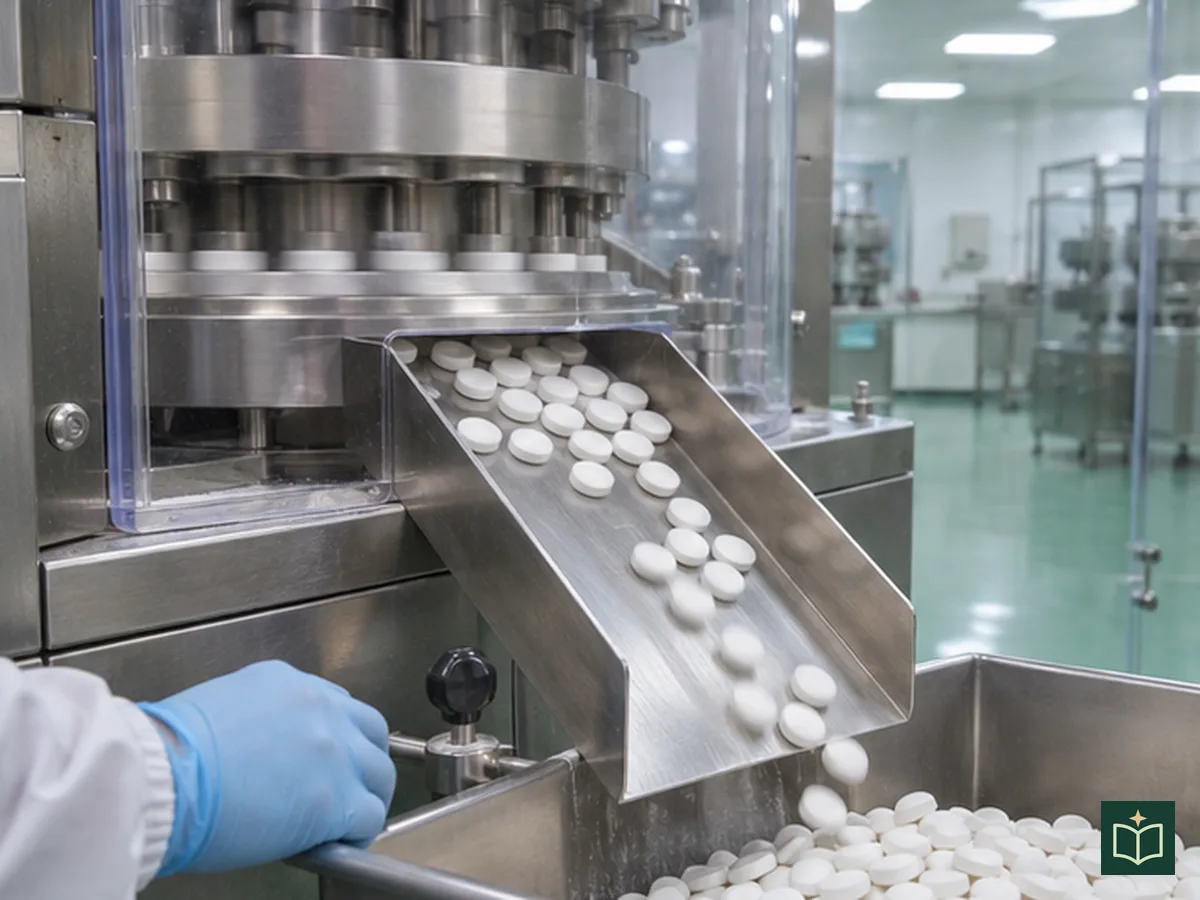
Compression happens on a rotary press. A turntable carries a ring of steel dies, each a small hole shaped like the tablet. As the turntable spins, granules flow into each die, and upper and lower punches squeeze together under high force, fusing the particles into a solid tablet that is then pushed out. The punches can be embossed with letters or scored lines. Large rotary presses can make well over 100,000 tablets an hour. Sensors monitor compression force on each tablet, which tracks its weight, and automatically reject any that fall outside limits. Operators also pull tablets regularly to check weight, thickness and hardness by hand.
Coating
Many tablets are then coated in a rotating perforated drum while a fine spray of coating liquid is applied and warm air dries it. A thin film coating can mask a bitter taste, make tablets easier to swallow, protect the ingredient from light and moisture and add colour for identification. Enteric coatings resist stomach acid so the tablet dissolves only in the intestine, protecting either the drug or the stomach lining. Modified-release coatings control how quickly the medicine is released over several hours. The coating must be applied evenly, because variations can change how the tablet performs in the body, so its thickness and weight gain are measured.
A batch in numbers
Consider a batch of 300 kilograms of finished blend for tablets that each weigh 600 milligrams, of which 500 milligrams is the active ingredient. Dividing 300,000 grams by 0.6 grams gives about 500,000 tablets. On a press producing 200,000 tablets an hour, compression would take about two and a half hours of running time, plus set-up and cleaning. Quality control might sample tablets throughout the run. A content uniformity test measures the active ingredient in individual tablets to confirm each is close to the stated 500 milligrams. A dissolution test checks how quickly the medicine is released in a liquid that mimics stomach conditions.
Released only after proof
No batch leaves the factory simply because it was made. Laboratories test samples for identity, strength, impurities, dissolution and microbial quality, and reviewers check the batch record for every step, deviation and signature. In many regions a designated qualified person must certify each batch before it is released for sale. Factories are inspected by regulators, and samples are kept so that any later complaint can be investigated. Tablets are then packed into blister strips or bottles that protect them from moisture. This system explains why genuine medicines are so consistent, and why counterfeit tablets made outside it can contain the wrong dose or none at all.
Sources & further reading
Figures are rounded and widely published; check the linked organisations for the latest editions. These organisations do not endorse this website.