A service noticed when it stops
Few public services are as routine, or as quickly missed, as rubbish collection. Within days of a strike or breakdown, streets fill with bags, smells and pests. Behind the regular round is a logistics operation run by municipalities or contractors on their behalf. It must collect waste from every home on a predictable schedule, using expensive trucks and crews as efficiently as possible, and deliver it to the right facilities. In many cities households use individual kerbside bins; in apartment-heavy places such as Gulf cities, residents more often use communal containers at the building or in the street, emptied by trucks that lift them mechanically.
Planning the round
Collection starts on a planner's screen. Each truck is given a route covering a set of streets or buildings, sized so the crew can finish within a shift and the truck fills once or twice before tipping. Planners consider traffic, one-way streets, school times and the time needed at each stop. Software now optimises routes using maps and data from previous rounds, reducing distance driven, fuel and missed bins. Many trucks carry GPS trackers, and bins may carry tags that record each lift. In hot climates, collections are frequent, often daily, because organic waste decomposes and smells far faster in summer heat than in cooler countries.
Inside a compactor truck
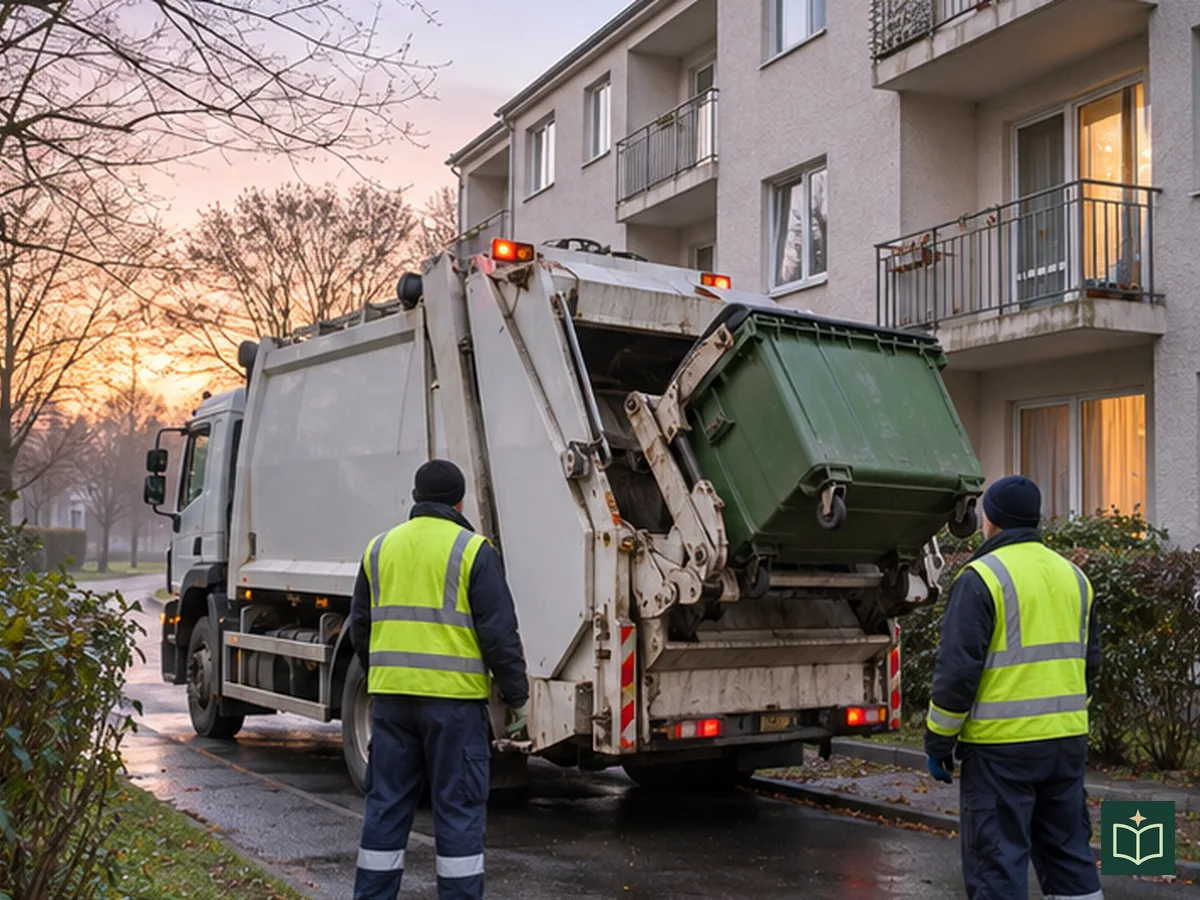
The familiar refuse truck is a mobile compression machine. Loose household waste is mostly air, so a hydraulic blade inside the body repeatedly sweeps rubbish from the loading area and presses it forward against what is already inside. This packs several times more waste into each load, reducing the number of trips to the tip. Rear-loading trucks have crew lifting bins onto a mechanism at the back; side-loaders use an automated arm controlled from the cab, often with one driver; front-loaders lift large commercial containers over the cab. Separate trucks, or split bodies, collect recycling so that materials do not mix with general waste on the way.
A worked round
Picture an illustrative route serving 800 apartments, each producing about 5 kilograms of waste a day. That is 4 tonnes daily, or 4,000 kilograms, which a typical large compactor truck can carry in a single load. If the crew can empty one communal bin every three minutes and there are 60 bins on the route, collection takes about three hours, plus driving time between stops and to the transfer station. Double the waste on a holiday weekend, and the same truck needs a second trip. Planners use calculations like these to decide how many trucks, crews and shifts each district needs throughout the year.
The transfer station
Driving every small truck all the way to a distant landfill, recycling centre or energy-from-waste plant would waste time and fuel. Many systems therefore use transfer stations, located closer to where waste is generated. Collection trucks tip their loads inside an enclosed building, where the waste is compacted again into large containers or trailers. A single long-haul vehicle can then carry the equivalent of several collection loads. Transfer stations also act as checkpoints. Loads are weighed, which lets authorities measure how much waste each area produces, and inspected for hazardous items such as batteries or gas cylinders that should never enter normal waste streams.
Where improvements come from
Collection is one of the biggest costs in waste management, often larger than treatment, so even small gains matter. Some cities are adding sensors to bins that report how full they are, letting trucks skip empty ones. Electric refuse trucks are being tested for quieter, cleaner rounds. Underground containers save space and reduce smells in dense areas. The biggest variable, though, is what households put in the bin. Separating recyclables and food waste makes later processing cheaper and reduces the amount sent to disposal. The round described here ends at the transfer station; what happens next depends on the recycling, recovery and landfill facilities each city has built.
Sources & further reading
Figures are rounded and widely published; check the linked organisations for the latest editions. These organisations do not endorse this website.