Two basic forces
Every bridge has the same job: carry its own weight and the weight of whatever crosses it, plus wind and other forces, down to the ground. It does this through two kinds of internal force. Compression squeezes a material, pushing its particles together; tension stretches it, pulling them apart. Stone and concrete are strong in compression but weak in tension. Steel handles both well, which is why it transformed bridge building in the nineteenth century. The main bridge types are different answers to one question: how to arrange compression and tension so that the materials available can span a gap of a given length.
The beam
The simplest bridge is a beam laid across two supports, like a plank over a stream. When a load sits in the middle, the beam bends. Its top surface is squeezed into compression and its bottom is stretched into tension. Concrete beams therefore have steel reinforcement near the bottom, often pre-tensioned to keep the concrete squeezed. Trusses, frameworks of triangles, are a lighter way to build a deep beam, with each member in either tension or compression. Beam bridges are cheap and common for motorway overpasses and short river crossings, but the bending grows rapidly with span, so they become heavy and expensive for very long gaps.
The arch
An arch turns downward load into an outward and downward push. Each part of the curve presses against its neighbours, keeping the whole structure in compression, which is why Roman masons could build stone arches that still stand two thousand years later. The weak point is the ends: the arch pushes outward on its supports, called abutments, which must be massive or set into solid rock. Modern arches use steel or reinforced concrete and can carry a deck above, below or through the arch. Abu Dhabi's Sheikh Zayed Bridge, opened in 2010, uses sweeping arches that carry its roadway across the channel to the city.
Cantilevers
A cantilever is a beam fixed at one end and free at the other, like a diving board. Cantilever bridges extend arms outward from piers, often balanced so that the weight on each side of a pier roughly cancels out. A short suspended span may connect the tips of two arms in the middle. The top of each arm is in tension and the bottom in compression. The design was popular for long railway bridges in the late nineteenth century, and Scotland's Forth Bridge, completed in 1890, is the famous example. Cantilevering is also a construction method, letting builders extend a bridge outward over water without temporary supports below.
Suspension and cable-stayed
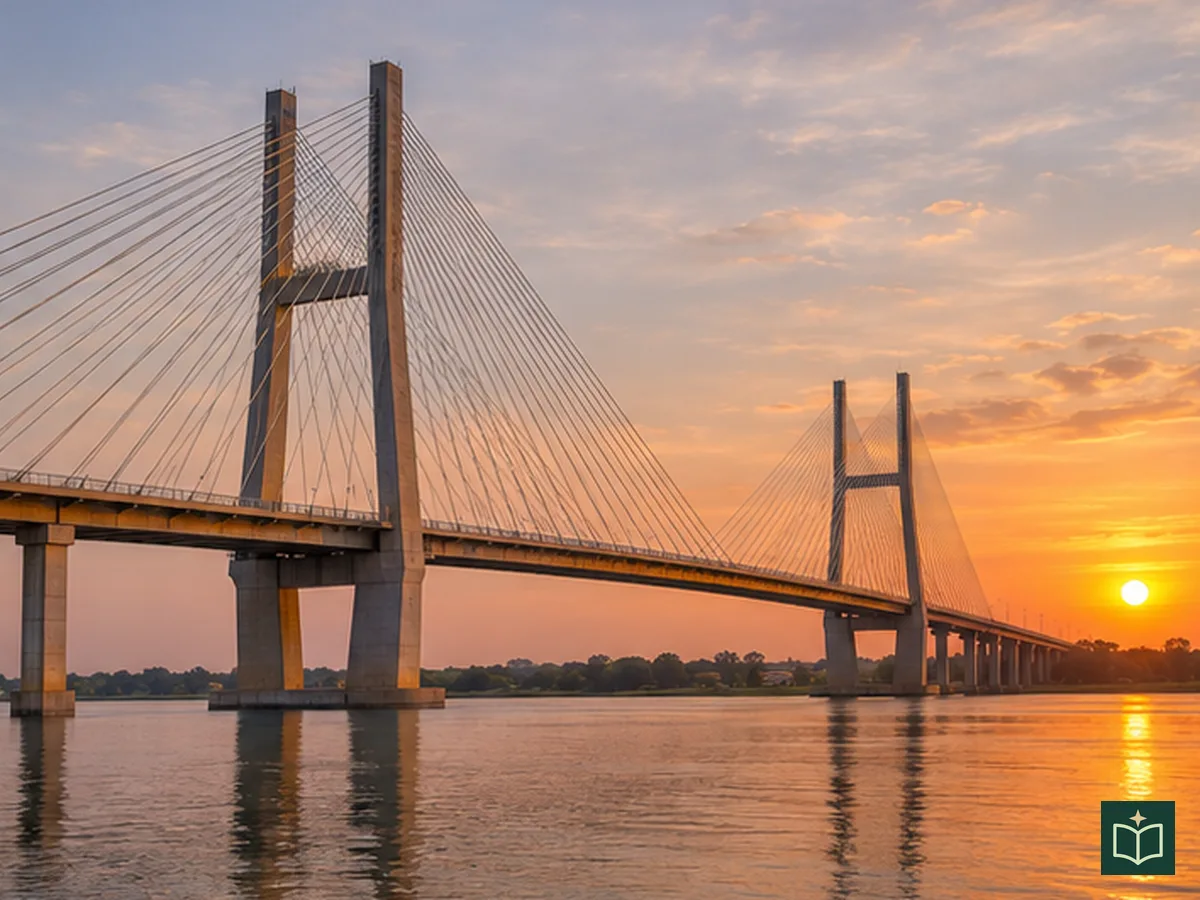
For the longest spans, engineers hang the deck from cables, using steel's great strength in tension. In a suspension bridge, two main cables drape over tall towers and are anchored in massive blocks at each end. Vertical hangers carry the deck from the main cables. The towers are in compression, the cables in tension, and the anchorages resist the enormous pull. This arrangement allows spans approaching two kilometres. A cable-stayed bridge is simpler: straight cables run directly from the towers to the deck, often in a fan or harp pattern, with no anchorage blocks. It is economical for spans of a few hundred metres to about a kilometre.
Choosing a design
Engineers choose a bridge type by weighing span length, ground conditions, shipping clearance, materials, construction method, cost and appearance. Soft ground may rule out an arch's outward thrust. A busy shipping channel may demand a long single span high above the water, favouring suspension or cable-stayed designs. Every bridge must also cope with wind, which can set long, light decks swaying, a lesson learned when the Tacoma Narrows Bridge in the United States collapsed in 1940. Since then, decks have been tested in wind tunnels before construction. Looking at any bridge, it is possible to read its type and work out where its forces travel.
Sources & further reading
Figures are rounded and widely published; check the linked organisations for the latest editions. These organisations do not endorse this website.