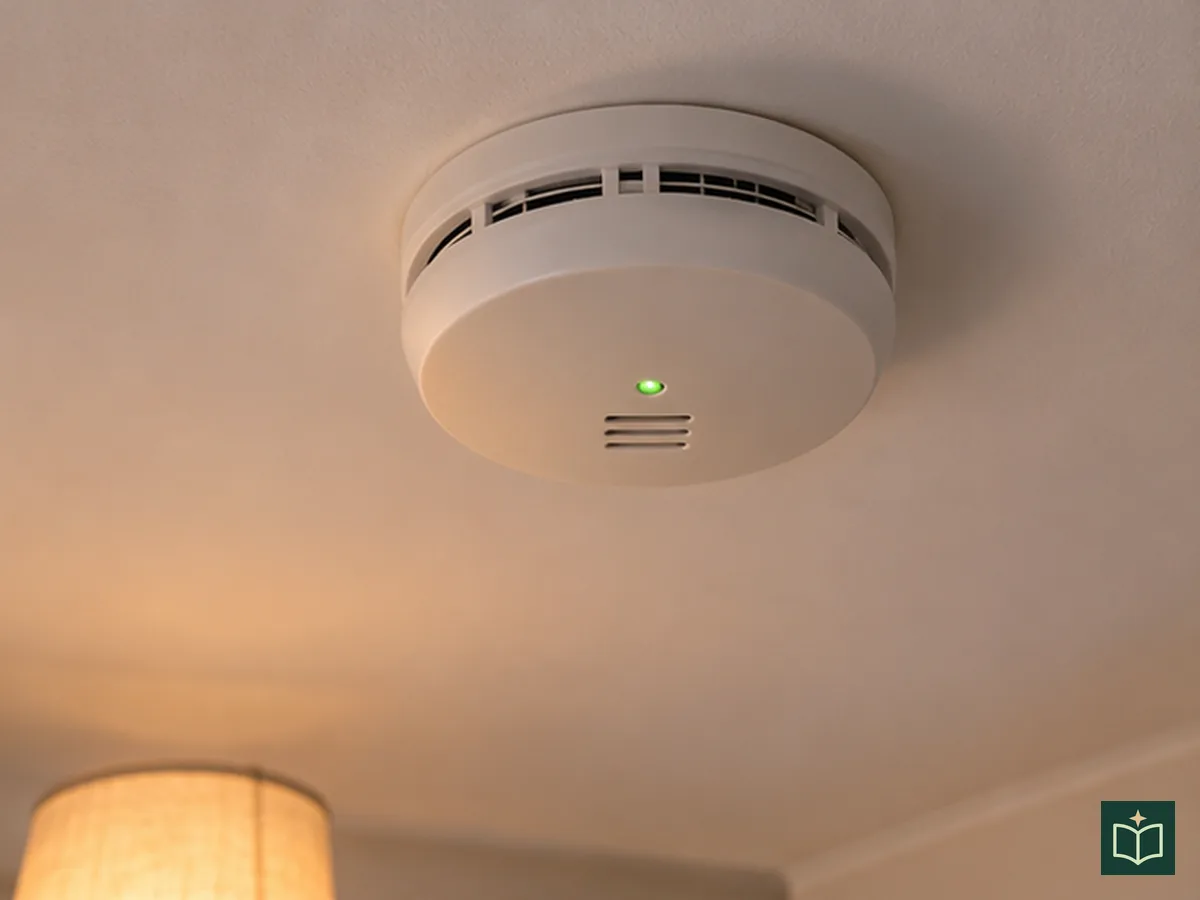
Why early warning matters
Most deaths in house fires are caused not by flames but by smoke and toxic gases, often while people are asleep. A fire can fill a room with lethal smoke within a few minutes, and smoke can dull the senses rather than wake a sleeper. A smoke alarm's job is to detect the earliest signs of fire and sound loudly enough to wake everyone, giving time to escape. Alarms became cheap and widespread from the 1970s, and fire services in many countries credit them with large falls in fire deaths. Two main detection methods are used, and they respond best to different kinds of fire.
Optical alarms
An optical, or photoelectric, alarm contains a small dark chamber with a light source, usually an infrared LED, and a light sensor set at an angle so the beam does not normally reach it. Clean air lets the light pass straight by. When smoke enters, its particles scatter the light in all directions, and some reaches the sensor. Once the scattered light passes a set level, the alarm sounds. Optical alarms are particularly good at detecting the larger particles from slow, smouldering fires, such as a cigarette on a sofa or overheating wiring. They are also less prone to false alarms from cooking fumes, making them suitable near kitchens.
Ionisation alarms
An ionisation alarm contains a tiny amount of a radioactive material, americium-241, between two electrically charged plates. Its radiation ionises the air in the chamber, allowing a small, steady current to flow between the plates. When smoke particles enter, they attach to the ions and reduce the current, and the drop triggers the alarm. Ionisation alarms react quickly to the small particles produced by fast, flaming fires, such as burning paper. The radioactive source is very small and sealed, and poses no meaningful risk in normal use, though old alarms should be disposed of according to local guidance. They are more easily set off by toast and steam.
Heat alarms for kitchens
Kitchens are a common place for fires to start, but cooking regularly produces smoke and steam that would trigger a smoke alarm. Frequent false alarms tempt people to remove batteries, which is dangerous. Heat alarms solve this by ignoring smoke altogether. They sound when the temperature at the ceiling passes a fixed point, often around 58 °C, or in some designs when it rises unusually quickly. Because heat takes longer to build up than smoke, heat alarms are not suitable for bedrooms or escape routes. They work best alongside smoke alarms elsewhere, ideally interlinked so that a fire detected in the kitchen sets off alarms throughout the home.
Placement and upkeep
Smoke rises and spreads across the ceiling, so alarms are usually fitted on the ceiling, away from corners and walls where air can stagnate. Guidance commonly calls for at least one on every floor, in hallways outside bedrooms and in rooms where fires often start, such as living rooms. Dust, insects and age reduce sensitivity, so most fire services recommend testing alarms monthly and replacing units about ten years after manufacture. Many modern alarms have sealed ten-year batteries. Interlinked systems, connected by wire or radio, make sure everyone hears the warning. In the UAE, the Hassantuk programme links alarms in many homes directly to civil defence.
Limits and choices
No single detector catches every fire as early as possible. Fire safety organisations often recommend optical alarms for most living areas and either combined or multi-sensor alarms, which use both methods or add heat and carbon monoxide sensing, for wider coverage. A smoke alarm also cannot detect carbon monoxide, an invisible gas from faulty fuel-burning appliances, which needs its own detector. An alarm is only useful if people respond, so households benefit from an escape plan that everyone knows. If an alarm chirps, it usually signals a low battery or the end of its life, and it should be fixed promptly rather than silenced.
Sources & further reading
- National Fire Protection Association · Smoke alarms ↗
- Britannica · Smoke detector ↗
- US EPA · RadTown radiation education ↗
Figures are rounded and widely published; check the linked organisations for the latest editions. These organisations do not endorse this website.