Two kinds of ultraviolet
Sunlight contains ultraviolet radiation, invisible light with shorter wavelengths than violet. Two types reach the ground. UVB is the main cause of sunburn and directly damages DNA in skin cells. UVA penetrates deeper, contributes to skin ageing and also plays a role in skin cancer. UVA makes up about 95 per cent of the ultraviolet reaching Earth's surface, because the ozone layer absorbs most UVB. Both are strongest when the Sun is high. In the Gulf, the UV index regularly reaches 11 or more, rated extreme, around midday in summer, and stays high for much of the year. This explainer offers general information, not individual medical advice.
How filters work
Sunscreens contain UV filters of two broad kinds. Organic, or chemical, filters are carbon-based molecules that absorb ultraviolet light and release the energy as a tiny amount of heat. Each covers a particular band, so products combine several to span both UVB and UVA. Mineral filters, zinc oxide and titanium dioxide, are fine particles. They were long described as reflecting sunlight like a mirror, but research shows they mainly absorb UV too, with scattering playing a smaller part. Modern formulations make these particles small enough to rub in without leaving a thick white layer. Either type can provide strong protection when well formulated and properly applied.
What SPF actually measures
SPF stands for sun protection factor. In a laboratory test, small areas of volunteers' skin are exposed to a controlled UV lamp with and without sunscreen, and testers note the dose that causes slight reddening. If protected skin needs 30 times the dose, the product is SPF 30. In effect, it lets through one-thirtieth of the burning radiation. So SPF 15 blocks about 93 per cent, SPF 30 about 97 per cent and SPF 50 about 98 per cent. Doubling the number does not double protection; it halves what gets through, from about 7 per cent to about 3 per cent. The rating chiefly reflects UVB.
The UVA label
Because SPF says little about UVA, sunscreens carry separate claims. In many markets, 'broad spectrum' means a product meets a minimum standard of UVA protection relative to its UVB protection. European products may show a circled UVA symbol, while the PA+ rating system is common in parts of Asia. Look for both a decent SPF and broad-spectrum or UVA labelling; dermatology bodies commonly recommend at least SPF 30 for outdoor exposure. Sunscreen is one layer of defence among several. Shade, clothing, wide-brimmed hats and sunglasses block UV more reliably, and avoiding the hours around midday, roughly 10 in the morning to 4 in the afternoon, cuts exposure substantially.
The application gap
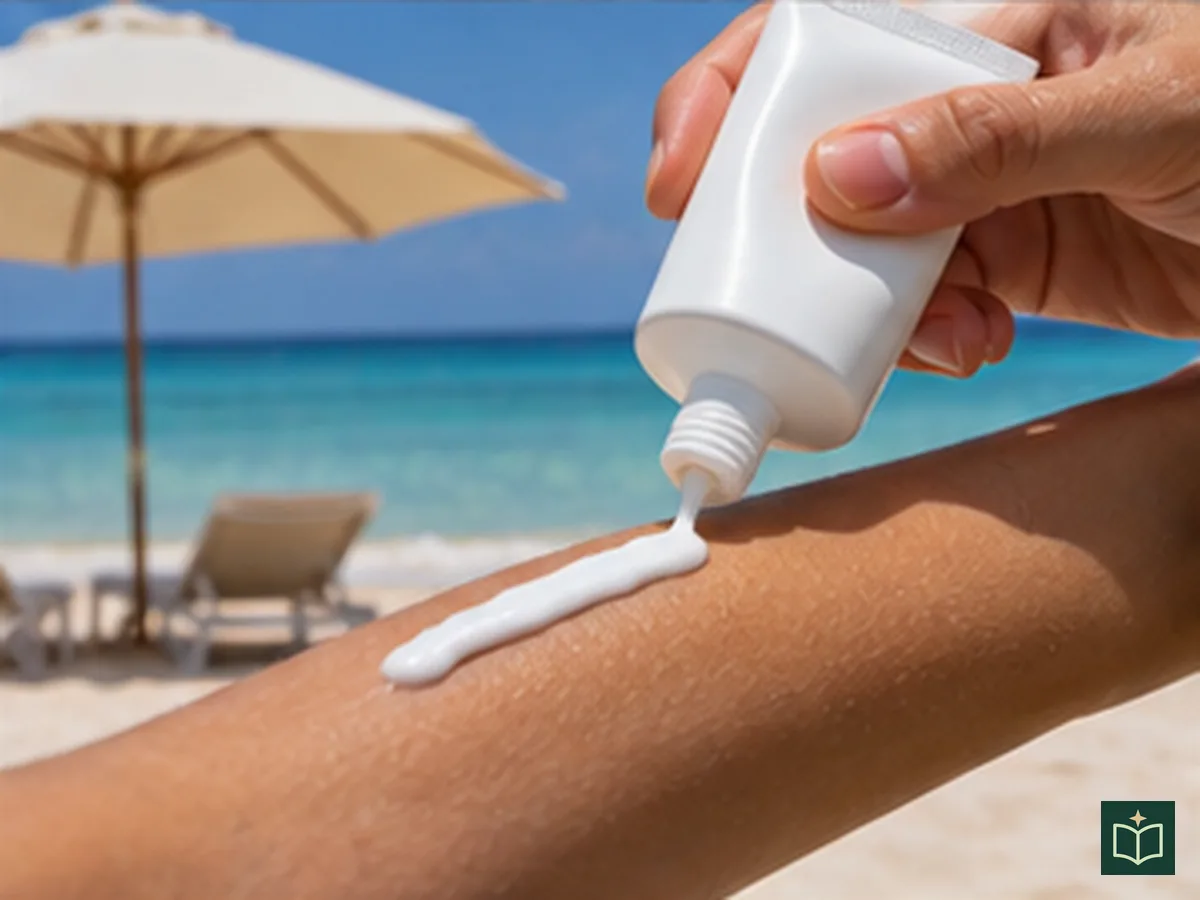
Laboratory SPF tests use a thick layer of 2 milligrams per square centimetre of skin. Studies of real behaviour find that most people apply only a quarter to a half of that. Because protection falls steeply as the layer thins, the effective SPF can end up far below the label. For an adult, the test amount works out at about 35 millilitres, roughly seven teaspoons, to cover the whole body. Sunscreen also wears off: sweat, swimming, towelling and rubbing remove it, so it should be reapplied at least every two hours and after swimming. In a hot, humid Gulf summer, heavy sweating makes regular reapplication especially important.
Myths and limits
Several misconceptions persist. A high SPF does not allow unlimited time in the sun; it only reduces the dose. Darker skin burns less easily but can still be damaged and is not immune to skin cancer. Thin cloud lets through much of the UV, so overcast days can still bring sunburn. 'Water resistant' means protection was tested for a set time in water, often 40 or 80 minutes, not all day. Sunscreens also expire, and heat, such as inside a parked car, can degrade them. Used generously and often, alongside shade and clothing, sunscreen is a proven way to prevent sunburn, and regular use has been shown to lower the risk of some skin cancers.
Sources & further reading
- World Health Organization · Ultraviolet radiation ↗
- US Food and Drug Administration · Sunscreen ↗
- Britannica · Ultraviolet radiation ↗
Figures are rounded and widely published; check the linked organisations for the latest editions. These organisations do not endorse this website.