A reaction in every kitchen
Toast, roasted coffee, grilled meat, fried onions, the crust of bread and the dark surface of a biscuit all owe their colour and much of their flavour to one family of chemical reactions. It is named after Louis-Camille Maillard, a French chemist who described in 1912 how sugars and amino acids, the building blocks of proteins, turn brown when heated together. Maillard was interested in biology rather than cooking, but his discovery became central to food science. It is not a single reaction but a branching network of hundreds, which is why a seared steak, a cup of coffee and a loaf of bread taste so different despite sharing the same basic chemistry.
How the chemistry unfolds
The process starts when a reducing sugar, such as glucose or fructose, meets an amino acid. Their reactive groups join, and the new molecule rearranges into a more stable but still reactive form. From there the pathways multiply. Intermediates break apart, combine with each other and with more amino acids, and form a huge variety of small, volatile molecules responsible for aromas ranging from nutty and toasty to meaty and floral. Later stages build large brown polymers called melanoidins, which provide the colour. Which flavours appear depends on the particular sugars and amino acids present, as well as temperature, time, acidity and moisture. Change any one of these and the result tastes different.
Why boiling never browns
The Maillard reaction runs slowly at room temperature but speeds up dramatically when food is hot, becoming rapid at around 140 to 165°C. Water is the obstacle. As long as a surface is wet, it cannot rise much above 100°C, the boiling point of water at sea level, because the energy goes into evaporation. That is why boiled meat stays grey and boiled potatoes stay pale, while the same foods roasted or fried turn golden. Cooks exploit this by patting meat dry before searing, avoiding overcrowded pans that trap steam and preheating ovens properly. Slight alkalinity also speeds browning, which is why pretzels are dipped in an alkaline solution before baking.
Not the same as caramelisation
Browning is often loosely called caramelisation, but the two are different. Caramelisation involves sugar alone: heated to around 160°C or more, sugar breaks down and recombines into brown, bittersweet compounds, as in toffee or the sauce on a crème caramel. The Maillard reaction needs amino acids as well as sugar and can begin at lower temperatures. Many foods undergo both. Luqaimat, the fried dough dumplings popular across the Gulf, owe their golden crust largely to Maillard reactions, while the date syrup drizzled over them brings its own deep, caramel-like notes. Onions cooked slowly for a long time also develop both kinds of flavour as their natural sugars concentrate.
Coffee, bread and roasting
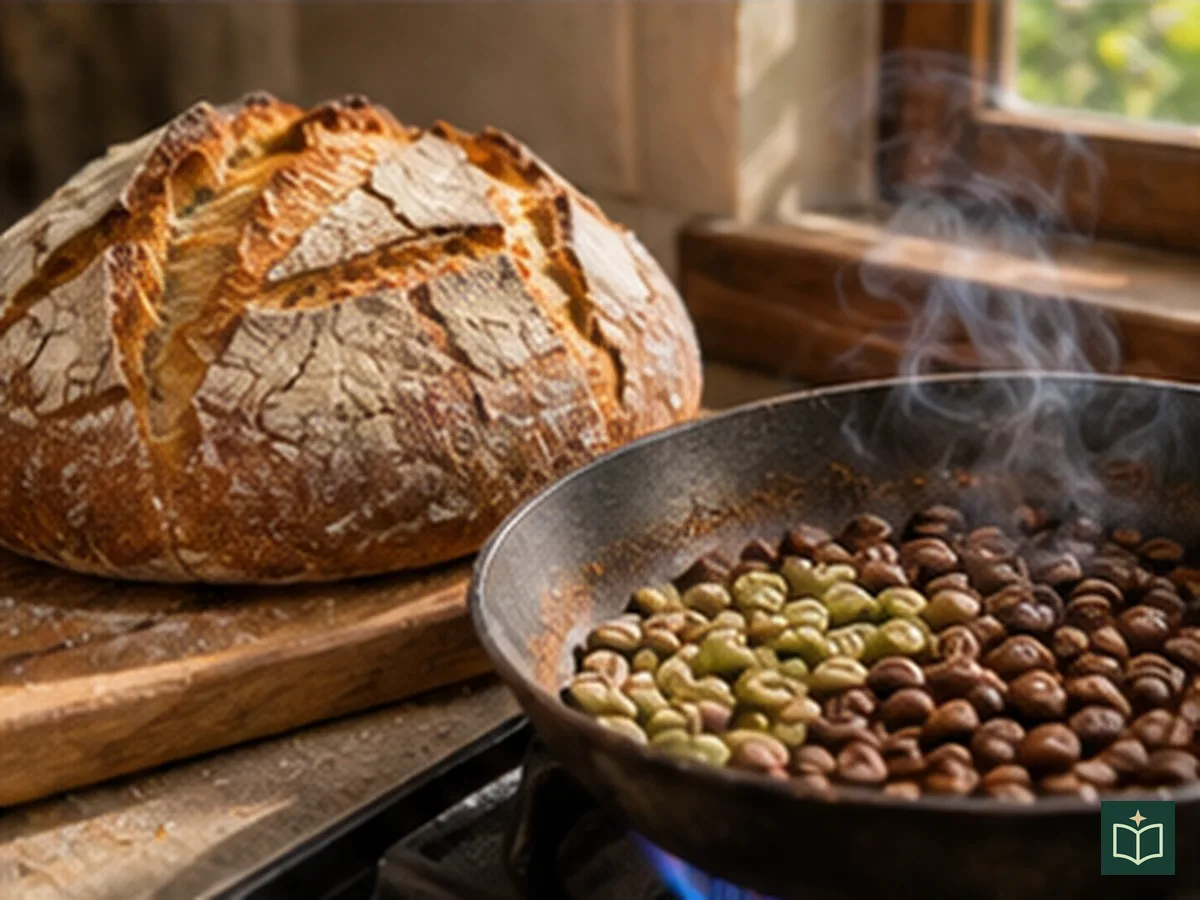
Coffee shows how much the reaction can change a food. Raw coffee beans are green and taste grassy. Roasting at around 200°C drives off water and launches Maillard reactions and caramelisation, producing hundreds of aroma compounds and the familiar brown colour. Light roasts, traditional for Arabic coffee, or gahwa, keep more of the bean's bright acidity and let added cardamom stand out; dark roasts develop deeper, more bitter notes. In bread, the surface of the dough dries in the oven and browns into a flavourful crust, while the moist interior, held near 100°C, stays pale and soft. A single loaf therefore contains two quite different chemistries.
Too much of a good thing
Browning has a downside. One by-product of Maillard reactions in starchy foods cooked at high temperatures, such as chips, crisps and dark toast, is acrylamide, a compound that causes cancer in laboratory animals at high doses. Food safety agencies advise reducing exposure, for example by cooking starchy foods to a golden rather than dark brown colour. Charring meat produces other compounds of concern. A slow version of the same chemistry also happens inside the body, where glucose gradually attaches to proteins; it is the basis of the HbA1c blood test used to monitor diabetes. The reaction behind a delicious crust is, in fact, a fundamental process well beyond the kitchen.
Sources & further reading
Figures are rounded and widely published; check the linked organisations for the latest editions. These organisations do not endorse this website.