The simple sensor
For decades, most street lights were controlled by a photocell, a small light sensor usually mounted on top of the lamp head and facing the northern sky in the northern hemisphere so that direct sunlight does not fool it. As daylight fades, the sensor's electrical properties change, and when light falls below a set level a switch turns the lamp on. Designers build in hysteresis, meaning the lamp turns off at a brighter level than it turned on, and a short delay, so that a passing headlight, a cloud or a flash of lightning does not cause flickering. Each lamp acts independently, which is why neighbouring lights sometimes switch on a minute apart.
The clock that knows the sky
Photocells can fail, get dirty or be covered by dust, a frequent problem in desert cities. Many systems therefore use astronomical timers, which calculate sunrise and sunset for a given latitude, longitude and date. They switch lights at a fixed offset from those times, such as a few minutes after sunset, regardless of local conditions. Some combine both approaches, using the timer as the main control and the photocell to react to unusually dark days, such as during a sandstorm. Timers usually control a whole circuit of lights from a cabinet at the roadside, rather than each lamp individually, which reduces maintenance but means one fault can darken a whole street.
Smart networks
Modern LED street lights increasingly carry a small controller node, often plugged into a standard socket on top of the fitting. Each node talks to a central management system over a wireless mesh, a cellular link or the power cable itself. Operators can then switch, dim and schedule lights from a computer, group them by street or district and change settings for events, Ramadan nights or road works. Each lamp reports its status, energy use and faults, so crews know which light has failed without waiting for a resident to complain. Some systems connect to traffic or motion sensors, brightening when vehicles or pedestrians approach and dimming on empty roads.
Counting the energy
Street lighting is one of the largest electricity bills for many cities. A lamp that burns about 11 hours a night runs for around 4,000 hours a year. Replacing an older 150-watt sodium lamp with a 70-watt LED saves 80 watts, or about 320 kilowatt-hours a year per light. Across 100,000 lights, that comes to roughly 32 gigawatt-hours a year, before any additional dimming. LEDs also last much longer, reducing the cost of crews and lifting platforms. Dimming to a lower level in the quietest hours after midnight saves more, though lighting standards set minimum levels for road safety, so savings must be balanced against visibility.
Light that lands where needed
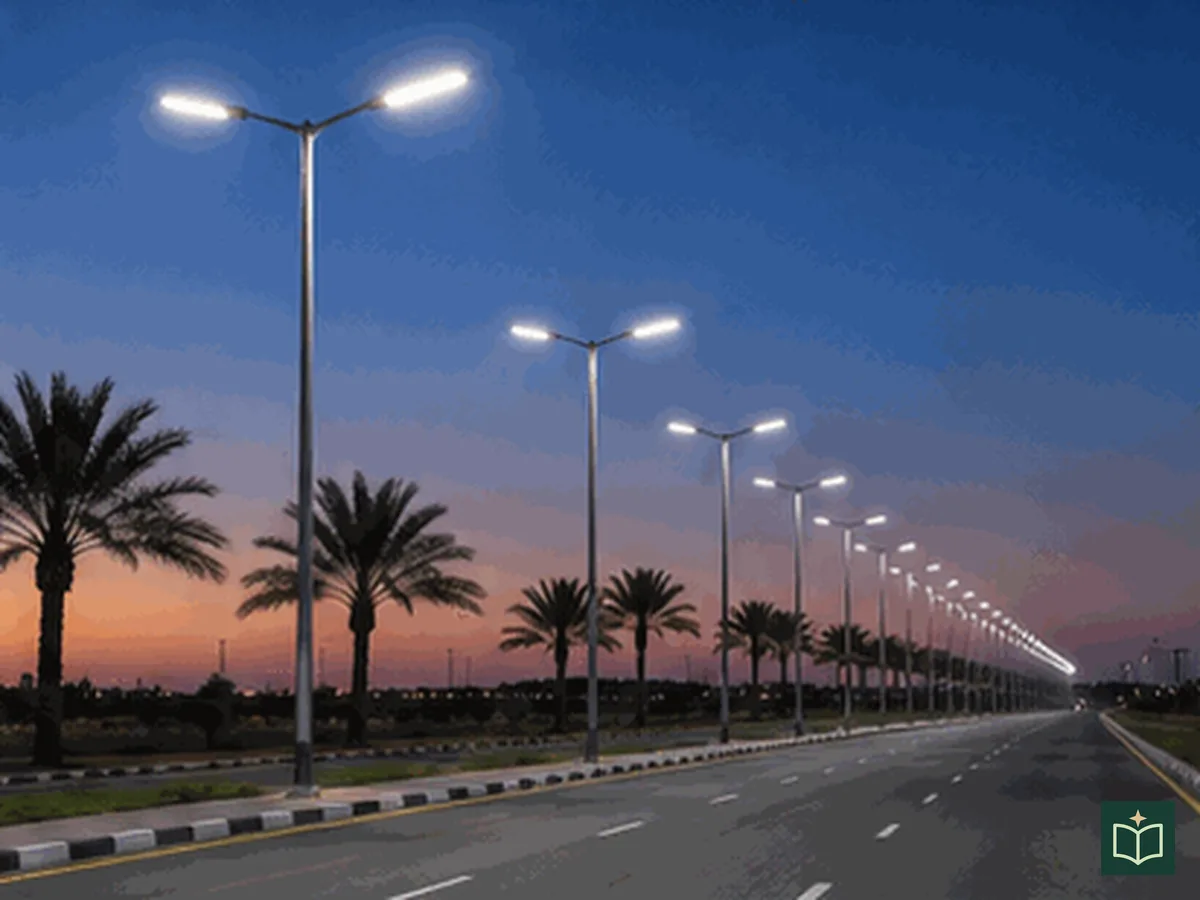
Older lamps scattered much of their light sideways and upwards, contributing to sky glow that hides the stars and disturbs wildlife. LED fittings use optics to direct light onto the road and pavement, reducing waste. The colour of LED light is also a choice. Early installations often used a cold bluish-white, which some residents found harsh and which affects nocturnal animals more strongly; many cities now prefer warmer tones. Engineers design layouts to give even brightness, avoid dark patches between poles and limit glare for drivers. Good lighting improves road safety and helps people feel secure, but more light is not automatically better.
What happens when one fails
Even networked lights fail, through a burnt-out driver, water ingress, cable damage or a vehicle hitting a pole. In older systems, failures were found through night patrols or public reports. Networked lights report problems automatically, and some systems predict failures by tracking changes in power use. Cabinets protect circuits with breakers that trip on faults, and maintenance teams prioritise junctions and crossings. Roads in many Gulf cities are lit along long highway stretches, so remote monitoring saves considerable driving. The goal remains unchanged since gas lamps were lit by hand: light the streets reliably at dusk, switch off at dawn and waste as little as possible.
Sources & further reading
Figures are rounded and widely published; check the linked organisations for the latest editions. These organisations do not endorse this website.