Sand on the move
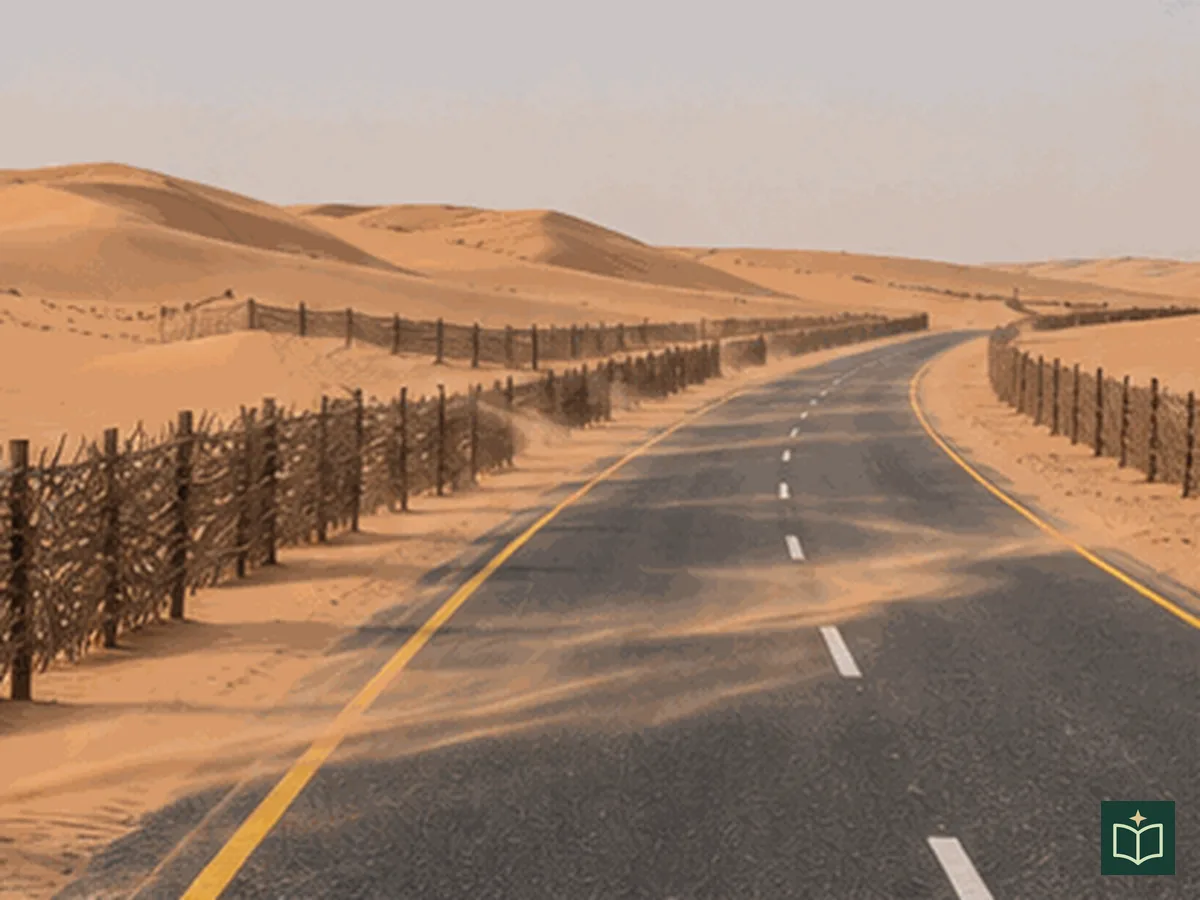
Across the deserts of Arabia, wind constantly shifts sand. Most of it does not fly high: grains are lifted briefly, then fall back and bounce along the surface in a process called saltation, mostly within a metre of the ground. Larger grains roll or creep along, while fine dust can be lifted high into the air in storms. When moving sand meets an obstacle or a patch of calmer air, it drops. A road can become such a place, particularly if it sits in a dip or is lined with kerbs and barriers. Sand that settles on a carriageway reduces grip, hides lane markings and can build into drifts that block lanes.
Dunes that walk
Whole dunes can migrate too. Crescent-shaped barchan dunes, common in areas with a steady prevailing wind and limited sand, advance as sand blows up their gentle windward slope and slides down the steep face beyond. Small dunes can move several metres or even tens of metres in a year. If a dune advances 15 metres a year towards a road 150 metres away, it will arrive in about a decade. Engineers therefore study satellite images, wind records and local landforms before fixing a route. Where possible, roads are aligned to avoid active dune fields or to run parallel to the prevailing wind, which reduces the amount of sand blown across them.
Fences and barriers
Sand fences are one of the oldest tools. They are typically made of porous materials such as palm fronds, mesh or slatted panels, and placed some distance upwind of the road. The fence slows the wind passing through and around it, so sand drops in front of and behind the barrier instead of reaching the carriageway. A porosity of about half is common, because a solid wall causes turbulence and scouring. As sand accumulates, fences are raised or new rows added. Earth bunds and ditches serve a similar role, trapping sand before it reaches the road. These measures need upkeep, because a filled fence stops working and can become a new source of sand.
Plants and surface treatments
Vegetation stabilises sand by slowing the wind at ground level and binding the surface with roots. Belts of drought-tolerant trees and shrubs, including native species such as ghaf, are planted alongside some roads and irrigated during establishment. In China's Taklamakan Desert, a highway built in the 1990s has been protected with grids of straw pressed into the sand and a long shelterbelt of plants watered by drip irrigation. Other approaches spread gravel, clay or chemical binders over loose sand to form a crust that resists erosion. Each method has costs: plants need water in places where water is scarce, and surface treatments can break down.
Designing the road itself
The shape of the road affects whether sand settles. Engineers favour gently sloped, raised embankments that encourage the wind to speed up slightly over the carriageway, carrying sand across rather than dropping it. Steep cuttings, high kerbs and solid barriers create sheltered zones where sand collects, so designers avoid them in exposed sections or use open guardrails instead. Wide, flat clear zones on either side help too. Railways face the same challenge in sharper form, because sand can bury tracks and damage moving parts. Recent rail projects in the Gulf have used combinations of embankment shaping, fences and protective structures to keep lines clear.
Clearing and the road ahead
No design stops all sand, so road authorities run maintenance patrols. Mechanical sweepers, loaders and graders remove drifts, especially after storms, and warning signs alert drivers to sections prone to sand cover. Drivers are advised to slow down and increase following distance when sand blows across the road, because visibility and grip can change suddenly. Costs are significant on long desert routes, which is why prevention through good alignment and barriers is usually cheaper than repeated clearing. As traffic grows and new highways and railways cross the region, managing sand is a permanent part of infrastructure in Arabia, much as snow clearing is in colder countries.
Sources & further reading
Figures are rounded and widely published; check the linked organisations for the latest editions. These organisations do not endorse this website.