Why cities need drains at all
In open desert or farmland, much of the rain that falls soaks into the soil, evaporates or is taken up by plants. A city changes that balance. Roofs, roads, car parks and pavements are almost waterproof, so rain runs off them quickly and in large volumes. Without a way to remove it, that water pools in low points, underpasses and basements within minutes. Storm drainage is the network built to deal with this runoff. In many older cities it shares pipes with sewage, which can cause pollution when storms overload the system. Newer networks usually keep storm water separate, because it is cleaner and can often be released to the sea or reused.
From gutter to gully to pipe
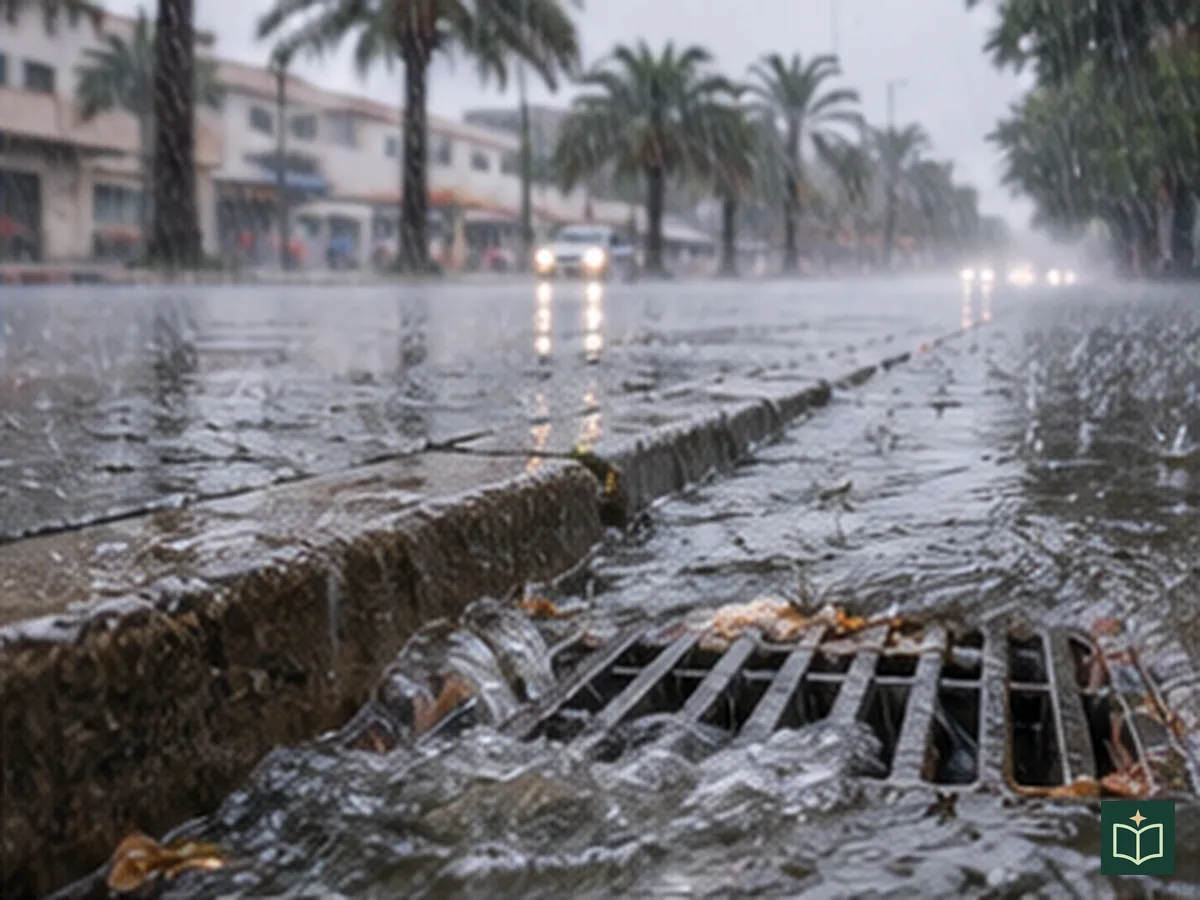
The journey starts at the surface. Roads are built with a slight camber, so water runs to the kerb, where a channel carries it to a gully: a grated inlet with a pit below that catches silt and litter. From there, pipes run underground at a steady downhill gradient so gravity does most of the work. Small branch pipes join larger trunk mains, much like streams joining a river. Where the land is too flat, pumping stations lift the water to a higher level so it can keep flowing. At the end, the outfall releases it into the sea, a creek or a lagoon, often through a screen or settling basin.
Tunnels, ponds and soakaways
Pipes are only one tool. Some cities bore deep storm tunnels that can hold huge volumes during a downpour and drain them slowly afterwards. Others use retention ponds and underground tanks that store water temporarily, letting the network catch up. Soakaways, which are gravel-filled pits or perforated chambers, let water seep into the ground instead of travelling anywhere. They suit sandy soils well, but they can fill and stop working if the water table is high or if they silt up. Engineers increasingly mix these with green infrastructure, such as planted swales and permeable paving, which slow the runoff down and reduce the peak flow arriving at any one pipe.
Sizing a drain
Engineers size drains with a simple idea: runoff equals rainfall intensity, multiplied by the area draining to a point and by a runoff coefficient describing how much of the rain runs off. Take a one-hectare car park of 10,000 square metres, a storm of 50 millimetres an hour and a coefficient of 0.9 for asphalt. That gives 10,000 × 0.05 × 0.9, or 450 cubic metres an hour, which is 125 litres every second. A pipe and gully network must carry that peak. Designers choose a design storm, such as one expected on average once every few years, and accept that rarer, heavier storms will exceed the system for a while.
When desert rain arrives
Gulf cities face a particular dilemma. Rain is rare, so building drains for every street to cope with the heaviest storms would mean costly infrastructure that sits dry for years. Many areas were therefore designed around modest rainfall, with some roads relying on tankers and pumps to clear standing water. In April 2024, the UAE recorded its heaviest rainfall in 75 years of records, with about 255 millimetres falling in under a day at one station near Al Ain. Water collected in underpasses, roads and residential areas faster than networks could remove it. The event prompted authorities to announce major investment in additional drainage and storage capacity across several emirates.
Common misconceptions
A flooded street does not always mean a blocked drain. Often the network is working exactly as designed but has simply reached its capacity, and the surface becomes a temporary channel. Clearing the grate helps only when debris is the problem. Another myth is that drains in dry places do nothing; sand, dust and litter build up between storms, so routine cleaning before the rainy season matters. Finally, storm water is not clean. It carries oil, rubber particles, rubbish and fertiliser from roads and gardens, which is why outfalls are screened and why many cities discourage pouring anything into a roadside gully.
Sources & further reading
Figures are rounded and widely published; check the linked organisations for the latest editions. These organisations do not endorse this website.