Two ways to fly freight
Air cargo travels in two very different ways. Belly cargo rides in the lower deck of passenger aircraft, beneath the cabin and alongside suitcases. Dedicated freighters, often converted or purpose-built versions of airliners, carry nothing but cargo on both decks. Before the pandemic, roughly half of all air freight travelled in passenger bellies. That share fell sharply in 2020, when most passenger flights were grounded and freighter capacity suddenly mattered far more. Belly space is cheap for airlines, because the flight is already paid for by passengers. Freighters, by contrast, fly where cargo demand is, can take very large or heavy items and operate to tighter schedules set by shippers.
What flies, and why
Shipping by air costs many times more than by sea, so it is used when speed or security justifies the price. Typical cargo includes pharmaceuticals and vaccines, electronics, machine parts needed urgently, fresh flowers, seafood, fruit, fashion, mail and online-shopping parcels. Live animals, including racehorses, also travel by air in special stalls. Many goods need controlled temperatures, so airports operate cool rooms and airlines offer temperature-managed containers. Dangerous goods such as lithium batteries are allowed only under strict packing and labelling rules set by international aviation bodies. The industry often says that air cargo carries less than one per cent of world trade by volume but around a third by value.
Pallets, containers and paperwork
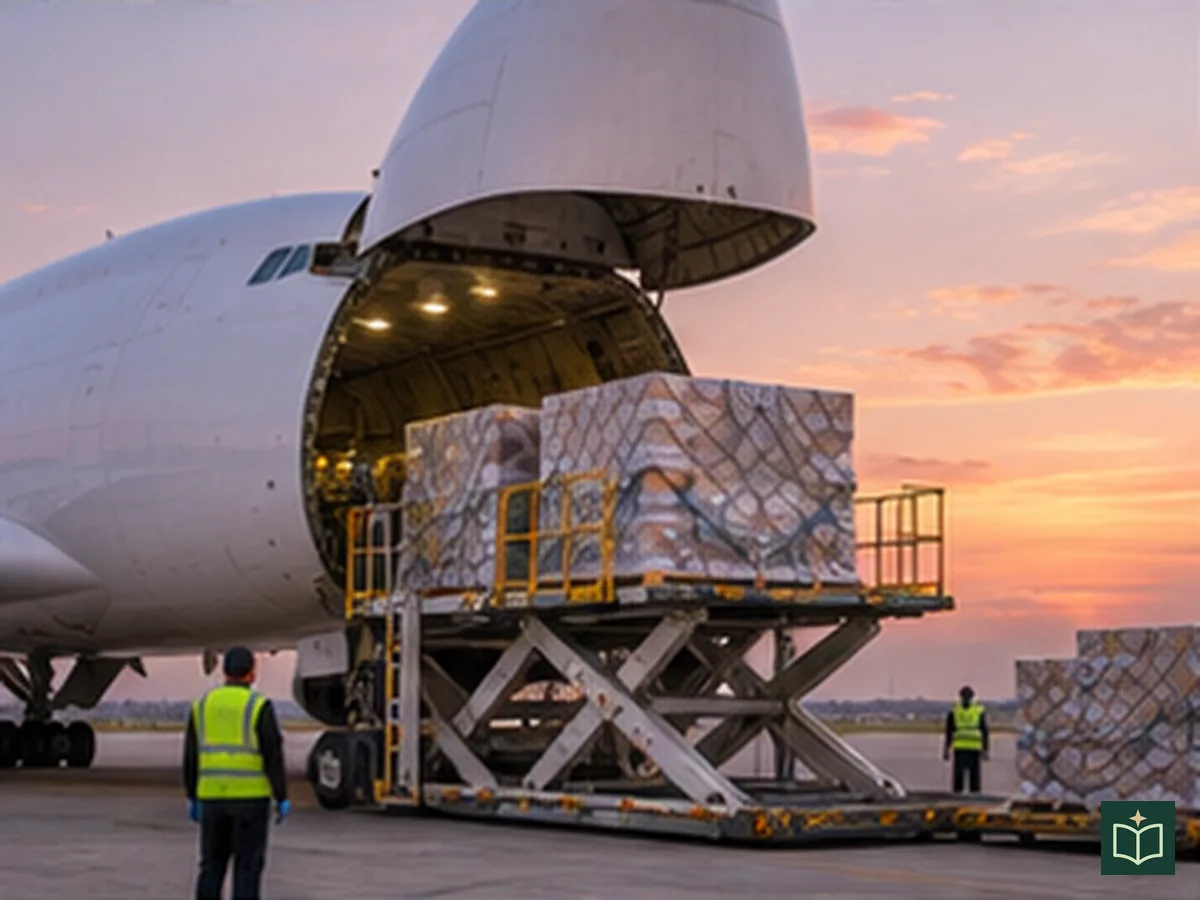
Cargo is not loaded loose. Freight forwarders collect shipments from many customers and build them onto flat aluminium pallets or into unit load devices, curved containers shaped to fit the aircraft's hold. Each piece carries an air waybill, the contract and tracking document for the shipment, now usually electronic. Security screening, customs declarations and dangerous goods checks happen before loading. Ground handlers then weigh every unit, and the airline's load planners position them to keep the aircraft balanced within its centre-of-gravity limits. A wide-body freighter such as a Boeing 777F can carry around 100 tonnes, while a passenger jet's belly typically holds a fraction of that alongside baggage.
Paying for space, not just weight
Because aircraft fill up by volume as well as weight, airlines charge on whichever is greater. A common formula divides a package's length, width and height in centimetres by 6,000 to give a volumetric weight in kilograms. A box measuring 100 by 80 by 60 centimetres works out at 480,000 divided by 6,000, or 80 kilograms. If the box itself weighs only 30 kilograms, the shipper still pays for 80, because the bulky box takes space that denser cargo could have used. Prices per kilogram rise and fall with demand, fuel costs and how much belly capacity passenger airlines are flying at any moment.
Why hubs like Dubai matter
Most cargo does not fly direct. It travels to a hub, where it is unloaded, sorted and transferred to onward flights, much like passengers changing planes. The Gulf's position between Europe, Asia and Africa makes its airports natural transfer points, since much of the world's population lives within an eight-hour flight. Dubai International and Al Maktoum International, along with Doha's Hamad International, handle large volumes of transit freight. Emirates SkyCargo and Qatar Airways Cargo are among the world's biggest international cargo carriers, combining belly space on large passenger fleets with freighters. Nearby free zones let companies store goods and re-export them quickly, linking air freight with sea and road networks.
Limits and trade-offs
Air cargo is fast but carbon-intensive. Flying a kilogram of goods emits far more carbon dioxide per kilometre than moving it by sea or rail, which is why companies are urged to reserve air freight for cargo that genuinely needs it. Capacity is also fragile. Disruptions to passenger travel, airspace closures or sudden demand surges can send prices soaring, as happened during the pandemic. Security rules add cost and time, and paperwork errors can strand shipments at a hub. Finally, speed in the air does not guarantee speed overall: a shipment can spend longer clearing customs or waiting for a truck than it spent flying.
Sources & further reading
Figures are rounded and widely published; check the linked organisations for the latest editions. These organisations do not endorse this website.