From vapour to ice
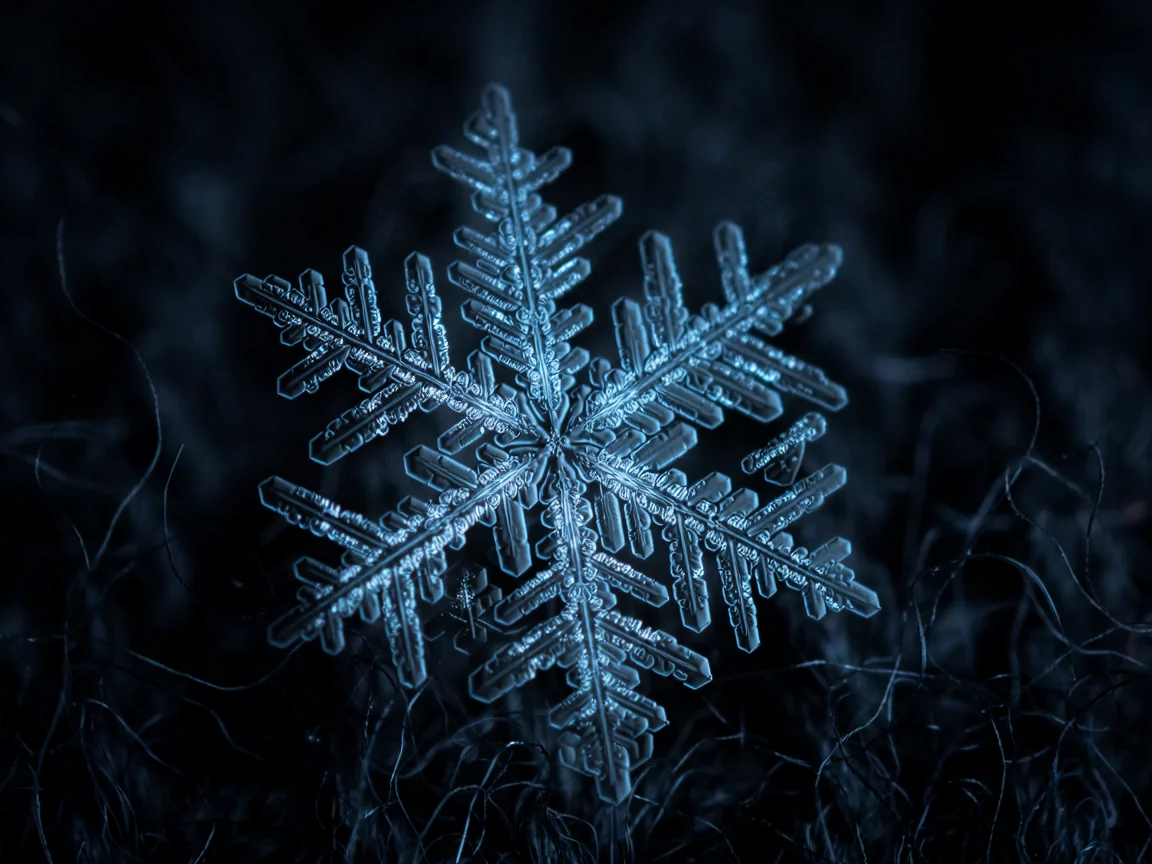
High in a cloud, water vapour can freeze directly onto a tiny particle of dust or pollen without first becoming a liquid drop. The first crystal is a small six-sided prism. As more vapour deposits on it, the crystal grows, and its corners, which stick out into the moist air, grow fastest.
Why six sides
When water freezes, its molecules link through hydrogen bonds into a hexagonal lattice. That underlying geometry is why snow crystals have six-fold symmetry. The physicist Ukichiro Nakaya grew thousands of artificial snowflakes in the 1930s and mapped how their shapes depend on conditions.
Temperature writes the shape
Plates grow at some temperatures and long needles or columns at others, while high humidity encourages elaborate, branching star shapes. As a crystal falls through layers of air, its growth changes, which is why each arm carries the same detailed history and the six arms look alike.
Is every flake unique?
The number of possible growth histories is so vast that two large, complex snowflakes are extremely unlikely to look identical. Many falling flakes stick together into clumps, and others are broken or partly melted, so perfect single stars are best seen on cold, calm days.
Sources & further reading
Temperature ranges are approximate guides. Photograph: original AI-generated illustration (Adobe Firefly). Reference organisations do not endorse this website.