The problem it solved
In the nineteenth century, some shipowners overloaded old vessels so heavily that they sat dangerously low, and many sank with their crews. Insurance could make a lost ship profitable, and sailors who refused to sail could face prison. The British politician Samuel Plimsoll campaigned against these so-called coffin ships, and the Merchant Shipping Act of 1876 made load line markings compulsory on British ships. International agreements followed, and the current International Convention on Load Lines was adopted in 1966 under what became the International Maritime Organization. Today almost every large merchant ship in the world carries the mark, and port authorities can detain a vessel loaded beyond it.
Freeboard and reserve buoyancy
The key quantity is freeboard: the vertical distance from the waterline up to the main deck. Freeboard represents reserve buoyancy, the extra hull volume that can be pushed underwater when the ship rolls, pitches or takes on water. A ship with too little freeboard is easily swamped by waves and may not recover from heavy weather. The load line rules calculate a minimum freeboard from the ship's length, depth, shape and features such as hatches and superstructure. Tankers, which have small, tightly sealed deck openings, can be permitted less freeboard than general cargo ships, because water is less likely to get inside them.
Reading the mark
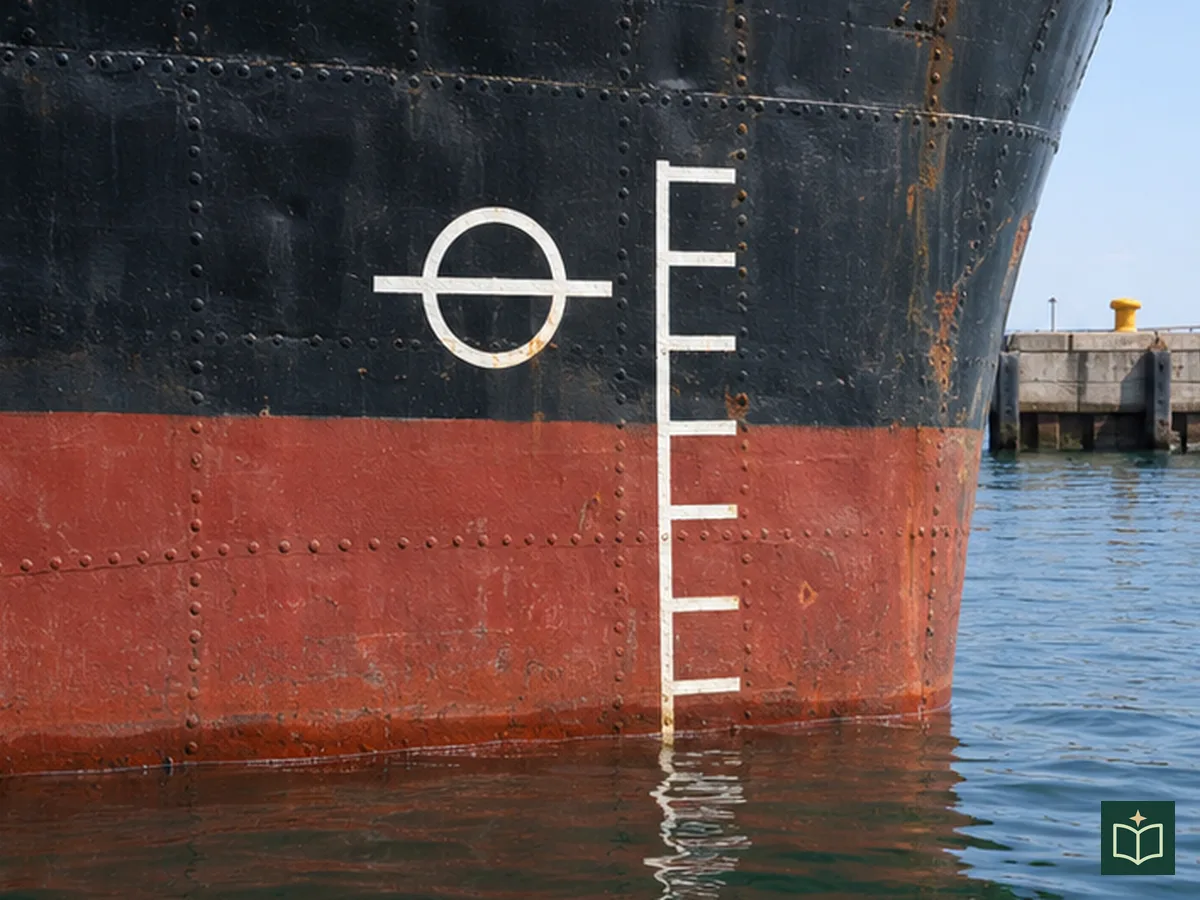
Amidships on each side, the hull carries a circle with a horizontal line through its centre, the Plimsoll mark, usually flanked by letters identifying the authority that assigned it. Beside it is a ladder of short lines. S marks the summer load line, level with the line through the circle. T, for tropical, sits higher, allowing deeper loading in calmer tropical zones. W, for winter, sits lower, requiring more freeboard. Smaller ships may also carry WNA, for winter in the North Atlantic. F and TF show fresh-water and tropical fresh-water limits. International charts divide the oceans into zones and seasonal areas that determine which line applies on a voyage.
Why fresh water is different
A floating ship displaces a weight of water equal to its own weight. Fresh water has a density of about 1.000 tonne per cubic metre, while seawater is about 1.025, so a ship must displace about 2.5 per cent more volume in fresh water to float, and sits deeper. A ship loading in a river port may therefore immerse its summer line, as long as it will rise to that line on reaching the sea. Officers use the fresh water allowance, roughly the displacement divided by four times the tonnes per centimetre immersion, in millimetres. For a 40,000-tonne displacement and 50 tonnes per centimetre, that is 200 millimetres.
The line in daily operations
Load lines shape everyday decisions. Before loading, officers calculate how much cargo, fuel and water the ship can carry while ending the voyage at or above the correct mark, accounting for fuel burned and changes in sea area and season. Draught marks at the bow and stern, read with the mark amidships, show how the ship is floating. Surveyors and port inspectors check the marks and certificates, and the ship's load line certificate must be renewed periodically after inspection. For cargo owners, the line can limit how much a ship can lift on a given route, particularly in winter or when sailing through shallow channels or rivers.
Limits of the mark
The load line is a minimum safety standard, not a guarantee. A ship loaded correctly can still be lost through poor stability, shifting cargo, structural failure or bad weather decisions. Stability, which concerns how weight is distributed and how the ship returns upright after rolling, is governed by separate rules and calculations. Load lines also cannot stop a dishonest operator who falsifies records, which is why inspections matter. Still, the simple marking has been credited with saving many lives since its introduction. Seen from a quay, the painted disc and ladder of letters summarise a long history of safety regulation in a few lines of paint.
Sources & further reading
Figures are rounded and widely published; check the linked organisations for the latest editions. These organisations do not endorse this website.