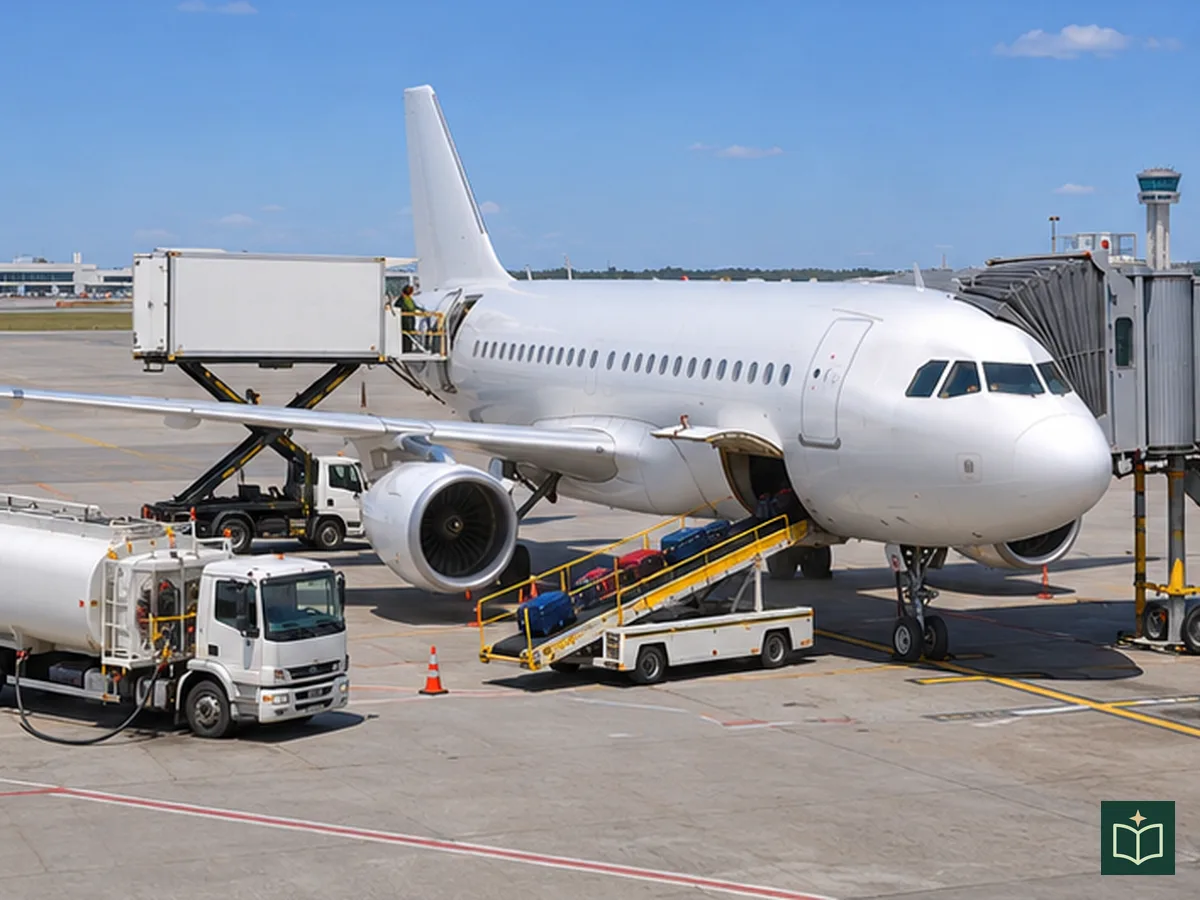
An aircraft earns money in the air
Airlines make money when aircraft are flying, not when they are parked. Every minute at the gate costs fees, crew time and, on busy routes, the chance to fly another rotation that day. The turnaround is the period from when an aircraft stops at the stand to when it is pushed back for the next flight. For a single-aisle jet on short-haul routes it is often scheduled at 30 to 60 minutes, and some low-cost carriers aim for about 25. A large widebody preparing for a long-haul flight from a hub such as Dubai usually needs 90 minutes or more, because there is much more to clean, catering to load and fuel to pump.
The first minutes
As soon as the engines stop and the anti-collision light goes off, ground staff place chocks at the wheels and safety cones around the aircraft. A ground power unit or the stand's fixed supply is connected so the aircraft's own auxiliary power unit can be shut down. The jet bridge or stairs are positioned, and the doors open. Passengers disembark first, while baggage handlers open the holds and begin unloading bags and cargo, often in containers on widebody aircraft. A turnaround coordinator, sometimes called a ramp agent or dispatcher, oversees the whole operation, tracking each task against a schedule and flagging delays.
Everything at once
Once the cabin is empty, cleaners move through it collecting rubbish, tidying seats and refreshing toilets. Catering trucks with lifting bodies rise to the service doors to swap used trolleys for fresh ones. A fuel truck, or a hydrant dispenser connected to pipes under the apron, refuels the aircraft. Other vehicles empty the toilet waste tanks and refill drinking water. Engineers walk around the aircraft checking tyres, brakes, fluid levels and any reported faults. On the flight deck, the incoming and outgoing crews may hand over, and pilots prepare the flight plan and systems. All of this happens in a crowded space where vehicles must avoid each other and the aircraft.
Sequence and the critical path
Some tasks can overlap; others cannot. Passengers must leave before cleaning finishes, and cleaning must finish before boarding starts. Bags for the next flight cannot load until arriving bags are off. This chain of dependent steps, the critical path, sets the minimum turnaround time. Fuelling may continue during boarding in many countries, but only with precautions such as clear exits and fire services informed. Take an illustrative 45-minute turnaround for 180 passengers: roughly 10 minutes to disembark, 10 to 15 for cleaning and catering, and 15 to board at about 12 passengers a minute, leaving a few minutes for final checks, closing doors and pushback.
The final checks
Before departure, the aircraft's load must be calculated precisely. A load controller compiles the loadsheet, combining passenger numbers, baggage and cargo weights, fuel and their positions to confirm the aircraft is within weight limits and properly balanced. The captain reviews and accepts it. Cabin crew check that everyone is seated and bags are stowed, and the doors are closed and armed. The jet bridge retracts, ground power is disconnected and the chocks are removed. A pushback tug, connected to the nose gear by a towbar or by lifting the nose wheel, pushes the aircraft back from the stand, after which it starts its engines and taxis away under its own power.
When turnarounds go wrong
Because the steps are interlinked, a small delay can ripple outwards. A late catering truck holds up boarding; a missing passenger whose bag is already loaded means the bag must be found and removed for security reasons. A delay on the first flight of the day can carry through every following rotation, a problem known as reactionary delay. Airports and airlines therefore study turnarounds closely, using cameras, sensors and data to see which tasks run late. Some airlines board from both ends of the aircraft to save minutes. For passengers, the visible part is the queue at the gate, but most of the work happens out of sight.
Sources & further reading
Figures are rounded and widely published; check the linked organisations for the latest editions. These organisations do not endorse this website.