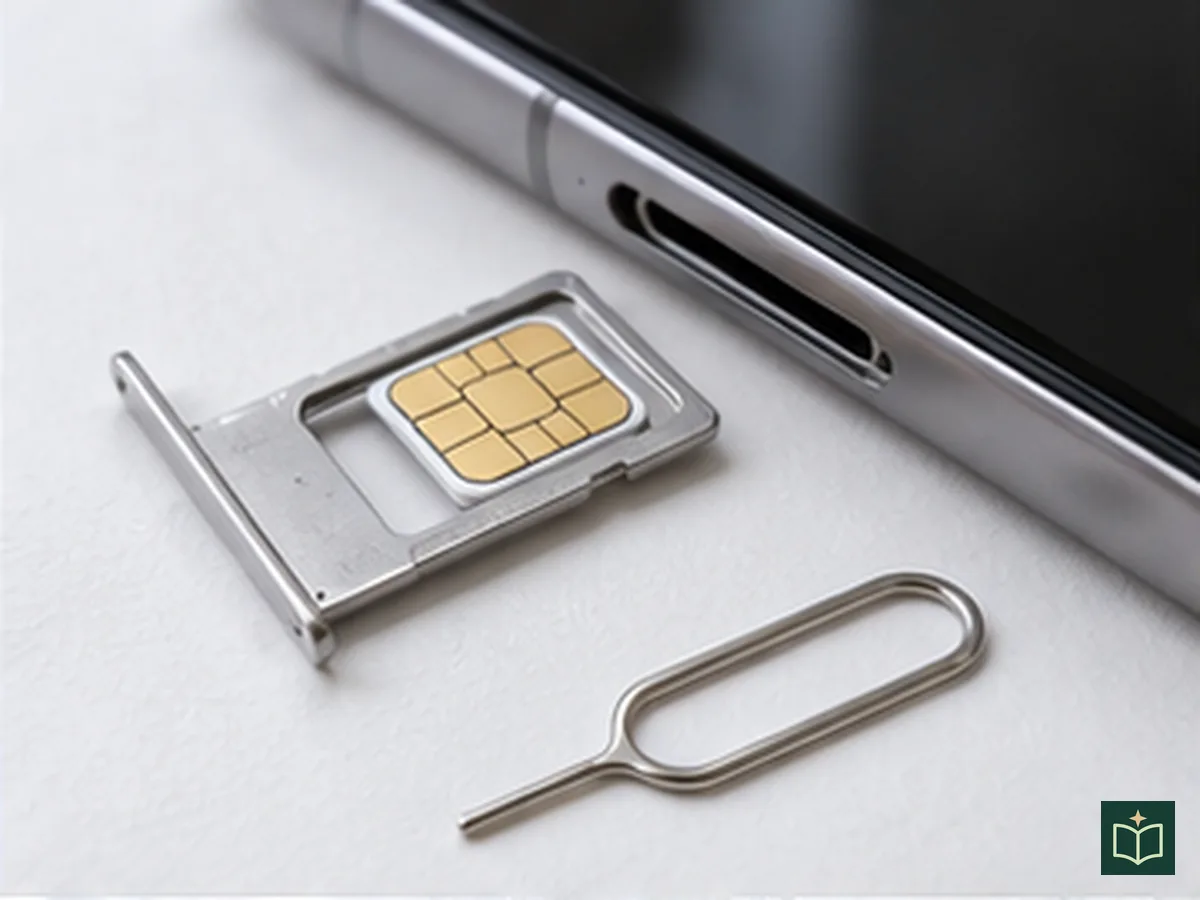
What a SIM actually does
A subscriber identity module, or SIM, is a tiny secure computer. It does not store your phone number in any meaningful sense, and it is not mainly a storage card. Its main job is to prove to a mobile network that it represents a particular paying subscriber, so the network can let the phone connect, bill the right account and encrypt the connection. Separating identity from the handset was a key idea of the GSM standard in the early 1990s. You could move your SIM into another phone and keep your account. That separation still shapes mobile networks today, even as the physical card shrinks or disappears.
The challenge and the answer
Each SIM holds a unique subscriber number, called the IMSI, and a secret key. The operator stores a copy of that key in a secure database. When a phone connects, the network sends a random number as a challenge. The SIM combines it with the secret key using a cryptographic algorithm and returns the result. The network performs the same calculation and compares answers. If they match, the SIM must hold the right key. The key itself never travels over the air, so eavesdroppers cannot copy it. Newer generations add mutual authentication, so the phone can also check the network is genuine, and 5G conceals the permanent identity.
From credit card to nano
The first SIMs were the size of a credit card. As phones shrank, the chip was cut down into the mini-SIM, then the micro-SIM and finally the nano-SIM, which is barely bigger than the metal contacts themselves. The chip inside is a secure element, designed to resist tampering and to make extracting the key extremely difficult. It also stores network settings, sometimes contacts and messages, and small applications used by operators. Because the SIM belongs to the operator, it can be updated remotely over the air, for example to change roaming preferences. A lost SIM can be blocked by the operator, and the number moved to a replacement card.
When the SIM becomes software
An eSIM keeps the same security idea but changes the packaging. Instead of a removable card, the phone contains a soldered secure chip called an eUICC. Operators no longer post a card; they provide a profile, the bundle of identity, keys and settings, that is downloaded into the chip over the internet. Usually the subscriber scans a QR code or uses an operator app, and the phone fetches the profile from a secure server following specifications from the GSMA, the industry body. One eSIM chip can hold several profiles, such as a home line and a travel data plan, and users can switch between them without touching a tray.
Why eSIM is spreading
For phone makers, removing the SIM tray saves space and a potential entry point for water and dust. For travellers, eSIM makes it easy to buy a local data plan before landing rather than queuing at an airport kiosk. Watches, tablets, cars and industrial sensors also benefit, since they can be connected without a card slot. Operators in the UAE and most major markets support eSIM, and identity checks still apply: UAE rules require mobile lines to be registered with the user's identity documents, whether delivered on a card or as a profile. Some phone models sold in certain countries now support only eSIM, with no physical tray.
Limits and misconceptions
A common belief is that an eSIM is less secure than a physical card. In practice, both use secure hardware and cryptographic keys, and eSIM removes the risk of a card being physically stolen and placed in another phone. The bigger risk for both is social engineering, where fraudsters persuade an operator to move a number to their own SIM or eSIM, then intercept text-message codes. This is called SIM swapping, and it is why banks increasingly favour app-based authentication. Switching phones can also be less straightforward with eSIM, because the profile must be transferred or reissued. Operators and phone makers are simplifying that process with built-in transfer tools.
Sources & further reading
- GSMA · Mobile industry association ↗
- ETSI · Smart card platform standards ↗
- UAE Telecommunications and Digital Government Regulatory Authority ↗
Figures are rounded and widely published; check the linked organisations for the latest editions. These organisations do not endorse this website.