From coil to car
A modern car factory receives giant coils of sheet steel and aluminium at one end and drives finished cars out of the other, often in a day or two. Between them lie four main areas. The press shop stamps flat metal into panels. The body shop welds them into the bare shell, called the body in white. The paint shop protects and colours it. Final assembly fits the thousands of other parts, from engine or battery to seats and screens. Each area is a factory within a factory, but all of them are linked by conveyors and tied to a single production rhythm that determines how fast the whole plant works.
Stamping and welding
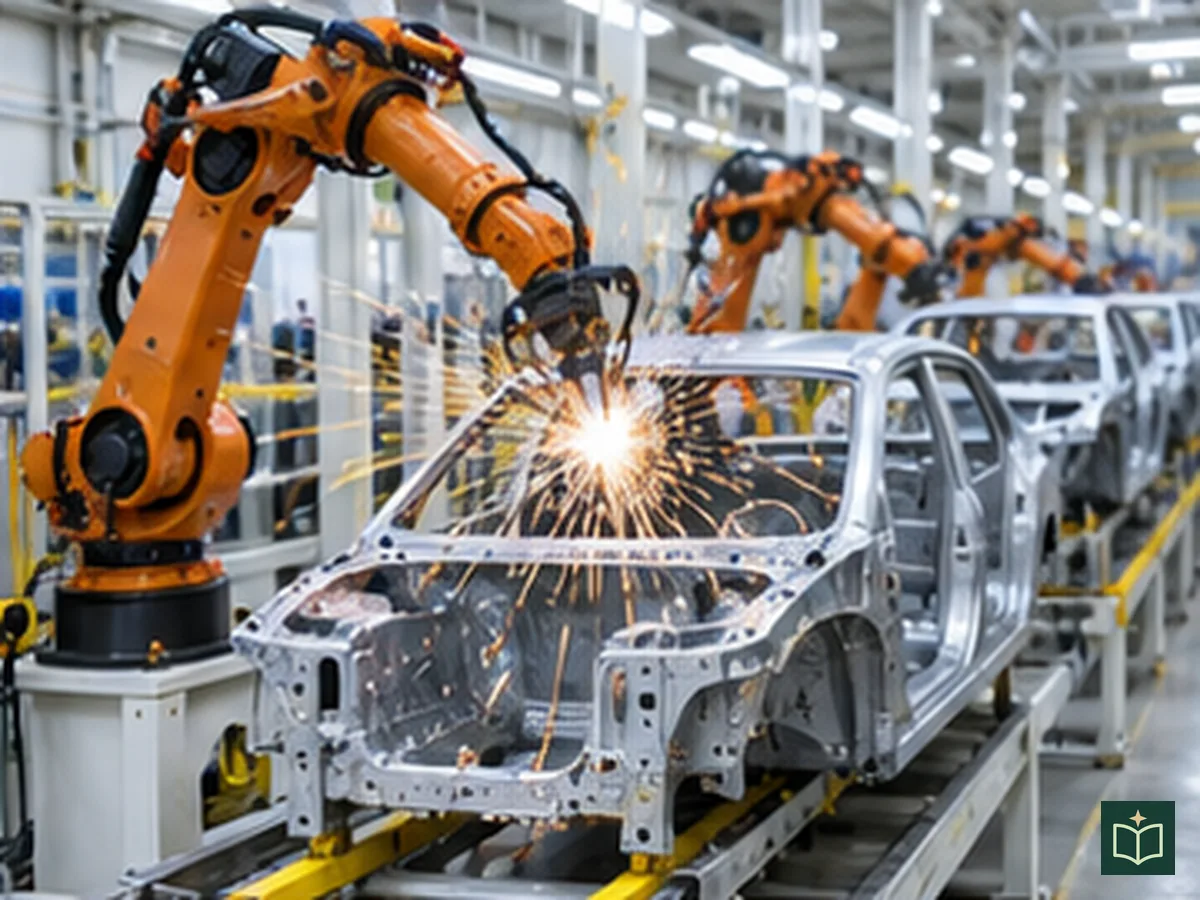
In the press shop, huge presses, some exerting thousands of tonnes of force, shape steel blanks between hardened dies into doors, roofs, bonnets and side panels in a few seconds each. The body shop is dominated by robots. Hundreds of robotic arms lift panels into fixtures and join them, mostly with spot welds that fuse metal at small points; a typical car body has several thousand. Lasers, adhesives and rivets are increasingly used too, especially for aluminium. Cameras and laser scanners check dimensions to fractions of a millimetre. Few people work here, because the tasks are heavy, repetitive and need precision that robots deliver consistently.
The paint shop
Painting is one of the most complex and energy-hungry stages. The body is first cleaned and dipped in a bath where an electric charge draws an anti-corrosion coating into every cavity, a process called electrocoating. It is baked, then seams are sealed against water. Robots spray primer, a coloured base coat and a clear protective top coat, with ovens curing each layer. The shop is kept almost dust-free, with filtered air and workers in special suits, because one speck can spoil a finish. Paint shops consume a large share of a plant's energy, mainly for heating ovens and conditioning the air, so manufacturers work hard to improve them.
Final assembly and takt time
Final assembly is where most people work. The painted body moves slowly along the line, often with doors removed to give workers access, then refitted later. Teams install wiring, dashboards, glass, seats and trim. At the marriage point, the body is lowered onto the engine, transmission and suspension, or the battery pack in an electric car. The pace is set by takt time: available production time divided by the number of cars required. Two shifts of 7.5 hours give 54,000 seconds; if the plant must build 900 cars a day, each station has 60 seconds to finish its task before the car moves on.
Just in time and stopping the line
To keep the line moving without huge stockpiles, carmakers rely on just-in-time supply, a method refined by Toyota. Suppliers deliver parts in the exact sequence they will be fitted, sometimes within hours of use, so a red car with a sunroof meets its matching parts at the right station. Toyota's system also gave workers the right to stop the line by pulling a cord when they spotted a defect, so problems are fixed at the source rather than passed downstream. Most plants now use similar andon signals. A line stoppage is expensive, but building hundreds of faulty cars that must later be repaired is far worse.
Limits and what is changing
Assembly lines are efficient but rigid. Changing a model can require months of retooling, and a shortage of one small part, as happened with microchips in 2021, can halt production entirely because just-in-time systems hold little buffer stock. Electric cars are reshaping factories: they have fewer engine parts but large battery packs, and some makers now cast big sections of the body in one piece, replacing dozens of stamped and welded parts. Robots are spreading into final assembly, but tasks such as routing flexible cables still favour human hands. The basic idea Henry Ford popularised in 1913, bringing work to the worker, remains intact.
Sources & further reading
- The Henry Ford · Museum of American Innovation ↗
- Britannica · Assembly line ↗
- Toyota · Toyota Production System ↗
Figures are rounded and widely published; check the linked organisations for the latest editions. These organisations do not endorse this website.