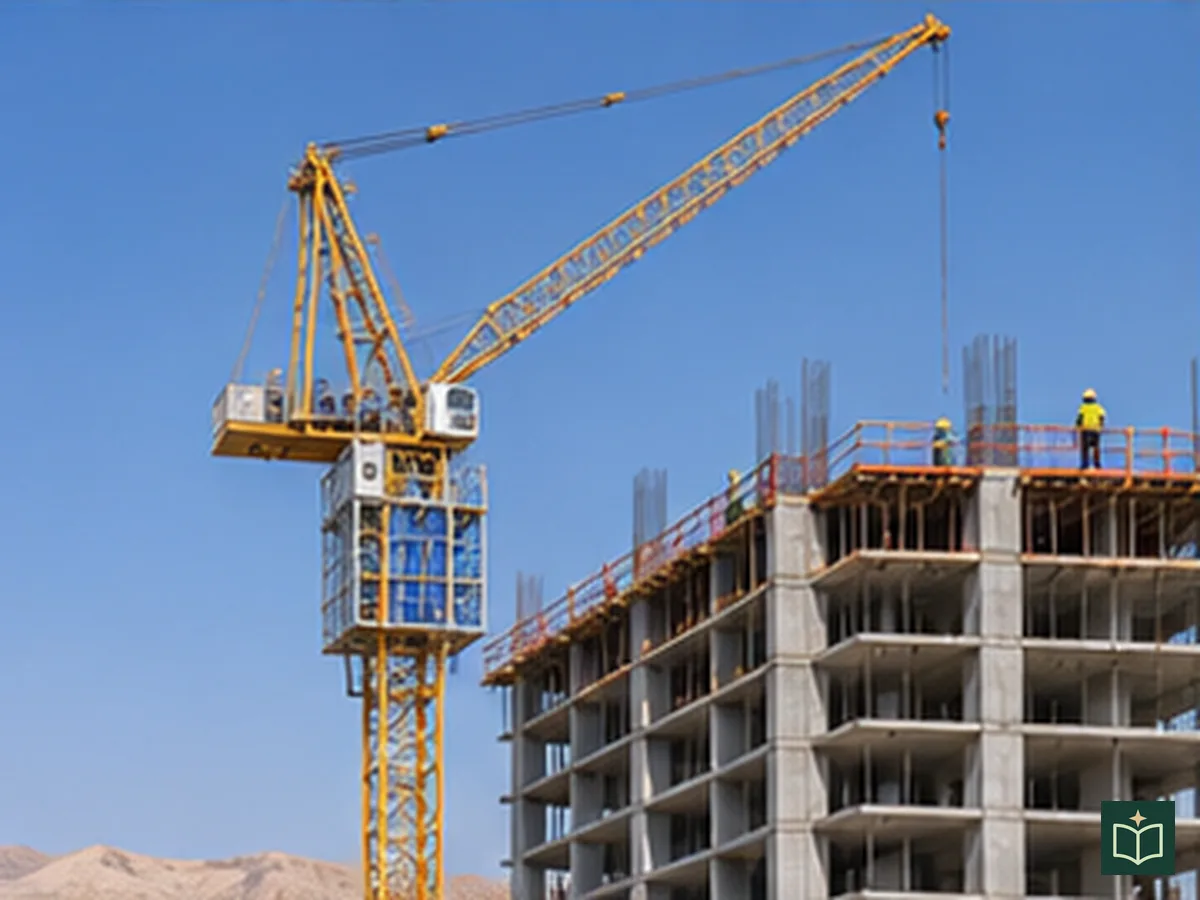
Anatomy of a tower crane
A tower crane is a steel lattice mast topped by a rotating slewing unit. From it extend a long working arm, the jib, and a shorter counter-jib carrying heavy concrete counterweights that balance the load. A trolley runs along the jib carrying the hook, while the operator sits in a cab high above the site. The base is anchored to a large concrete foundation or bolted into the structure. Gulf skylines often feature luffing-jib cranes, whose jib angles up and down instead of running a trolley along a flat arm. They suit crowded sites, because the jib can be raised to avoid swinging over neighbouring towers or roads.
Putting one up
Tower cranes arrive on lorries in pieces. A large mobile crane lifts the first mast sections onto the foundation, then the slewing unit, cab, counter-jib and jib, and finally the counterweights in a carefully planned order. Erection usually takes a day or two and requires calm weather, since large steel sections act like sails. Engineers check bolts, electrics and safety limiters before the crane lifts anything. Load moment limiters cut power if a lift would exceed the crane's capacity at that distance from the mast, because a crane can lift a heavy load close in but only a much lighter one at the tip of its jib.
How a crane climbs
As the building rises, the crane must grow too. Climbing uses a hydraulic frame, often called a climbing cage, which fits around the top of the mast just below the slewing unit. The crane lifts a new mast section and parks it on a rail beside the frame. Hydraulic rams then push the whole upper crane upwards by the height of one section, opening a gap. The new section is rolled into the gap and bolted in place, and the process repeats. If mast sections are six metres tall, adding ten raises the hook by 60 metres. Climbing is done in low wind, with no loads on the hook.
Tied to the building
A free-standing tower crane can only rise so high before the mast becomes too slender to resist wind and loads. Beyond that height, crews tie the mast to the building with steel collars and struts at intervals, so the structure carries some of the sideways force. On supertall projects, cranes are often placed inside the building's core or on brackets fixed to it. These internal climbing cranes jack themselves up through the floors, supported by the structure rather than a long mast from the ground. That keeps the crane short and stiff, even when it is working hundreds of metres in the air, as on Dubai's tallest towers.
Coming down from the roof
Removing a crane from the top of a finished skyscraper is a puzzle. A tower crane on the ground can simply climb down by reversing the climbing process, removing mast sections one at a time. A crane perched on top of a tall building cannot. Instead, it lifts a smaller crane, often a derrick, onto the roof, which then dismantles the big crane piece by piece and lowers the parts to the ground. A still smaller crane may then dismantle the derrick, until the last pieces are small enough to go down in the building's goods lifts. Planning this sequence begins years earlier, during design.
Safety and limits
Crane accidents are rare but serious, often linked to overloading, high winds, poor ground or mistakes during erection, climbing and dismantling. Operators work within wind limits set by manufacturers, commonly around 20 metres per second, about 72 kilometres per hour, for lifting. Out of service, cranes are left free to rotate like weather vanes so the jib points away from the wind and the mast is not twisted. Gulf summers add heat stress for operators and crews, so work schedules often shift to cooler hours. Regular inspections, certified operators and banksmen, who guide lifts from the ground by radio, are essential. Each crane on a skyline represents careful engineering, not just steel.
Sources & further reading
Figures are rounded and widely published; check the linked organisations for the latest editions. These organisations do not endorse this website.