Starting with a disc
A hand-made bowl or teapot body usually begins as a flat circle of sheet silver, often sterling, which is 92.5% silver and mostly copper for strength. The silversmith calculates the size of the disc from the shape required, marks concentric guidelines on it and anneals it so it is soft. As a sense of scale, a disc 20 centimetres across and one millimetre thick has an area of about 314 square centimetres and a volume of about 31 cubic centimetres. With sterling’s density of roughly 10.4 grams per cubic centimetre, that blank weighs around 325 grams, a modest amount of metal for a small bowl.
How raising works
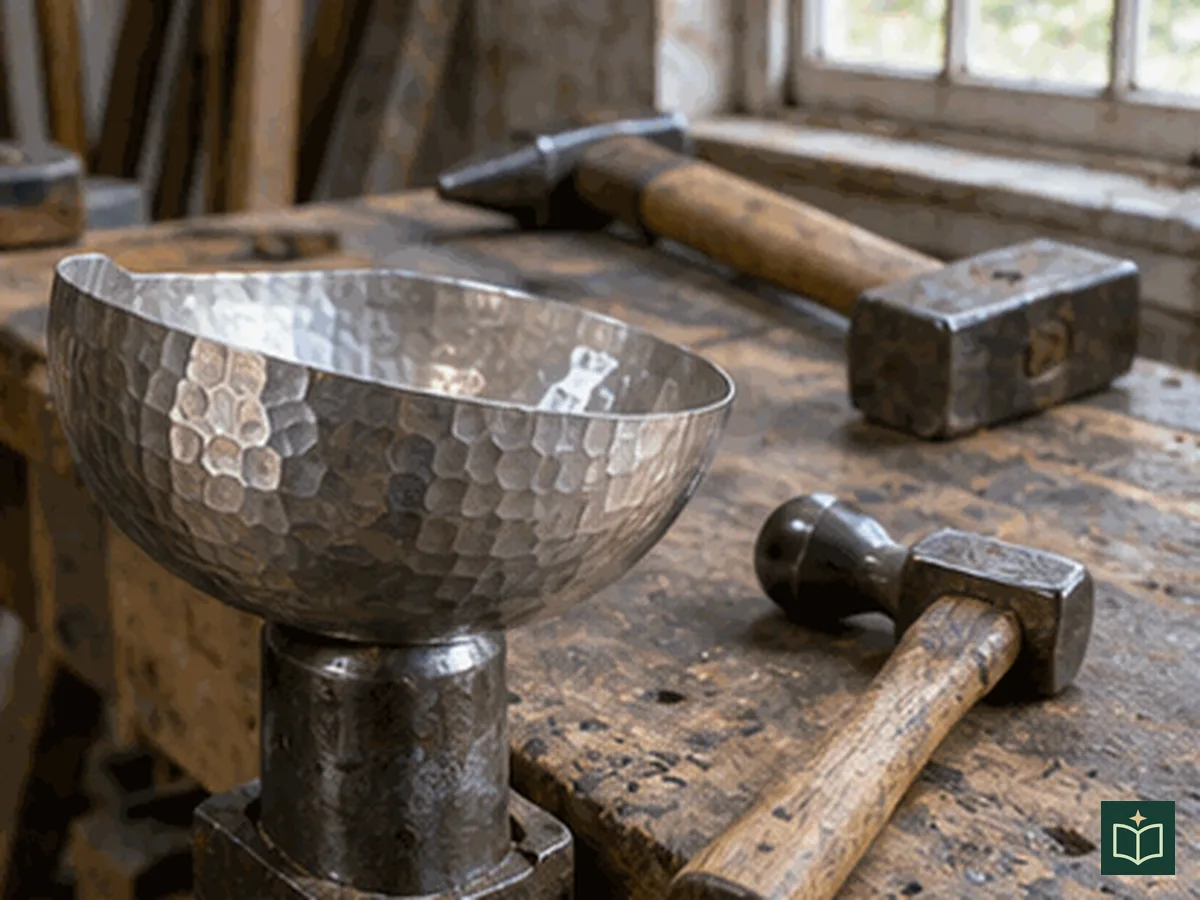
Raising means drawing that flat disc upward into a hollow. The smith holds it at an angle against a steel or wooden stake and strikes it with a raising hammer just above the point of contact, working round the disc in a spiral, course after course. Each blow pushes the metal down onto the stake and compresses the circumference, so the walls gradually rise and close in, like gathering a skirt. Because metal is crowded, not stretched, the walls thicken slightly. A related technique, sinking, hammers metal into a hollow in a wooden block and stretches it thinner, and is often used for shallow dishes and the bases of larger pieces.
Why the metal must be softened
Hammering makes silver harder and springier, a change known as work hardening. Crystals inside the metal fill with defects that block further movement, and if the smith keeps going the silver will crack. The cure is annealing: heating the piece with a torch or in a kiln to a dull red glow, roughly 600 to 650 °C for sterling, which lets the crystals reform and restores softness. The silver is then quenched and pickled in mild acid to remove oxides. In sterling, heat can also produce firescale, a stain of copper oxide just under the surface. A single vessel may go through this hammer-and-heat cycle many times.
Planishing and finishing
Once the shape is right, the surface is covered with dents and ripples. Planishing smooths it. The smith uses a polished, nearly flat hammer on a polished stake that matches the curve, overlapping light blows in neat rows until the whole surface is even. Planishing also leaves the metal hard, so the finished vessel keeps its shape. A teapot then needs more parts: a spout formed from a tapered sheet and soldered at the seam, a hinged lid, feet or a base ring, and a handle insulated with wood or another poor heat conductor. Joints use silver solders melting at different temperatures.
Spinning and stamping take over
From the late eighteenth century, especially in Sheffield and Birmingham, makers looked for faster methods. Drop stamps and presses forced sheet into steel dies, producing identical parts for candlesticks and cutlery. Spinning, refined in the nineteenth century, clamps a disc to a form on a lathe; as it turns, the worker presses a long tool against the metal, which flows over the form in minutes rather than hours. Electroplating, introduced commercially in the 1840s, allowed cheaper base-metal ware to be coated with silver. Most silverware sold today is spun, stamped or cast, with hand raising kept for special commissions and for teaching.
Why the handmade method survives
Hand raising remains valued because it can make shapes that spinning cannot, such as vessels with narrow necks, asymmetric forms or fluted walls that change thickness deliberately. It also produces metal that is evenly work-hardened, which helps thin walls keep their shape. Many silversmithing courses still teach raising first, because it trains the eye and hand to understand how metal moves. A good maker learns to read the colour of heated silver, the sound of a blow and the feel of hardening metal. When buying handmade silver, the hallmark records the fineness and assay office, but the faint facets of planishing are often the clearest sign of the craft.
Sources & further reading
Figures are rounded and widely published; check the linked organisations for the latest editions. These organisations do not endorse this website.