The puzzle of natal homing
Female sea turtles often lay their eggs on or near the beach where they themselves hatched, a behaviour called natal homing. Tagging programmes and genetic studies confirmed this: turtles nesting on a particular beach share genetic markers that differ from those of nesting populations elsewhere, even nearby. That is remarkable because the journey back begins decades after the turtle left as a hatchling the size of a palm. In between, young turtles drift on ocean currents and then settle in feeding grounds that may be hundreds or thousands of kilometres away. How they find one stretch of coastline again has occupied biologists for many years.
A map written in magnetism
The leading explanation involves Earth's magnetic field. Its strength and the angle at which field lines meet the surface vary from place to place, so each section of coastline has a fairly distinctive magnetic signature. Laboratory experiments, notably by researchers at the University of North Carolina, showed that young loggerhead turtles placed in tanks with magnetic fields mimicking distant ocean locations swam in directions that would keep them on their migratory routes. The idea is that hatchlings imprint on the signature of their birth beach as they crawl to the sea, and adult females later search for a coast that matches it. How turtles physically sense magnetism is still debated.
Evidence from the field
Some of the strongest support comes from the slow drift of Earth's magnetic field itself. A study of loggerhead nesting in Florida found that where the magnetic signatures of neighbouring coastal stretches drifted closer together over the years, nests became more concentrated, and where they drifted apart, nests spread out, as the magnetic hypothesis predicts. Turtles probably combine this map with other cues near the end of the journey. Smell, wave direction, the shape of the coast and features of the sand may help them choose a final spot. Accuracy is regional rather than precise: a female may nest within tens of kilometres of her birthplace.
Turtles of the Gulf
Two species nest regularly on Arabian shores. Hawksbill turtles, critically endangered worldwide, nest on beaches and offshore islands in the UAE, Qatar, Bahrain and Oman, often in spring, and feed on sponges around coral reefs. Green turtles graze seagrass in the Gulf and nest in large numbers on Oman's coast at Ras Al Hadd and Ras Al Jinz, one of the most important green turtle rookeries in the Indian Ocean. Satellite tracking of hawksbills tagged in the UAE has shown females moving between nesting beaches and feeding grounds elsewhere in the Gulf. Both species take many years to mature, so a nesting female today may have hatched decades ago.
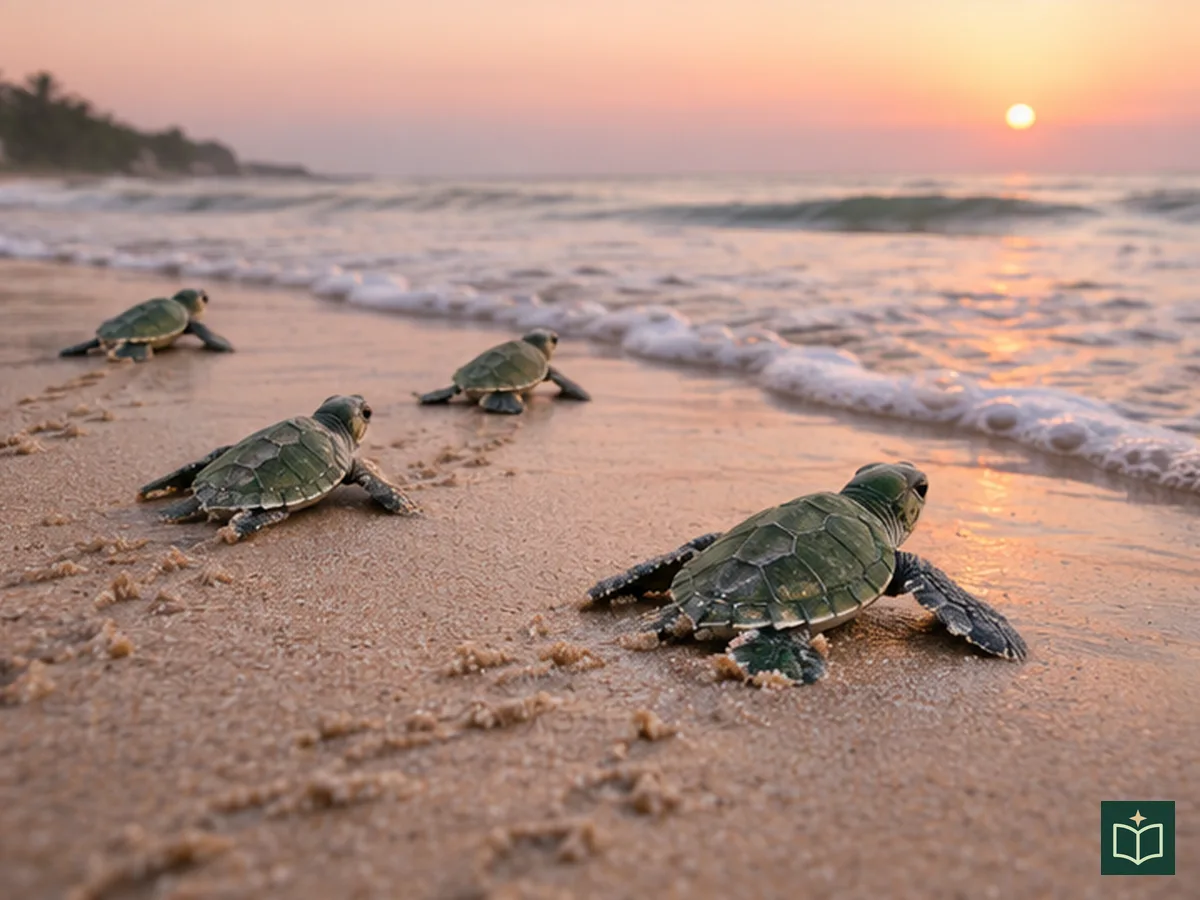
Hatchlings on a beach at night
Nesting usually happens at night. A female hauls herself above the high-tide line, digs a chamber with her rear flippers and lays around a hundred eggs before covering them and returning to sea. About two months later the hatchlings emerge, often together after dark, and head for the brightest horizon, which on a natural beach is the sea. Artificial lights from roads, hotels and homes can draw them inland, where many die. Sand temperature also matters: warmer nests produce more females and cooler nests more males, so rising temperatures could skew sex ratios. That is why conservation groups ask coastal developments to shield lights in the nesting season.
Why it matters
Natal homing makes each nesting beach a distinct, irreplaceable population. If turtles from one beach are lost, the beach may stay empty for generations, because turtles from elsewhere are unlikely to colonise it quickly. Coastal construction, artificial lighting, plastic pollution, fishing nets and egg collection all threaten turtles worldwide, and the slow pace of maturity means populations recover only over decades. Understanding the magnetic map also has a practical side: large metal structures and electrical installations near coasts could, in principle, alter local fields. Protecting the beach where a turtle was born is, quite literally, protecting the place it will one day come back to.
Sources & further reading
Figures are rounded and widely published; check the linked organisations for the latest editions. These organisations do not endorse this website.