Sand that hops
Sand moves mainly by saltation, a word taken from the Latin for leaping. A gust lifts a grain, it flies a short distance and lands, splashing other grains into the air or nudging them along the surface. Most of this traffic stays within about a metre of the ground, which is why a sandstorm stings the legs far more than the face. Dust, being much finer, is carried high and far, but sand-sized grains, between about 0.06 and 2 millimetres across, are too heavy for that. They travel in a low, bouncing carpet that piles up wherever the wind loses strength.
How a dune creeps forward
A growing mound takes on a typical profile: a long, gentle slope facing the wind and a short, steep slope on the sheltered side, called the slip face. Wind pushes grains up the back of the dune and drops them just beyond the crest, where they pile until the slope passes its angle of repose and slides. Each small avalanche moves a little sand from the back of the dune to the front. Repeated millions of times, this conveyor shifts the entire dune downwind, even though no individual grain travels far in one go. Small dunes move fastest because they hold the least sand.
Wind decides the shape
The pattern of the wind, more than the sand itself, sets a dune's form. Where wind blows mostly from one direction and sand is scarce, crescent-shaped barchans form, their horns pointing downwind. Plentiful sand under a steady wind builds long transverse ridges at right angles to it. Two winds alternating from different directions stretch sand into linear, or seif, dunes that run for kilometres. Where winds shift through the year from several directions, sand is heaped into star dunes, pyramids with radiating arms. Star dunes grow upwards rather than travelling, which is why they include some of the tallest dunes on Earth.
Liwa's megadunes
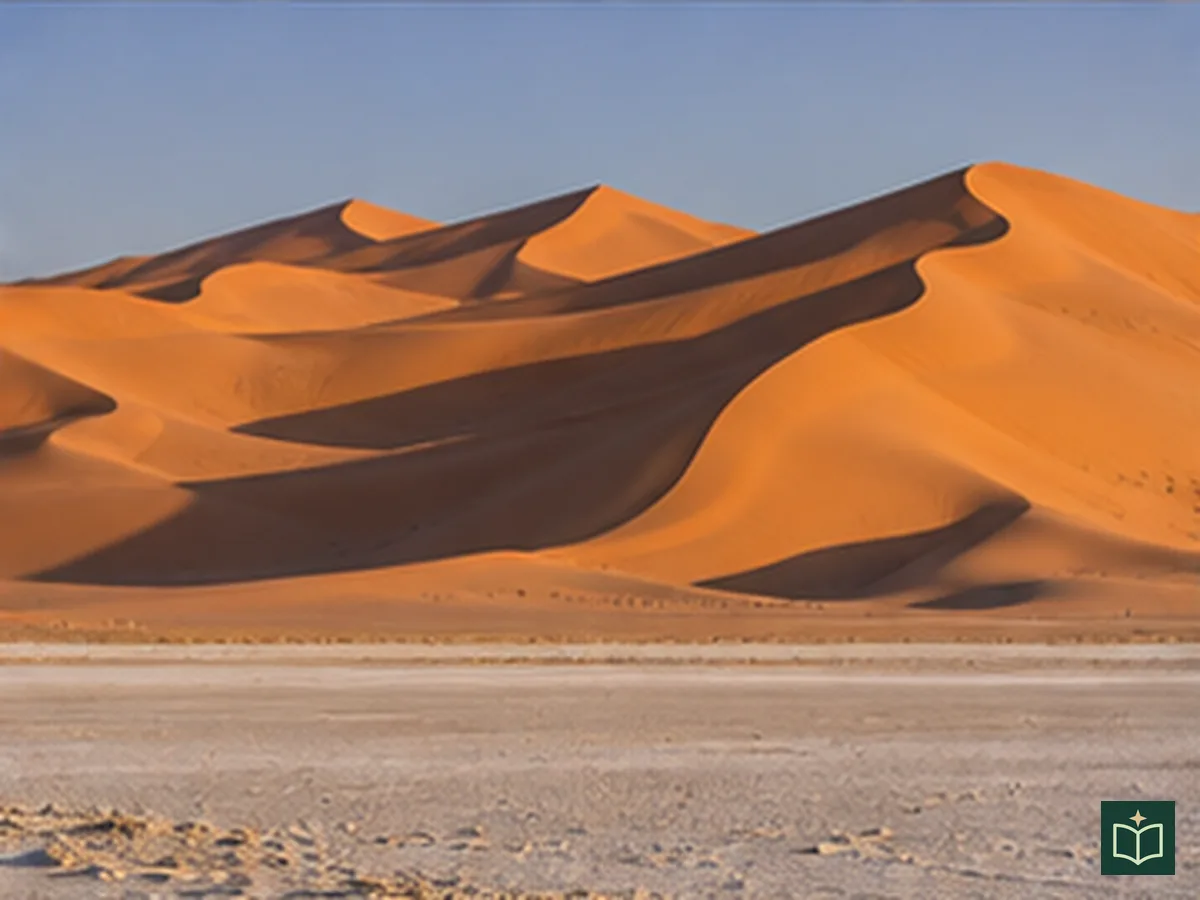
The Liwa oases, on the northern edge of the Rub' al Khali in Abu Dhabi, sit among some of the largest dunes anywhere. Here giant ridges, often more than 100 metres high, rise above flat salt plains called sabkha that separate them like streets. Moreeb Dune, near Liwa, is widely reported to rise roughly 300 metres from base to crest. These are compound dunes, or draa: smaller dunes ride on their flanks and still respond to each season's winds, while the giants beneath reflect wind patterns built up over tens of thousands of years. Farms and villages curve along the hollows where groundwater lies closest to the surface.
Fast dunes, slow dunes
Speed depends on size. A barchan a few metres high can advance tens of metres a year, enough to bury a road or fence within a season. A megadune holds so much sand that the same wind barely shifts it at all over a human lifetime. Damp ground slows movement too: sand that lands on moist sabkha tends to stick, which helps anchor the bases of Liwa's dunes. Plants act in a similar way, trapping grains around their roots. That is why desert roads are cleared by bulldozers after windy spells, while the great dunes beside them look much as they did generations ago.
Reading wind from sand
Because dunes record the winds that built them, geographers read them like weather vanes frozen in sand. Satellite images show dune crests lining up across hundreds of kilometres, revealing the prevailing northwesterly shamal across much of the UAE and older wind regimes preserved in the largest ridges. The same physics shapes dunes on Mars and on Saturn's moon Titan, where spacecraft have photographed linear dunes formed under very different conditions. On Earth, understanding dune movement helps engineers place roads, pipelines and farms, and choose between fences, planting and regular clearing to keep wandering sand in check. Dunes, in other words, are both a hazard to manage and an archive of past climate.
Sources & further reading
Figures are rounded and widely published; check the linked organisations for the latest editions. These organisations do not endorse this website.