A shape named after a letter
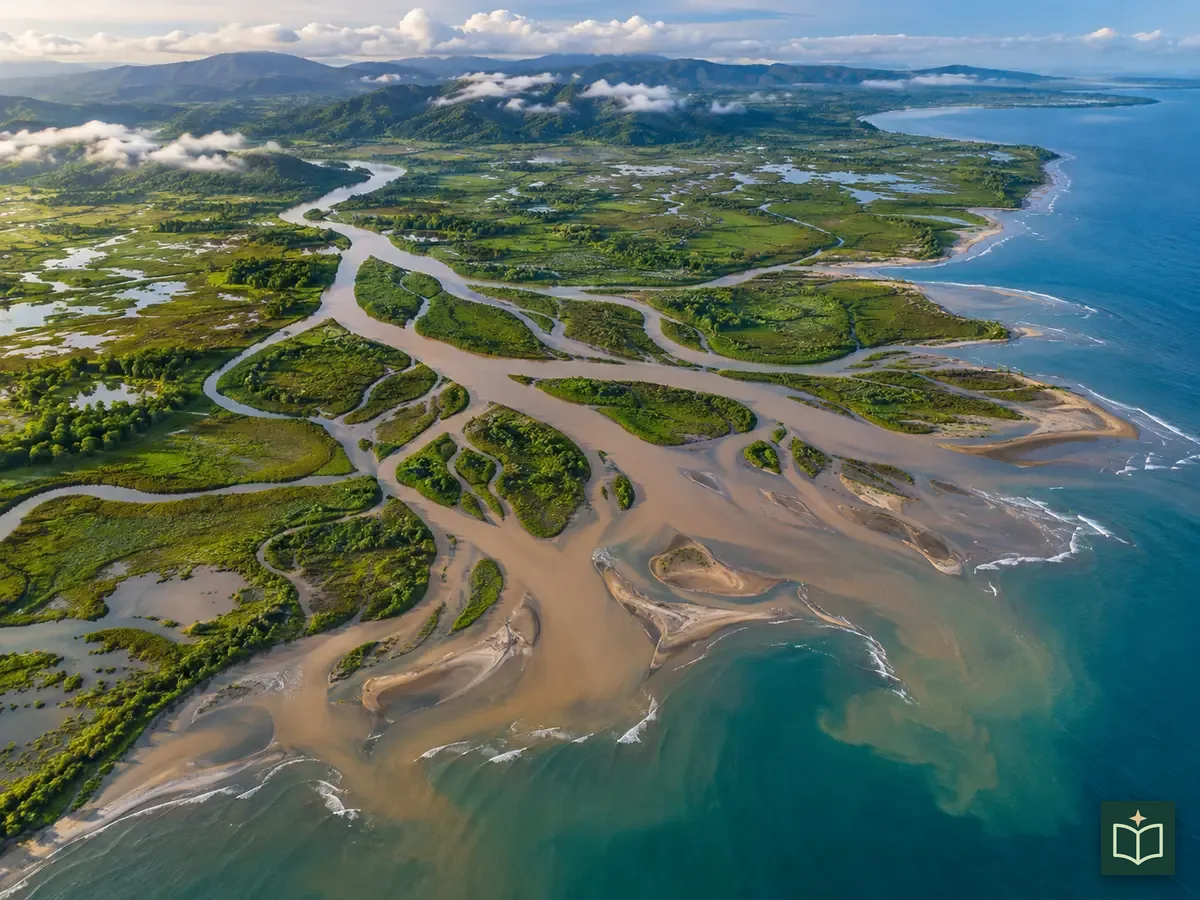
The Greek historian Herodotus noticed that the land at the mouth of the Nile formed a rough triangle, like the capital letter delta, Δ. The name stuck for any landform built by a river where it enters a sea, lake or larger river. Deltas form because rivers carry enormous loads of sand, silt and clay eroded from their catchments. As long as the current is fast, the sediment stays suspended or rolls along the bed. When the river reaches standing water, it spreads out and slows, loses its carrying capacity and begins to drop its load. Over centuries, those deposits accumulate into new land.
How the land grows
Deposition sorts itself by size. Coarse sand settles first near the river mouth, while finer silt and clay drift further before sinking. As deposits build up, they partly block the channel, and the river eventually breaks through its banks to find a shorter or steeper route, a process called avulsion. Repeated many times, this creates a fan of branching channels called distributaries, separated by marshes, natural levees and low islands. Each channel extends the coastline for a while, then is abandoned as the river shifts elsewhere. Vegetation traps further sediment, and floods spread fresh layers of silt across the plain, renewing its fertility.
Three main types
Geologists often classify deltas by the force that dominates them. River-dominated deltas, such as the Mississippi’s, push long fingers of land into a calm sea, giving a bird’s-foot shape. Wave-dominated deltas, such as the Nile’s, are smoothed into arcs because waves redistribute sediment along the shore. Tide-dominated deltas, such as the Ganges–Brahmaputra, are cut by funnel-shaped channels that tides scour twice a day. Many deltas combine all three influences. At the head of the Gulf, the Tigris and Euphrates join to form the Shatt al-Arab, which with the Karun river has built a broad, low plain of marshes and date groves.
Crowded and productive
Deltas are among the most densely populated places on Earth. Flat land, fresh water, rich soils and access to the sea have drawn farmers and traders for millennia; ancient Egypt depended on the Nile delta, and cities such as Alexandria, Dhaka, Kolkata, Shanghai and New Orleans stand on or beside deltas. The Ganges–Brahmaputra delta, the largest in the world at roughly 100,000 square kilometres, is home to well over a hundred million people. Rice paddies, fisheries and aquaculture make deltas vital to food supplies, while their mangroves and wetlands shelter wildlife and help buffer coasts against storms and storm surges.
Why many deltas are sinking
Delta land naturally compacts as loose sediment settles. In the past, fresh deposits from floods offset that sinking. Today, dams trap much of the sediment upstream; Egypt’s Aswan High Dam, completed in 1970, sharply cut the flow of silt to the Nile delta, and parts of its coast have retreated since. Embankments that protect fields from floods also stop new sediment spreading across them. Pumping groundwater, oil and gas accelerates subsidence. Combined with rising sea levels, this means many deltas are losing height relative to the sea, increasing flood risk and pushing salt water into farmland soils and drinking-water supplies.
Managing a moving coastline
Some countries are experimenting with working alongside the river rather than against it. In Bangladesh, tidal river management lets controlled floods deposit silt inside embankments, raising the land. In Louisiana, planners have long studied diverting sediment-laden Mississippi water into sinking marshes to rebuild them. The Netherlands, built largely on the delta of the Rhine, Meuse and Scheldt, has decades of experience combining dykes, storm barriers and room-for-the-river schemes. The common lesson is that a delta is never fixed. It stays healthy only if sediment keeps arriving, and planning for it means thinking about the whole river basin, sometimes across several countries.
Sources & further reading
Figures are rounded and widely published; check the linked organisations for the latest editions. These organisations do not endorse this website.