A landscape named after a plateau
Karst takes its name from the Kras, a limestone plateau on the border of Slovenia and Italy where nineteenth-century scientists first studied sinkholes and disappearing rivers in detail. The term now describes any landscape shaped mainly by the dissolving of rock rather than by mechanical erosion. Most karst develops in limestone and dolomite, which are made largely of calcium and magnesium carbonate, but gypsum and salt can form karst too, often far more quickly. Karst regions are found on every continent except Antarctica, including the Mediterranean, southern China, Florida, the Yucatán Peninsula and the limestone mountains of Oman and the UAE.
Chemistry that carves
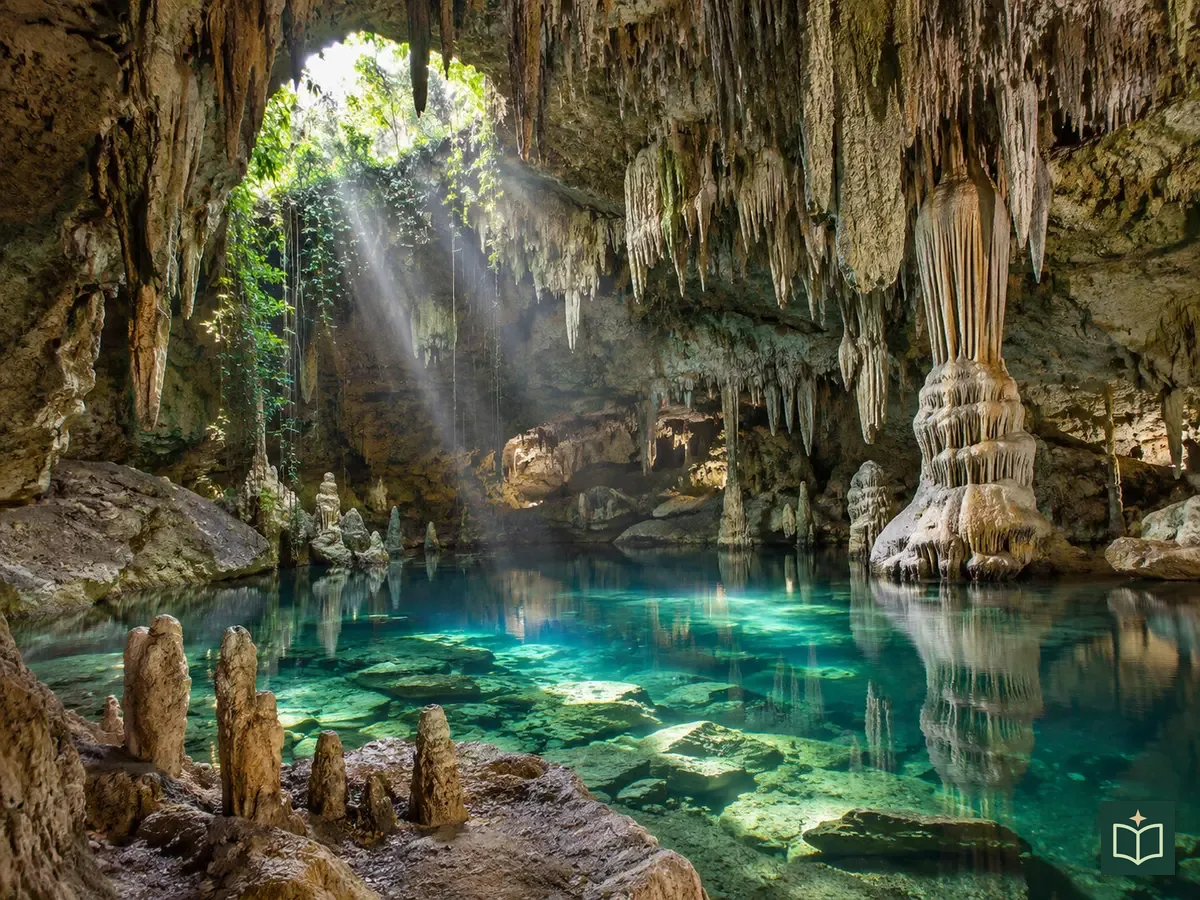
Rain is not pure water. As it falls and then soaks through soil, it absorbs carbon dioxide, forming a weak solution of carbonic acid. That acid reacts with calcium carbonate, turning solid rock into dissolved calcium and bicarbonate that the water carries away. The process is slow, but it works relentlessly along cracks, joints and the boundaries between rock layers. Once a crack widens enough for water to flow faster, dissolution speeds up, and a network of channels can grow into caves. When water later drips into air-filled caves, it releases carbon dioxide and deposits calcite, building stalactites from the ceiling and stalagmites from the floor.
Features above and below
Karst produces a distinctive set of landforms. Sinkholes, also called dolines, form where the surface dissolves or collapses into voids below. Rivers may vanish into swallow holes and reappear kilometres away as large springs. Limestone pavements, cut into blocks by widened joints, cover bare ground in places such as northern England. In humid tropical regions, intense dissolution leaves steep towers and cones, seen around Guilin in China and among the islands of Ha Long Bay in Viet Nam. On Mexico’s Yucatán Peninsula there are few surface rivers; instead, water flows underground and is reached through cenotes, sinkholes that the Maya relied on for water.
Caves of Arabia
The limestone of the Hajar Mountains contains some remarkable karst. Oman’s Al Hoota Cave, near Jebel Shams, has been opened to visitors, with walkways through its chambers and past an underground lake. On the Selma Plateau in eastern Oman lies Majlis al Jinn, one of the largest known cave chambers in the world, entered through openings in its roof. Many of these caves formed when the climate was wetter, and their stalagmites preserve chemical records of ancient rainfall. Scientists have used formations from Oman and Yemen to reconstruct how the Indian Ocean monsoon shifted over hundreds of thousands of years, revealing periods when Arabia was green.
Water that moves fast
Karst aquifers are important but fragile. Hydrogeologists estimate that up to a quarter of the world’s people rely at least partly on water from karst. Because water travels through open conduits rather than seeping slowly through sand, it can move kilometres in days and receives little natural filtering. Pollution from farms, septic tanks or spills can therefore reach springs and wells quickly. Karst also poses engineering risks: sinkholes can open suddenly beneath roads and buildings, particularly where groundwater pumping lowers the water table or leaking pipes concentrate flow. Florida, which sits on a vast limestone platform, is known for frequent sinkholes and has detailed rules for assessing them.
Reading a hidden landscape
Studying karst requires seeing underground. Cave explorers survey passages by hand, sometimes diving through flooded sections, while scientists add harmless dyes to sinking streams to trace where the water emerges. Geophysical tools such as ground-penetrating radar help locate voids before construction begins. Caves also act as archives: their sediments preserve bones, pollen and tools, and their mineral deposits record past climates with precise dates. Many karst areas are protected for their scenery and biodiversity, including unusual cave-adapted animals that are blind and pale. For visitors, the appeal is simple: few landscapes show so clearly how patient chemistry can reshape solid rock.
Sources & further reading
Figures are rounded and widely published; check the linked organisations for the latest editions. These organisations do not endorse this website.