A name from Anatolia
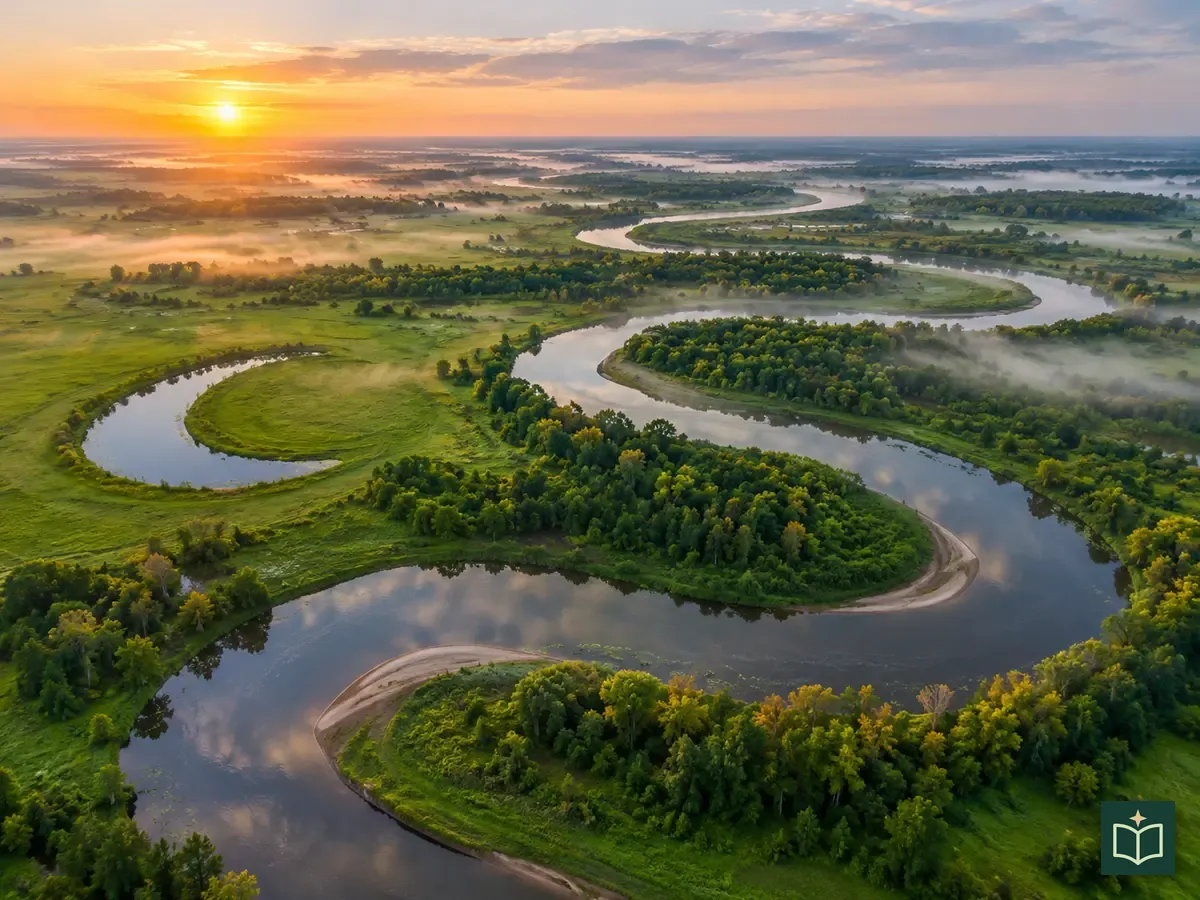
The word meander comes from the Maeander, the ancient name of the Büyük Menderes River in western Turkey, whose winding course was famous in the classical world. Today geographers use it for any river that loops back and forth across its floodplain. Perfectly straight natural channels are rare: even on gentle, uniform slopes, flowing water tends to develop bends. Meanders are most typical of lowland rivers carrying fine sediment across wide, flat valleys, from the Mississippi and the Amazon to small streams in English meadows. Their regular, almost rhythmic curves have fascinated scientists, artists and engineers for centuries, and they turn out to follow surprisingly consistent rules.
How a bend grows
Once a river begins to curve, the physics reinforces the curve. Water flowing around a bend is pushed towards the outer bank, where it runs faster and deeper. This erodes the outer bank, creating a steep cut bank. On the inner side, the current slows and drops sand and gravel, forming a gently sloping deposit called a point bar. As erosion and deposition continue, the bend becomes more pronounced and gradually migrates sideways and downstream. A secondary, corkscrew-like circulation across the channel, known as helical flow, carries sediment from the outer bank towards the inner one, helping to sharpen the pattern year after year.
Einstein and the tea leaves
In 1926 Albert Einstein published a short paper on why rivers erode their outer banks. He linked it to an everyday puzzle: when tea is stirred, the leaves gather in the centre of the cup rather than at the edge. In both cases, friction slows the water near the bottom, setting up a circulating flow that sweeps material inward along the bed while faster water presses against the outer wall. Einstein also discussed how Earth’s rotation could favour erosion of one bank slightly over the other, an idea connected to an older observation known as Baer’s law. The rotation effect is small, but the tea-leaf analogy remains a classic.
Oxbow lakes and floodplains
As neighbouring bends grow towards each other, the strip of land between them, called the neck, becomes narrower. During a flood, the river may break through, taking the shorter route and abandoning the loop. Sediment soon seals the ends of the old channel, leaving a curved, isolated body of water called an oxbow lake. Over time, oxbows fill with silt and vegetation and become wetlands. Across thousands of years, migrating meanders sweep across the entire valley floor, reworking it and leaving behind a rich mosaic of old channels, ridges and swamps that ecologists value for their biodiversity and that farmers value for their soils.
Living with a moving river
Meandering rivers make awkward neighbours for fixed property lines. Banks erode, farmland disappears on one side and new land appears on the other. Where rivers form borders, shifting channels have created legal disputes, and international law has developed rules to decide whether a boundary moves with the river. Engineers have often straightened rivers to speed navigation and drain land; the lower Mississippi was shortened considerably by artificial cutoffs in the twentieth century. Straightening can, however, increase flow speeds, push flood problems downstream and damage habitats. Some projects in Europe and North America now restore meanders deliberately, to slow water down and revive wetlands.
Meanders in dry lands and beyond
Meanders are not only a feature of wet climates. In Arabia and other arid regions, satellite images reveal the curving traces of ancient river channels preserved beneath sand or in the shape of wadi beds, relics of wetter periods thousands of years ago. Some of the most striking examples are on Mars, where orbiting cameras have photographed winding channels and point bars suggesting that rivers once flowed there. Similar curves appear in ocean currents such as the Gulf Stream and in meltwater streams on glaciers. Wherever a flow interacts with the material around it, the same basic tendency to bend and loop seems to emerge.
Sources & further reading
Figures are rounded and widely published; check the linked organisations for the latest editions. These organisations do not endorse this website.